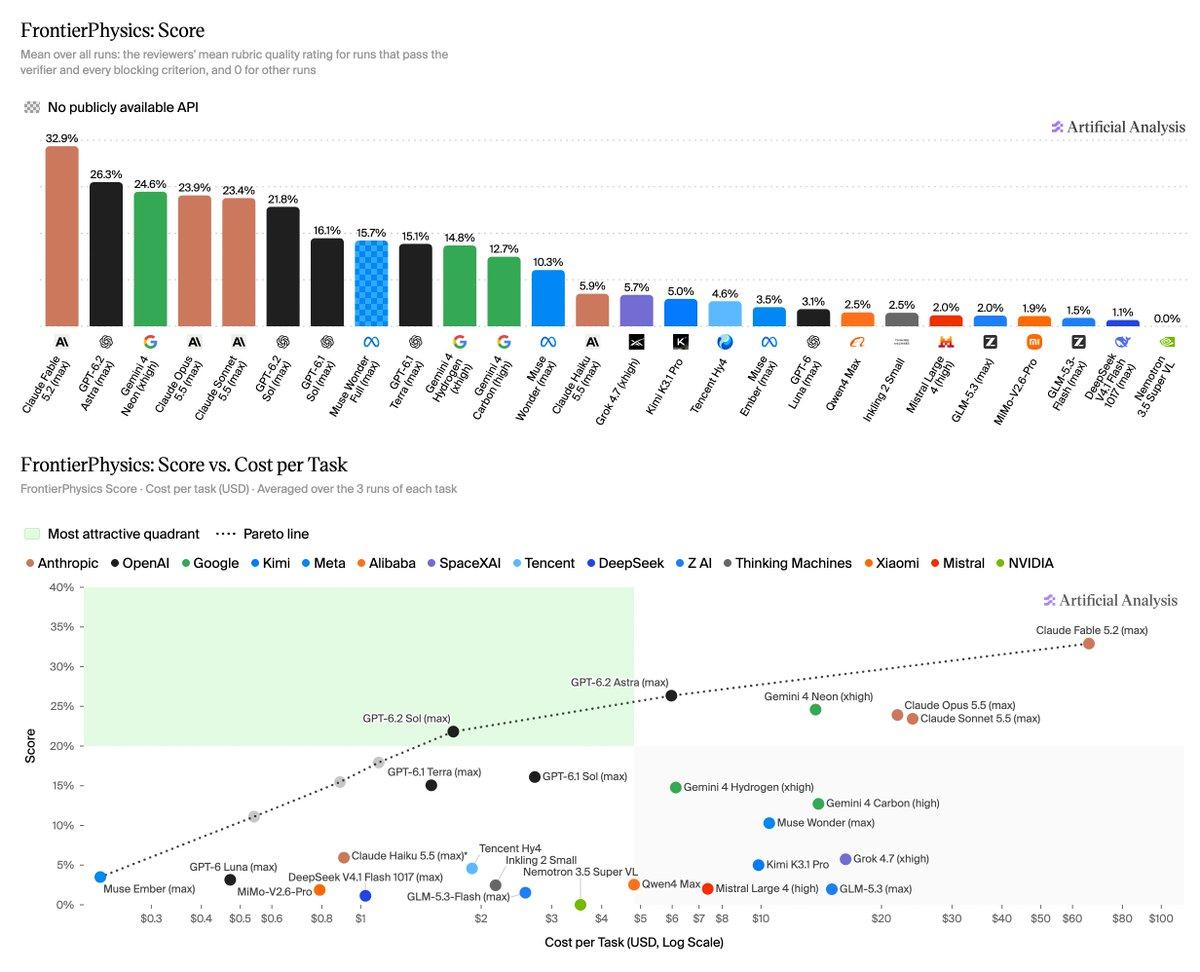
Cover: Artificial Analysis’s FrontierPhysics charts show the benchmark scores and costs per task.
Claude Won the Physics Test. Gemini Got the Numbers Right More Often.
In one FrontierPhysics task, Claude Fable 5.2 had to find a quantum critical point in a simulated chain of atoms. It ran hundreds of measurements, consulted papers and handed in a 19-page manuscript. Artificial Analysis published the run as an example of what its new leaderboard asks models to do. The assignment ends when the paper is in. OurNews Live
Claude Fable 5.2 led at 32.9%, 6.6 percentage points ahead of GPT-6.2 Astra at 26.3%. Both ran at their maximum reasoning settings, with the Fable result listed under Anthropic’s default fallback configuration. Gemini 4 Neon, tested at its extra-high setting, came third at 24.6%. BenchFlow’s physicists wrote the private tasks across nine fields. Artificial Analysis ran 54 of them three times per model, leaving out two that require GPUs.
On X, @cit1z3n_ asked “who checks the manuscript before it goes out.” The answer in this test is three GPT-6 Luna reviewers applying a rubric written by experts, after an automated check of the submitted results. A run gets zero if it fails that check or trips a rule meant to catch flaws serious enough to block publication. The leaderboard averages the quality scores of the surviving runs along with those zeroes.
Gemini 4 Neon cleared the numeric checks on 54% of runs, the most of any model, but only 28% of its runs cleared review as well. Artificial Analysis flagged problems such as a simulation set up incorrectly, a missing derivation or a conclusion the results couldn’t support. “right answer, wrong reasoning, ouch,” @fireplyai replied on X.
Then there’s the wait. Artificial Analysis estimated about 83 minutes per task for Fable and 17 for Astra, which it priced at $5.97 per task. Vraj, posting as @paleknight, said he’d still take the wait for research. The time savings are easy to measure. How much work a scientist has to redo after the model hands in its paper is the number a lab would want next.



Checking account…
Loading comments…