What OpenAI’s 2.25 Claim Means for Matrix Multiplication
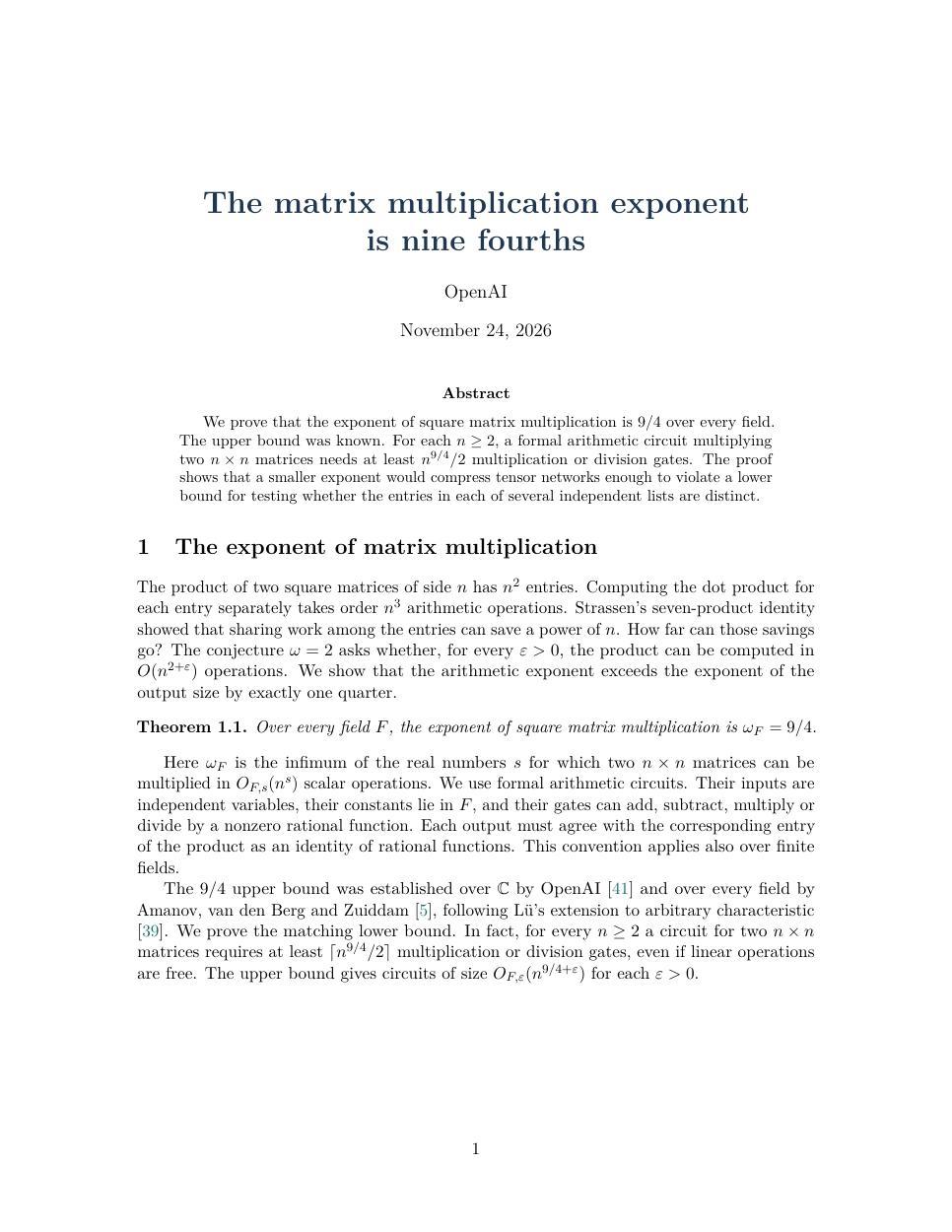
Cover. The title page of OpenAI’s November 24 preprint.
OpenAI claims it has pinned down the exact exponent for multiplying square matrices at 2.25. Its November 24 preprint gives a lower bound that matches the upper bound it published in October. The search for faster ways to multiply matrices goes back to Volker Strassen’s 1969 breakthrough.
Why matrix multiplication mattersA matrix is a rectangular grid of numbers. Multiplying matrices is a building block for AI training, 3D graphics, physics simulations and some cryptographic computations.
Computer scientists use an exponent called omega (ω) to describe how the number of arithmetic operations grows as square matrices get wider. A smaller exponent means less work as the matrices grow. For two matrices with n rows and n columns, the schoolbook method takes roughly n³ operations. Doubling the width means about eight times the work. Strassen showed in 1969 that you could do better.
How the two bounds meet- October’s upper bound (ω ≤ 2.25). An upper bound shows how fast an algorithm can go in theory. After decades of progress brought the bound to about 2.37, OpenAI’s October preprint lowered it to 2.25, or 9/4, over the complex numbers. Other researchers have since published their own proofs of the upper bound, including one that applies over every field. October preprint · Independent write-up
- November’s lower bound (ω ≥ 2.25). Researchers had hoped the exponent could be as low as 2. OpenAI now claims that no method using formal arithmetic circuits, the mathematical model in the preprint, can achieve a smaller exponent. If the lower bound holds, the two bounds meet at exactly 2.25. November preprint
The lower bound is a preprint claim and awaits peer review. OpenAI’s Lean formalization covers the exact exponent for division-free programs that compute formal polynomial identities. The paper also treats circuits that can divide. Lean verification scope
The exponent describes how arithmetic work scales for very large matrices. The result gives no immediate speedup for today’s GPUs or AI apps. Actual performance also depends on constants, memory traffic and the hardware running the algorithm.


Checking account…
Loading comments…