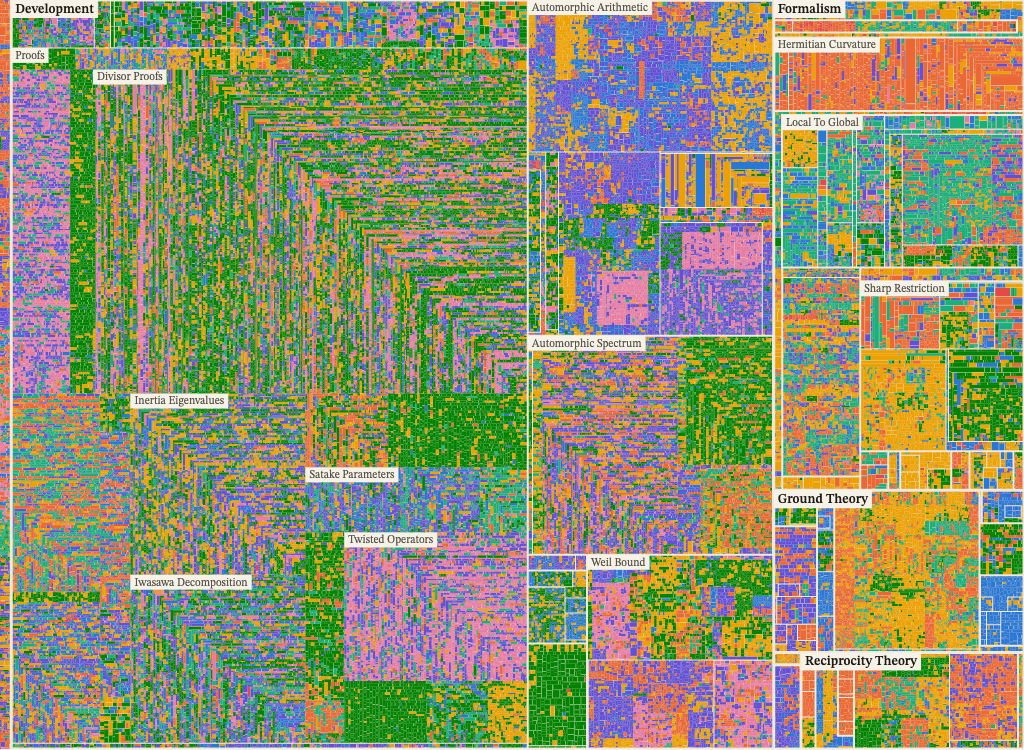
Cover: Treemap of the original Lean archive by pengowray. Each rectangle represents one Lean module.
What the Riemann Proof Says About the Limits of Human Understanding
Merely the length itself tells us a lot. The original proof of the classification of finite simple groups, one of the longest proofs mathematicians have produced, took up roughly 15,000 journal pages by one estimate. The Riemann hypothesis proof that Levent Alpöge developed with Claude was released as more than 17 million lines of Lean code. Alpöge later said his figure of 250,000 pages was a joke. Reading and understanding the entire Lean archive is virtually impossible for any one person.
The good news is that the Lean community is reducing and compressing it, and making rapid progress. A computer can check the proof while mathematicians are still working out how to explain it. Our Live on the proof check · Our Live on the effort to shorten it
However, my takeaway is that the world itself might be thought of as a language, and our brains can read only a tiny fraction of it through vision, touch, smell, taste and our other senses. That's why we have invented and are still inventing highly compressed languages such as English, Chinese, geometry, functions, maths, C++, graphs, paintings, sculptures, Lego toys and so on. These invented languages give us simplified interpretations of what the world is, and through them we can understand a little of it.
When you translate something written in English into Chinese or vice versa, you can lose a bit of the original information. To reduce that loss, sometimes you leave a hard-to-translate word in its original form. I reckon it's the same when we interpret the universe. If the universe is a language vastly more complicated than ours, even maths leaves most of it out. As we try to capture more detail, we are forced to decompress our mathematical descriptions until, at some point, we can no longer follow them.
If the universe could speak and explain itself nicely to us, we still might not be able to understand it. A human brain can take in only so much information at once. A neat, compressed and comparatively short explanation helps. We can work together, but we certainly can't combine our brains like a cluster of thousands of Blackwells. So maybe one path forward is an intermediary that can understand more of the universe than we can and explain it to us better than the universe itself could.
Assuming mankind will always be the smartest species on Earth might be our ego getting in the way. We've seen that pride before. Galileo was placed under house arrest after defending the idea that Earth moves around the Sun. The idea that Earth was far older than human history took decades to gain wide acceptance. Darwin and his supporters were mocked for arguing that we shared ancestors with other apes. This time, will our pride get in the way again? Or will we be capable of accepting second place if that day comes?



Checking account…
Loading comments…