ournews.aiNews in the AI era.

The Jensen Huang Issue

More on this
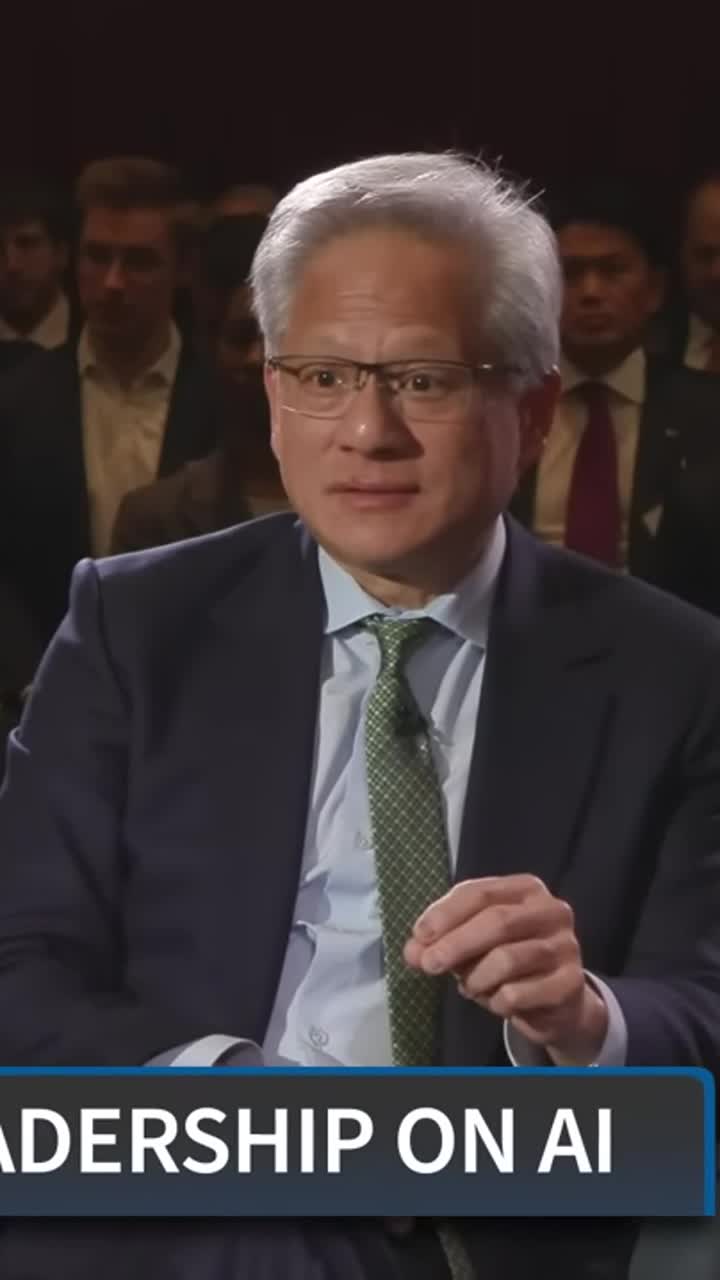
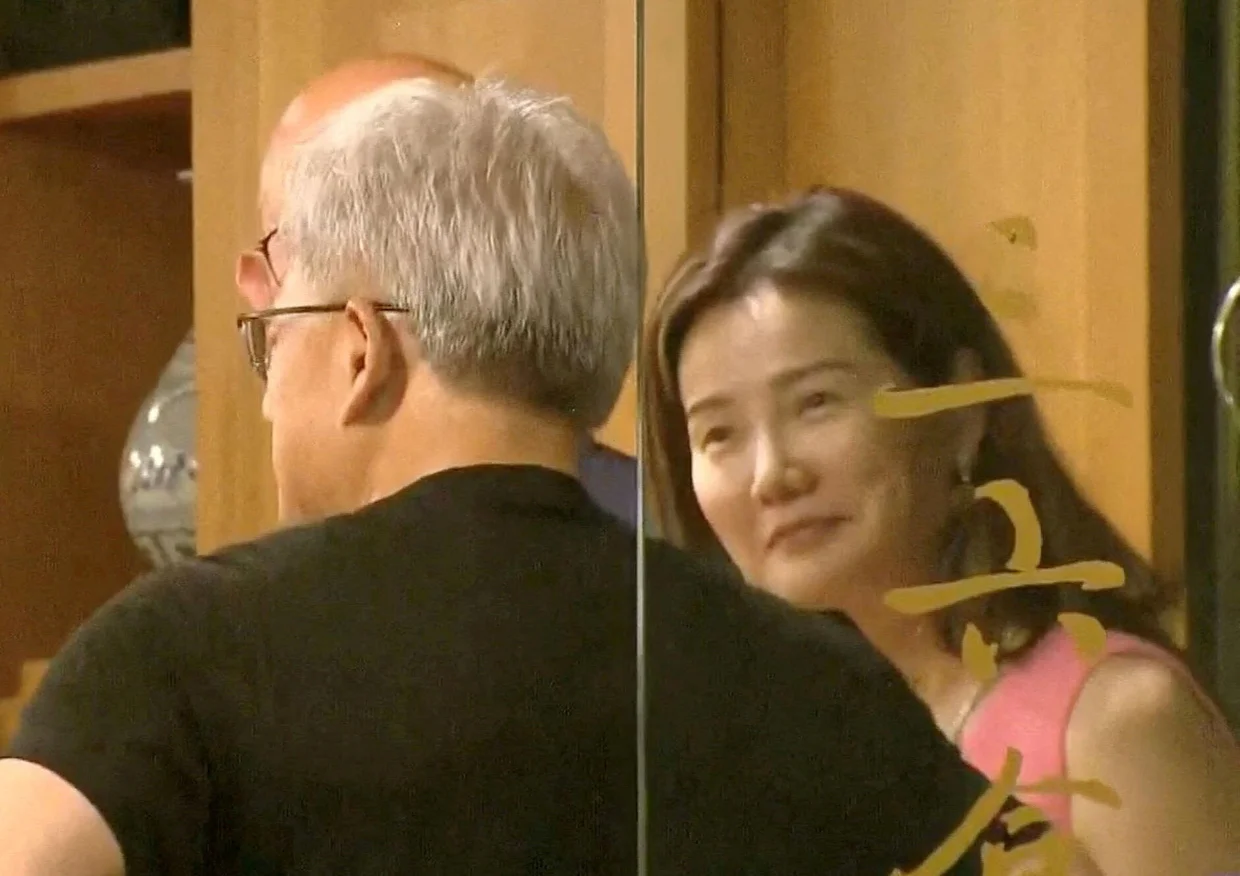
Jensen Huang and Alice Huang at a Taipei restaurant, May 22, 2025. CTI / Reuters TV
The long read

The fall of Jensen Huang and the fight to bring him back

Read the feature

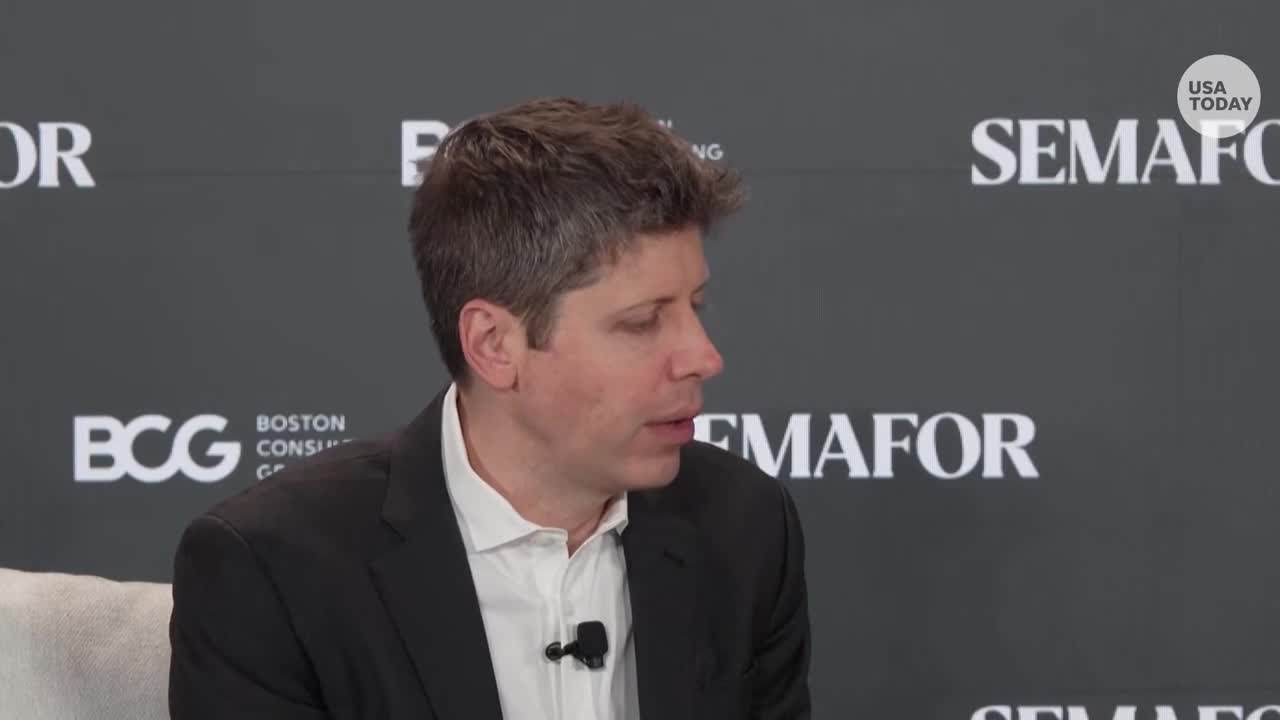
Cover: Sam Altman speaking at Semafor’s Silicon Valley & The World, November 16, 2026; USA TODAY source-video frame. Image source.

Sam Altman remembers his own ouster when asked about Jensen Huang

Sam Altman paused over the question at Semafor on November 16. He said he knew too little to answer it. Then he volunteered something he knew firsthand: what it felt like to be the chief executive whose future everyone else was discussing.

Altman had his own experience to draw on. OpenAI’s board removed him in November 2023. He was back within days. Listen to where his answer turns: first he talks about the company Huang built, then about his own memory of being out, and finally about the debt AI companies owe the man who supplied their chips. His sympathy is personal. The decision about Huang’s job belongs to Nvidia’s directors.

Clip transcript

Sam Altman: I don’t think I know enough to answer that question. Jensen has long been a hero of mine. Heroes have flaws. I am grateful for the company he’s built.

Altman: I do have personal strong empathy to a situation like this. I remember what it was like, although it feels like forever ago. But it’s hard to imagine the AI revolution without Jensen.

Original recording

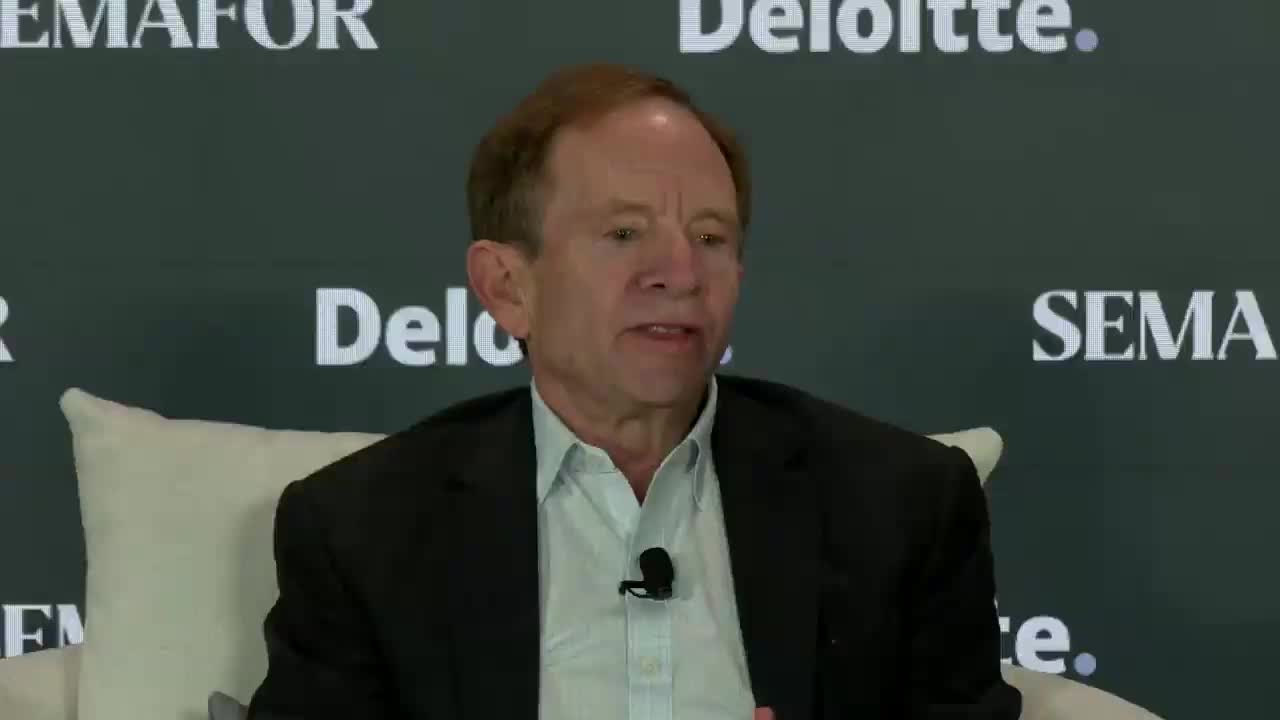
Cover: Steven Rattner speaking on the Semafor panel with Arianna Huffington, San Francisco, November 16, 2026; original video frame. Image source.

Steven Rattner takes apart the case for a Jensen Huang comeback

At Semafor on November 16, Steven Rattner was asked how much weight Nvidia’s directors should give an online campaign for Jensen Huang. His answer came in the first five seconds. He thought the idea of bringing Huang back was ridiculous.

Rattner drew a line through three questions that had become tangled up. Intelligence officials could investigate the espionage allegation. A board could examine a chief executive’s relationship with a customer. But a relationship with someone who worked for the chief executive raised a question the board could answer for itself: what conduct would it accept from its boss?

That distinction is the heart of his objection to the Sam Altman analogy. Altman’s return to OpenAI showed that a board could reverse itself. Rattner wanted Nvidia’s directors to consider the grounds for this particular departure before borrowing the ending from another company’s story.

Clip transcript

Steven Rattner: Look, I think the idea of bringing Jensen back is ridiculous, to be perfectly honest. I mean, let’s separate the pieces. The question of whether this woman was a spy or not is definitely of huge interest, should be a huge interest to us. It’s of national security. It’s what are the Chinese up to? How many spies are there? That’s really an important thing.

Rattner: The question of whether he had an affair with her is less important but not irrelevant because she was a customer, and that’s sort of a gray area. What’s not a gray area is you can’t have affairs with subordinates or anybody who works for you, especially if you’re the CEO.

Rattner: That’s been well proven. There’s so many CEOs — [company name unclear], Intel, McDonald’s — who’ve lost their jobs over this that I don’t know what, honestly, what planet he was on. I have nothing against him. I don’t know him, but it’s just an incredible lack of judgment or wisdom or whatever.

Rattner: Frankly, I think the idea of somehow creating some equivalence between Sam Altman coming back and Jensen coming back just doesn’t even come close to computing. You can’t bring Jensen back.

Panel exchange: The false equivalence, you’re kidding. Yeah, it’s a total false equivalence.

Original recording

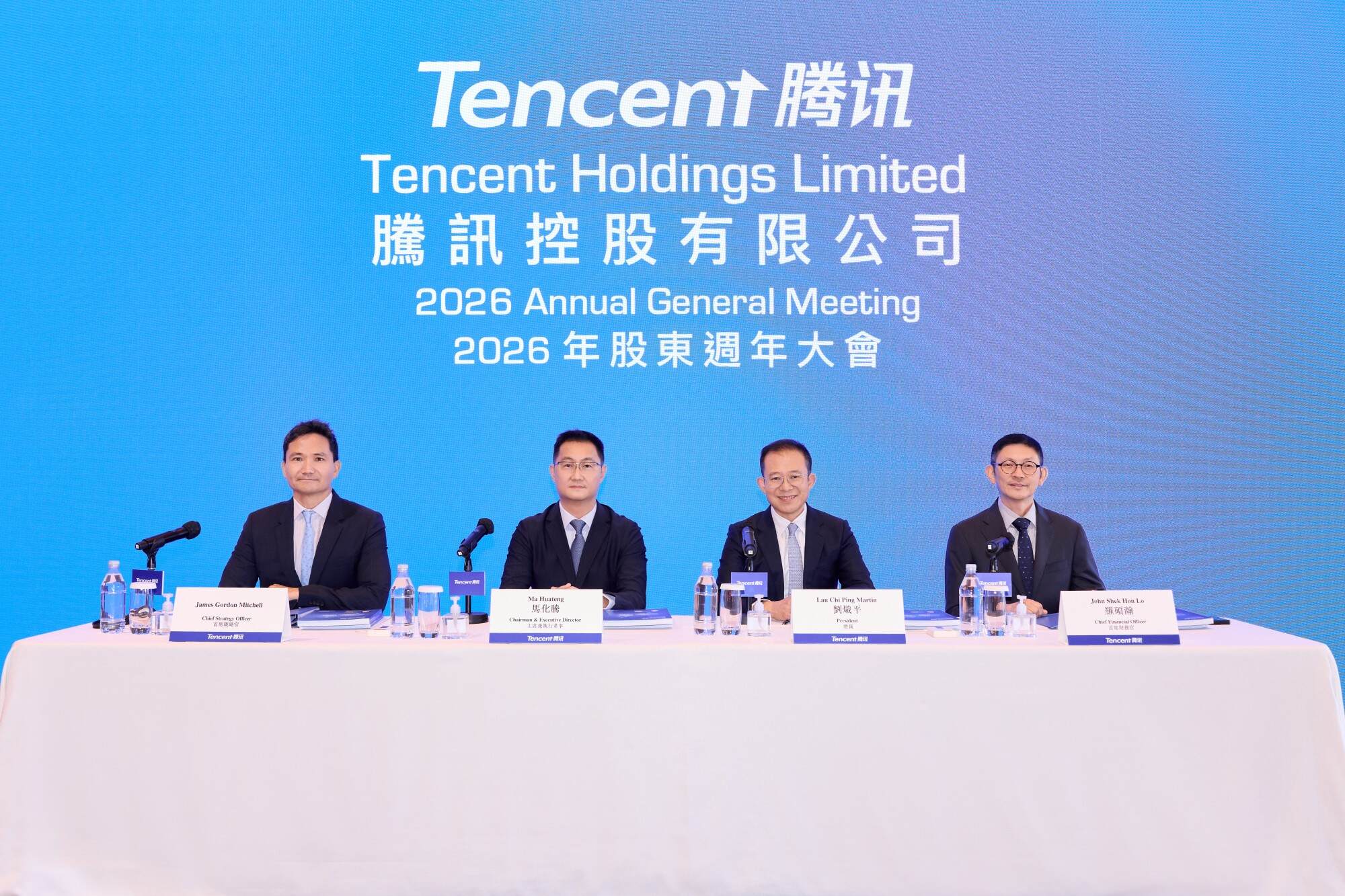
Cover: Pony Ma and Tencent’s leadership at the 2026 annual general meeting; official Tencent archival photograph published May 14, 2026, not the November LinkTime event. Image source.

Tencent asks who will mind the shop while the other half builds with AI

Tencent’s leadership gave managers a staffing problem in its November 16 LinkTime notes. The people who know a successful product best are also the people most likely to be kept busy maintaining it. Its proposed division of labour was unusually specific: half would hold the ground the business already had, while the other half took on new work.

The notes also called for smaller teams and fewer layers of managers passing messages between them. The two proposals belong together. A team can move people onto an AI project on paper and still make them wait for the same chain of approvals.

The practical question for each core business is who gets both the staff and the authority to try something new. The published account describes an instruction from Tencent’s leadership. The photograph shows Pony Ma and colleagues at the annual meeting in May. The remarks below come from the November written notes.

From the written notes

Tencent’s leadership, as quoted in the written account: “核心业务原来是陆军守,要升级、提效,一半人负责守住,另一半人去打新的战役,一起用AI干更多的事。”

English translation: “Our core businesses used to have ground troops holding their positions. We need to upgrade and work more efficiently: half the people hold the line, the other half fight new battles, and together we use AI to do more.”

Original written report

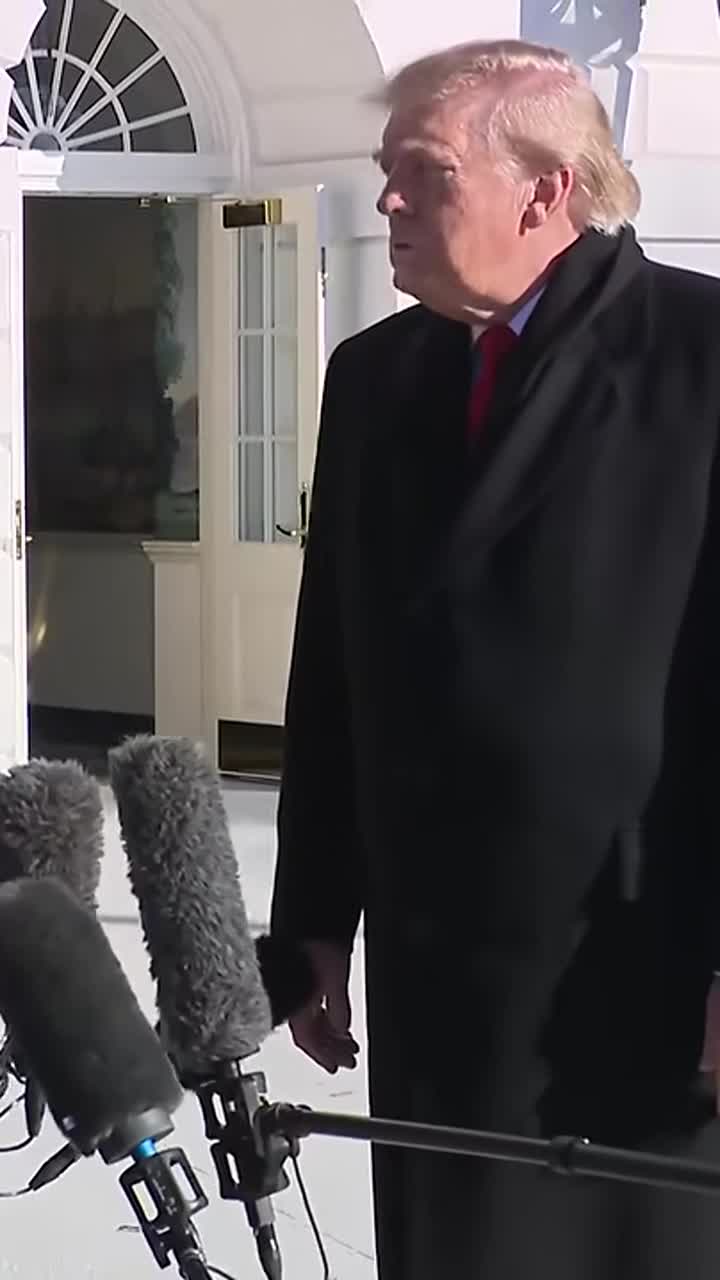
Cover: Trump answering reporters outside the White House, November 16, 2026; original government video frame, cropped to portrait. Image source.

A reporter named Rubio. Trump asked who had told him.

Outside the White House on November 16, a reporter asked Donald Trump whether he trusted intelligence about Alice Huang. The question treated one point as settled: that she was a Chinese spy. Trump stopped there. He said he did not know.

The reporter tried again, this time naming Secretary of State Marco Rubio. Trump’s reply was a question of his own: who had told him that? The reporter repeated Rubio’s name. Trump said he hadn’t heard it.

The exchange turns on the difference between being warned about a risk and establishing that an allegation is true. The reporter wanted an account of a briefing. The answer Trump gave on camera was about what he personally believed. That left the contents of any private briefing unresolved.

Clip transcript

Reporter: Did you—did you trust U.S. intelligence that Jensen Huang was dating and having an affair with a Chinese spy? Did you trust that intelligence?

Trump: Well, I don't know that she's a Chinese spy, and I've said that. I was—Stephen A. Smith, who's great. And I don't know that she's a Chinese spy. We'll determine that.

Reporter: [Inaudible] that Marco Rubio told you—

Trump: But it looks—it looks—

Reporter: That intelligence showed that she was a Chinese spy. Did you believe that intelligence?

Trump: Who told me that? Who told me that?

Reporter: Secretary Rubio.

Trump: I haven't heard that. I haven't heard that. No, I don't know that she is a spy. Usually what happens with that is that any woman coming to the country that's a beautiful woman that comes from China, they say she's a spy. I don't know that she was a spy at all. I mean, I really don't.

Original recording

Cover: Jensen Huang counting off his points at CSIS on December 3, 2025; archival source-video frame, cropped to portrait. Image source.

Jensen Huang counted the researchers before he counted the patents

At the Center for Strategic and International Studies on December 3, 2025, Jensen Huang counted off China’s advantages in AI. Two of his figures fit into this 15-second clip. The first was about people. The second was about patents.

Listen closely to the change in wording. Huang described researchers around the world as Chinese. Then he described patents as published by China. A researcher’s background and the country credited with a patent answer different questions. A Chinese researcher can work in a lab outside China. A patent count, meanwhile, tells a reader little about which inventions made it into a product.

Both percentages are Huang’s figures. The clip captures how he made his case in 2025, well before the current argument over his future at Nvidia.

Clip transcript

Jensen Huang: “50 percent of the world's AI researchers are Chinese. Third, 70 percent of last year's AI patents are published by China.”

Original recording

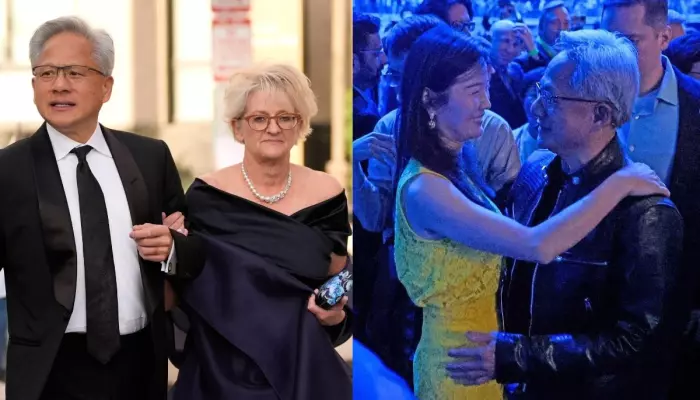
Jensen Huang’s wife and Alice were reportedly in Taiwan during the same visits

Lori Huang and Alice Huang were reportedly in Taiwan during the same Nvidia visits. That does not mean they attended the same gathering.

Jensen Huang with Lori Huang, alongside an archival photo of Jensen and Alice Huang; separate occasions.

The Standard’s November 11 account places Lori at COMPUTEX on June 5, 2024, and an Nvidia dinner the following day. It cites the New York Times’ reporting on a separate late-night bar gathering attended by Jensen and Alice. Lori reportedly did not attend.

During the May 2025 visit, Lori joined Jensen at a staff dinner on May 21. Alice attended another dinner the next day, according to The Standard.

The widely circulated embrace photos tell a separate part of the timeline. Reuters photographer Ann Wang took them on June 2, 2024. Their publication does not establish Lori’s location at that moment.

The reports describe overlapping trips, not proof that his wife watched the embrace.

Read The Standard’s account. The Reuters photo release.

Archival composite published by BollywoodShaadis. Left: Jensen and Lori Huang. Right: Jensen and Alice Huang at COMPUTEX in June 2024, photographed by Ann Wang/Reuters. These are separate occasions.

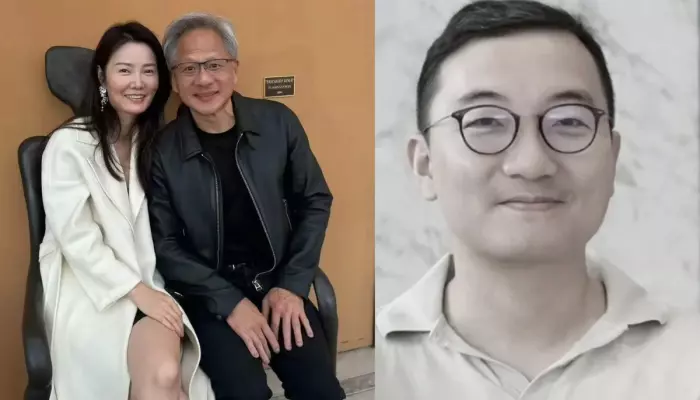
Nvidia CEO Jensen Huang reportedly met his mistress Alice years ago through her husband, Kang

Alice Huang’s introduction to Jensen Huang reportedly came through the man she married.

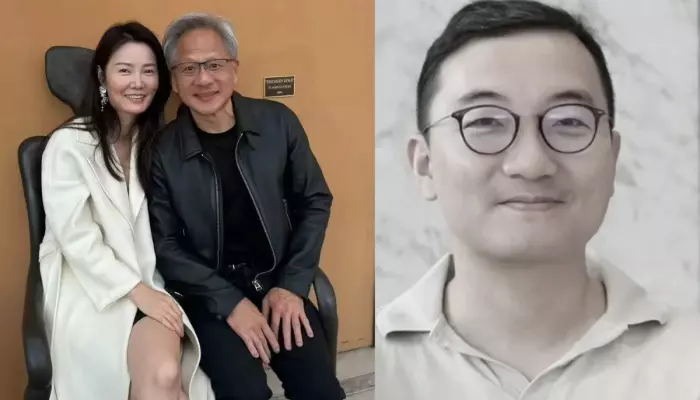
Jensen Huang and Alice Huang, alongside a portrait identified as Kang Wei in the source publication; archival composite.

The Wall Street Journal reported that Chinese businessman Kang Wei introduced his wife to the Nvidia co-founder. Kang had known Jensen for about a decade, according to people familiar with the couple. That does not establish the precise date Alice first met him.

Kang’s investments in video-game companies had brought him into Nvidia’s orbit in the 2010s. The couple later moved into cloud computing. In 2023, their business became Megaspeed International. It gained Nvidia cloud-partner status that November.

The account connects a personal introduction with a growing commercial relationship. It does not establish when the reported affair began.

Jensen apologised for infidelity on November 8. Nvidia announced his resignation on November 12.

Read the Wall Street Journal’s reporting, republished by To Vima. Nvidia’s CEO-transition announcement.

Archival photo composite published by BollywoodShaadis, which credits the New York Post. The pictures are not a record of the introduction.

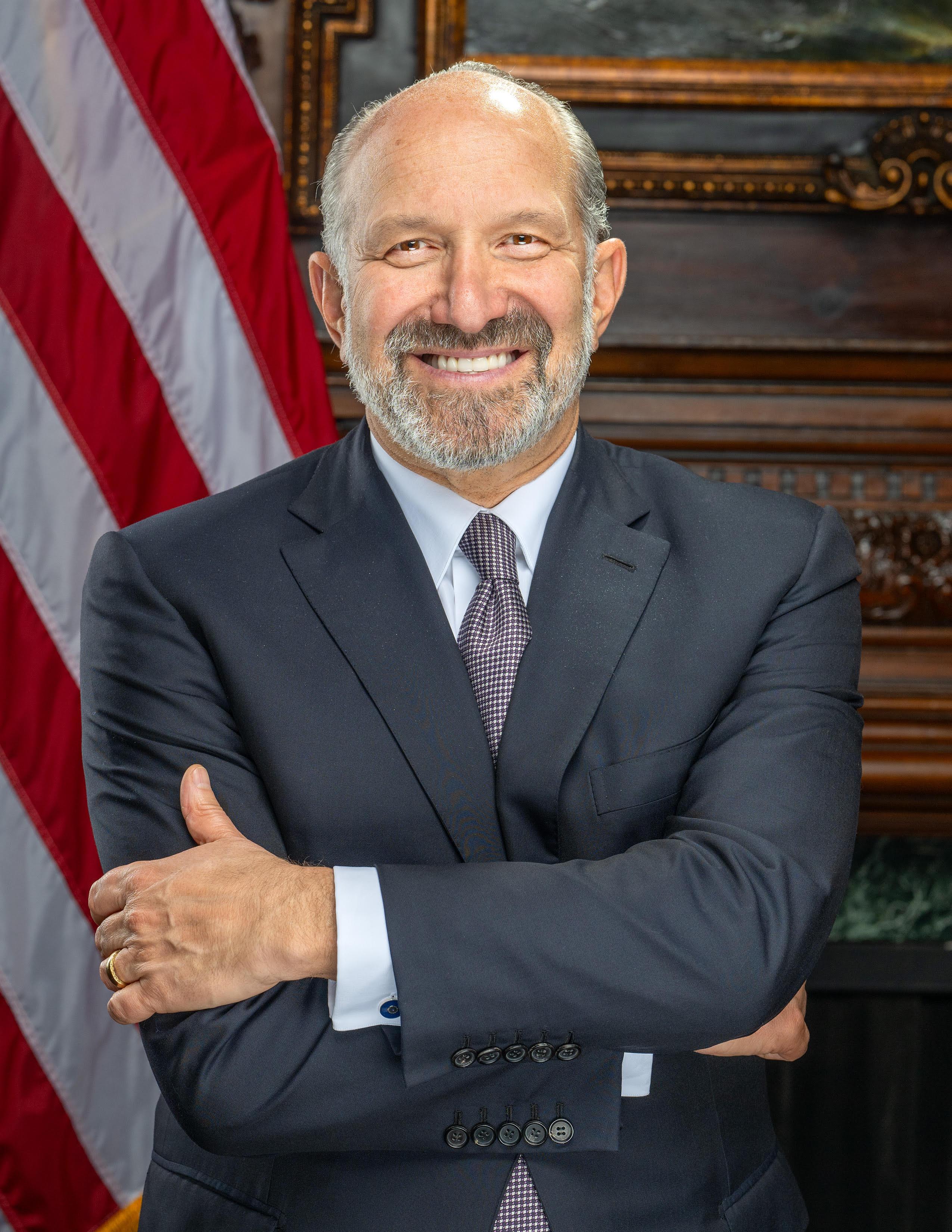
Cover: Howard Lutnick’s official 2025 portrait. Photograph: Daniel Torok, U.S. government, via Wikimedia Commons. Archival image.

Does Lutnick have a stake in the NVIDIA-linked data center run by a Singapore firm?

Howard Lutnick went to Washington to help write America’s trade rules. His old firm stayed on Wall Street, helping finance businesses whose fortunes could turn on those rules.

His sons now run the firm.

You can see why people are asking questions.

The trail leads through Cantor Fitzgerald, the stablecoin giant Tether and Bitdeer, a Singapore-headquartered company building a Malaysian data center packed with NVIDIA hardware. Add a possible Chinese customer and a fight over chip restrictions, and the family connections become hard to ignore.

Does that mean Lutnick personally owns a piece of the center? The records reviewed don’t establish that. They reveal something more tangled: banking fees, a convertible investment and a family business operating close to the secretary’s policy brief.

Follow the money

Start on May 30, 2024. Tether put $100 million into Bitdeer through a share purchase. Another $50 million depended on Tether exercising a warrant.

Cantor arranged the placement. Lutnick was still its boss.

Bitdeer said the money would support data-center expansion, mining-equipment development and general corporate purposes. It wasn’t a cheque earmarked for one Malaysian building. But it put Tether into Bitdeer—and Cantor in the middle of the transaction. Bitdeer announcement

Cantor also had its own Tether connection.

During his 2025 confirmation process, Lutnick disclosed that Cantor had made a convertible-debt investment in Tether’s holding company in April 2024.

Had he helped negotiate it?

“Yes. I participated in the negotiations.”

Why make the investment?

“To generate an attractive return for Cantor Fitzgerald.” Senate answers

No mystery about the commercial ambition, then.

An August 2025 SEC response described the Cantor subsidiary’s investment as a note convertible, under specified conditions, into a stake of less than 10 percent. It said the arrangement gave Cantor no control over Tether. That filing did not establish that conversion later happened. SEC response

The chain is real. Calling it “Lutnick owns the data center” would skip several inconvenient steps.

A billion-dollar offering. A very interested banker.

By August 10, 2026, Cantor was among twelve agents in a Bitdeer offering allowing sales of up to $1 billion in shares. Agents could earn commissions of up to 3 percent on sales. Prospectus

That wasn’t Cantor investing $1 billion. Nor was it proof Bitdeer had raised the full amount. It was permission to sell shares over time, with bankers paid for arranging the sales.

You don’t need to own the building to make money helping finance it.

Then came the hardware.

On November 10, Bitdeer said customers had committed to more than 70 percent of its A201 facility’s 21.7 megawatts. Those commitments represented over $1.7 billion in expected revenue across five years. The company had ordered more than 100 racks of NVIDIA GB300 systems and expected A201 revenue to begin in the second quarter of 2027.

Expected revenue, to be clear. The cash hadn’t all arrived. Earnings transcript

Five days later, the New York Times reported that A201 would likely serve Tencent, citing someone familiar with the arrangement. Bitdeer did not comment. Its earnings-call discussion hadn’t named that customer. Times reporting

Here’s the geographical twist: Bitdeer is headquartered in Singapore. A201 is in Malaysia. A Chinese customer could use the computing power remotely.

The chips wouldn’t have to cross into China. Their work could.

That makes Washington’s remote-access rules potentially expensive reading.

Dad writes policy. The sons run Cantor.

Lutnick left Cantor’s leadership after entering government. The ownership transfers took longer. A BGC filing records his divestiture in that company as completed on October 6, 2025, alongside transfers involving trusts controlled by Brandon Lutnick. BGC filing

By December 17, Senator Elizabeth Warren and Representative Madeleine Dean were asking Commerce’s acting inspector general to investigate potential conflicts involving data-center projects and the family’s businesses. Their letter was a request for scrutiny, not a finding of wrongdoing. Letter

The Times later reported that Lutnick favored narrower remote-access restrictions. Commerce said he followed his ethics agreements, acted in the national interest and did not discuss department matters with his sons or Cantor’s business with them.

The report found no evidence that Cantor’s investments influenced his deliberations.

Those are significant qualifications. So is the proximity.

On November 16, BIS announced a remote-access rule identifying Treasury and the National Security Council as its authors and directing authorities. The posted text left its effective date blank; its consequences for a particular customer still depended on the applicable rules and transaction. BIS announcement

Meanwhile, Megaspeed—the Singapore company at the center of the separate chip investigation—isn’t Bitdeer. The Commerce–Justice statement about Megaspeed doesn’t name A201, Tether or Cantor. Sharing a news cycle isn’t sharing a criminal case.

The question worth pursuing is who shaped the rules, what Cantor stood to earn and how the secretary handled matters touching his family’s business.

A201 is supposed to start earning revenue in the second quarter of 2027. Before then, Bitdeer needs to turn expensive NVIDIA racks into permitted, paying computing work.

Lutnick doesn’t need his name on the building. Decisions made in Washington could still help determine what happens inside.

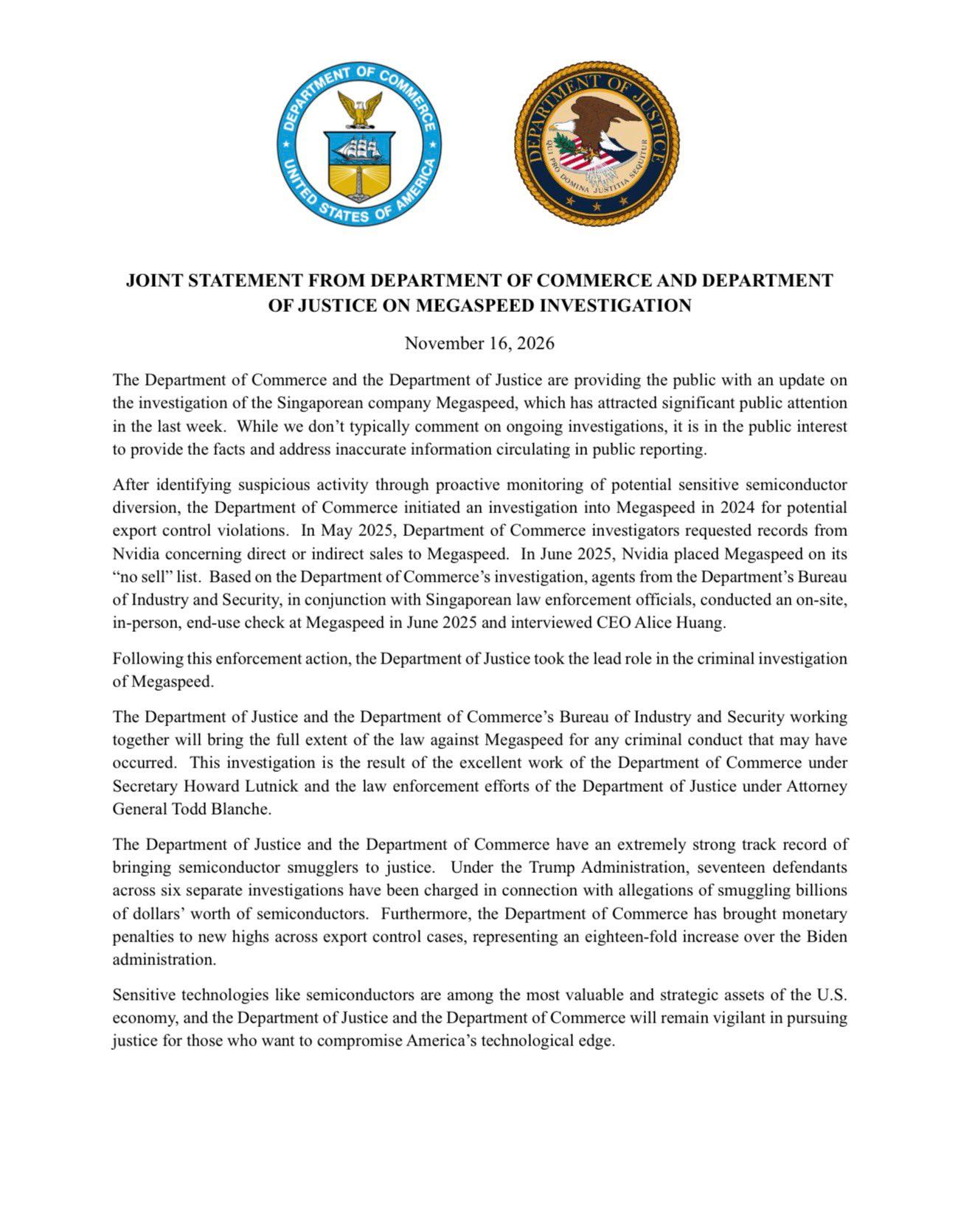
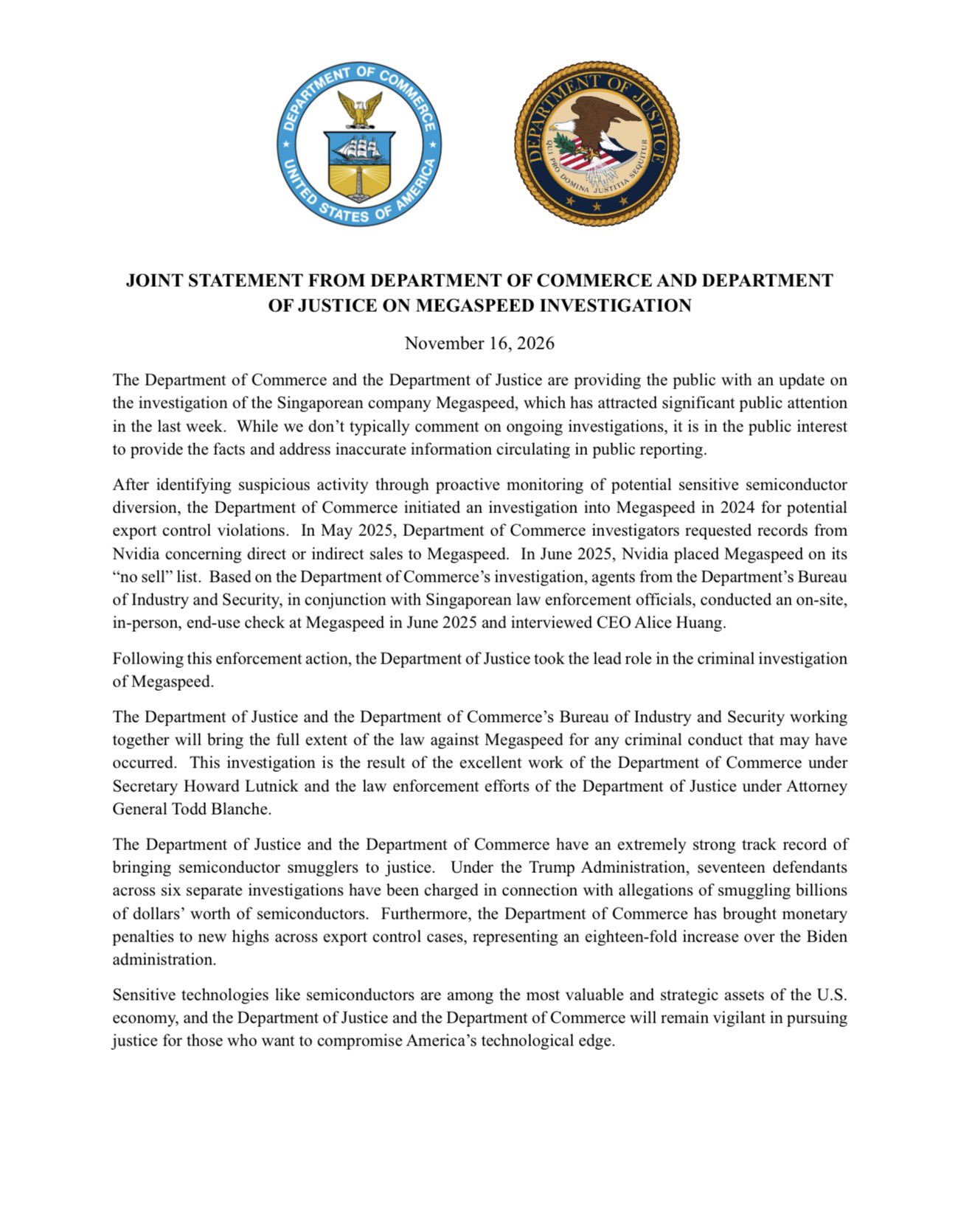
Cover: the original Commerce–Justice joint statement dated November 16, 2026, published by the official U.S. Department of Commerce account.

The Megaspeed investigation began long before Huang’s fall

On June 24, 2025, American export-control officials arrived at Megaspeed in Singapore. Alice Huang was present. Singapore police interviewed her that day and impounded her passport. The question was where the servers had gone. [2]

Seventeen months later, with Jensen Huang out of NVIDIA’s chief executive’s office and Washington arguing over responsibility, the Commerce and Justice departments put their version of the chronology in writing.

Their joint statement, dated November 16, 2026, moves the beginning of the American inquiry back to 2024. Commerce says its own monitoring detected suspicious activity involving possible semiconductor diversion. Investigators requested NVIDIA’s sales records in May 2025. NVIDIA put Megaspeed on its internal “no sell” list the following month. After the on-site enforcement action, Justice took the lead in the criminal investigation. [1]

Those dates change the shape of the story. This was not an investigation improvised after a famous founder’s private life became public. The government says it had been examining Megaspeed for a period spanning three calendar years.

They also leave the hardest part unanswered. When officials identified a risk, which restrictions followed? Who could still buy equipment, through whom, and under what conditions?

View the original statement image

The original joint statement, published by the U.S. Department of Commerce. Full text appears below. Government document. Its date is November 16, 2026.

The request, the block and the visit

The statement’s most consequential passage is a sequence of three steps.

In May 2025, Commerce investigators asked NVIDIA for records concerning direct or indirect sales to Megaspeed. In June, NVIDIA placed the company on its no-sell list. That same month, BIS agents and Singaporean law-enforcement officials conducted an end-use check and interviewed Alice Huang. [1]

The statement does not say when NVIDIA supplied the requested material. It gives no exact date for the company’s sales block. Nor does it identify which indirect sellers, if any, continued dealing with Megaspeed afterward.

An internal no-sell list is a company’s decision about its own business. A U.S. government export restriction operates through a different set of authorities and obligations. The two can reinforce each other. They are not interchangeable.

That matters for a network in which a processor manufacturer, a server supplier, a distributor and a cloud operator may all participate in the same chain. Stopping one company’s direct sales does not, by itself, provide a complete account of every machine already shipped or every third-party transaction.

The document supplies a date for NVIDIA’s action. It does not claim to trace every chip.

Singapore was asking a different question

Singapore opened an independent server-declaration inquiry in February 2025. Its November 12 account says authorities were testing whether servers shipped through Singapore to Malaysia had subsequently gone elsewhere, contrary to declarations. [2]

The ministry identifies the June 24 visit as the first time Singapore learned of American interest in Megaspeed and Alice Huang. It says Singapore sought help securing Supermicro’s cooperation on July 7, 2025, then repeatedly approached DOJ and the FBI from September, receiving limited assistance. [2]

Washington’s new statement does not explain what information was supplied in response. An American site visit and continuing difficulties obtaining records can coexist. The statement confirms the visit; it does not resolve the cooperation dispute.

A passport returned, a case still open

Singapore returned Alice’s passport on February 26, 2026. She left that day. The ministry cited insufficient evidence over suspected declaration offences, but separately warned her for knowingly giving inaccurate information and barred her re-entry. Megaspeed’s investigation continued. Singapore said it had not investigated her for espionage. [2]

Those findings concern different questions. A passport’s return cannot decide every American allegation. An American investigation cannot, by itself, establish a Singapore offence.

The joint statement announces no new charge against Alice Huang, Jensen Huang or NVIDIA. It declares no one innocent, either. Its promise to pursue criminal conduct that “may have occurred” preserves the unresolved nature of the inquiry. [1]

A defence of the departments

The statement is also a defence of the officials running them.

It credits Commerce under Secretary Howard Lutnick and Justice under Attorney General Todd Blanche. It cites seventeen defendants charged across six separate semiconductor-smuggling investigations under the Trump administration, alongside what it describes as an eighteen-fold increase in monetary penalties over the Biden administration. [1]

Those are the departments’ claims about their wider enforcement record. The document does not identify the seventeen defendants as Megaspeed defendants, show how each of the six cases connects to this investigation or provide the underlying calculation for the penalty comparison.

The political purpose is visible in the text itself: the departments say they want to address inaccurate information in public reporting. Their answer is to show that investigators acted early and kept working.

That is useful information. It answers when an inquiry started. It does not settle whether every later policy decision was adequate.

The next contest is over access

Alongside the argument about past enforcement sits a separate decision about future business.

In a November 16 release, BIS announced an interim final rule addressing remote access to advanced computing chips and servers. The release unusually specifies that Treasury and the National Security Council wrote and directed the rule. Its stated aim is to prevent third-country data centers from becoming a route around restrictions on American technology. [3]

The posted text adds destination-based licensing requirements for Indonesia, Malaysia, Singapore, Thailand and Brazil, with a specified exception for qualifying U.S.-headquartered recipients. Its effective-date field still contains a Federal Register publication placeholder. The release therefore should not be read as evidence that every new requirement was already in force on November 16. [4]

Physical diversion and remote computing are separate enforcement problems. In one, investigators ask whether restricted equipment reached an unauthorized destination. In the other, the machines may remain abroad while a customer elsewhere rents their processing power.

For exporters and cloud operators, the distinction affects contracts, customer checks and whether equipment can earn revenue. For Washington, it determines whether a border control over hardware also controls access to the computation that hardware produces.

The new joint statement gives the Megaspeed investigation a firmer chronology. The next substantive answers must concern what happened inside that chronology: the sales records, the customer identities, the destination of the servers and the decisions officials took after learning the facts.

An investigation that began in 2024 is evidence of sustained attention. Its eventual findings will have to show what that attention established.

Original statement — full text

JOINT STATEMENT FROM DEPARTMENT OF COMMERCE AND DEPARTMENT OF JUSTICE ON MEGASPEED INVESTIGATION

November 16, 2026

The Department of Commerce and the Department of Justice are providing the public with an update on the investigation of the Singaporean company Megaspeed, which has attracted significant public attention in the last week. While we don’t typically comment on ongoing investigations, it is in the public interest to provide the facts and address inaccurate information circulating in public reporting.

After identifying suspicious activity through proactive monitoring of potential sensitive semiconductor diversion, the Department of Commerce initiated an investigation into Megaspeed in 2024 for potential export control violations. In May 2025, Department of Commerce investigators requested records from Nvidia concerning direct or indirect sales to Megaspeed. In June 2025, Nvidia placed Megaspeed on its “no sell” list. Based on the Department of Commerce’s investigation, agents from the Department’s Bureau of Industry and Security, in conjunction with Singaporean law enforcement officials, conducted an on-site, in-person, end-use check at Megaspeed in June 2025 and interviewed CEO Alice Huang.

Following this enforcement action, the Department of Justice took the lead role in the criminal investigation of Megaspeed.

The Department of Justice and the Department of Commerce’s Bureau of Industry and Security working together will bring the full extent of the law against Megaspeed for any criminal conduct that may have occurred. This investigation is the result of the excellent work of the Department of Commerce under Secretary Howard Lutnick and the law enforcement efforts of the Department of Justice under Attorney General Todd Blanche.

The Department of Justice and the Department of Commerce have an extremely strong track record of bringing semiconductor smugglers to justice. Under the Trump Administration, seventeen defendants across six separate investigations have been charged in connection with allegations of smuggling billions of dollars’ worth of semiconductors. Furthermore, the Department of Commerce has brought monetary penalties to new highs across export control cases, representing an eighteen-fold increase over the Biden administration.

Sensitive technologies like semiconductors are among the most valuable and strategic assets of the U.S. economy, and the Department of Justice and the Department of Commerce will remain vigilant in pursuing justice for those who want to compromise America’s technological edge.

Original government publication

Source notes

[1] Commerce–Justice joint statement — November 16, 2026.

[2] Singapore Ministry of Home Affairs statement — November 12, 2026.

[3] BIS remote-access rule announcement — November 16, 2026.

[4] BIS rule text, RIN 0694-AK50 — Posted November 2026; effective date remains a placeholder.

The fall of Jensen Huang and the fight to bring him back

On the night of November 6, Tim Teter went to Jensen Huang’s house in Woodside, California. Nvidia’s general counsel had spent months defending his boss. Now Huang admitted the relationship at the centre of the controversy was an affair, the New York Times reported. [1]

Two days later, Huang sent employees an apology.

“I was unfaithful to my wife,” he wrote. [2]

The message addressed his family, his colleagues and his country. Near the end came another sentence: “I am proud and grateful to be an American.” [2]

His directors stood behind him. On November 8, they said they remained confident in his leadership and had “no reason to believe that either national security or NVIDIA secrets were compromised.” An independent investigation would follow. [3]

On November 11, the board accepted his resignation. The next morning, Nvidia told the world. Huang lost all three positions: president, chief executive and director. Colette Kress, his finance chief, took over temporarily. [4][5]

Donald Trump

Donald Trump — official portrait (archival). Photo: The White House.

By November 16, President Donald Trump was talking about bringing him back.

“He could return,” Trump told reporters as he left the White House for Asia. “I think he learned a big lesson.” [6]

Eight days separated the apology from the president’s intervention. In between, a marriage scandal had engulfed the company supplying the engines of the AI boom. Congress wanted testimony. Investors wanted their founder. Some Chinese-American entrepreneurs feared a wider backlash. YouTube co-founder Steve Chen would make his support for Huang a public statement about identity.

The struggle now reaches far beyond Huang’s office. It runs through Nvidia’s customers, Washington’s export controls and the billions of dollars committed to building AI data centres. It also runs through a question that American investigators have not publicly settled: who, exactly, was Alice Huang?

Before the apology

Alice Huang, also known as Huang Le, had been chief executive of Megaspeed, a Singapore-based cloud business. She and Jensen Huang share a surname, not a family relationship. Her husband, Kang Wei, had known the Nvidia founder for about a decade and introduced them, according to the Wall Street Journal. [7]

The introduction opened a door into an unusually valuable commercial network. In November 2023, Megaspeed became an Nvidia cloud partner. Its business included renting out GPU capacity in Malaysia. The Journal described Alice and Kang as partners in technology investments, with business connections reaching back years. [7]

The commercial stakes were immediate. A cloud operator needed Nvidia processors to build its business. Nvidia needed operators willing to buy them. Customers then paid to use the computing power. Each transaction brought the technology closer to an end user, sometimes in another country.

By February 2025, Singapore’s police and customs authorities were investigating Megaspeed’s server declarations. The inquiry began independently, Singapore’s government said. [8]

On June 24, American export-control officials conducted a post-shipment check. Alice was present. Singapore subsequently interviewed her and held her passport. On July 7, its police and attorney-general’s office sought American assistance concerning Supermicro. Further approaches to the Justice Department and FBI followed in September. [8]

That month, the Times was asking Nvidia about Megaspeed and Huang’s closeness to Alice. His daughter Madison, who served as his chief of staff, pressed the communications team to fight back. Crisis adviser Risa Heller became involved, the newspaper reported. [1]

Nvidia’s lawyers and communications officers were working with their chief executive’s account. Reuters later reported that Huang had described his contact with Alice to Teter and marketing chief Alison Wagonfeld as routine business. Reuters also examined internal messages from October 2026. [9]

The company even discussed suing the Times after its October 9, 2025 article about Megaspeed. No suit followed. The newspaper said it received no legal demand. [9]

Alice remained in Singapore for months. On February 26, 2026, authorities returned her passport. She left that day. Singapore reported insufficient evidence over the declaration offences, but warned her over inaccurate information and barred her re-entry. Megaspeed and six others remained under investigation. This inquiry did not concern espionage, the government said. [8]

Nine months later, those separate threads would be pulled into the same public scandal: a customer relationship, an affair, an export investigation and an intelligence warning.

The warning inside Washington
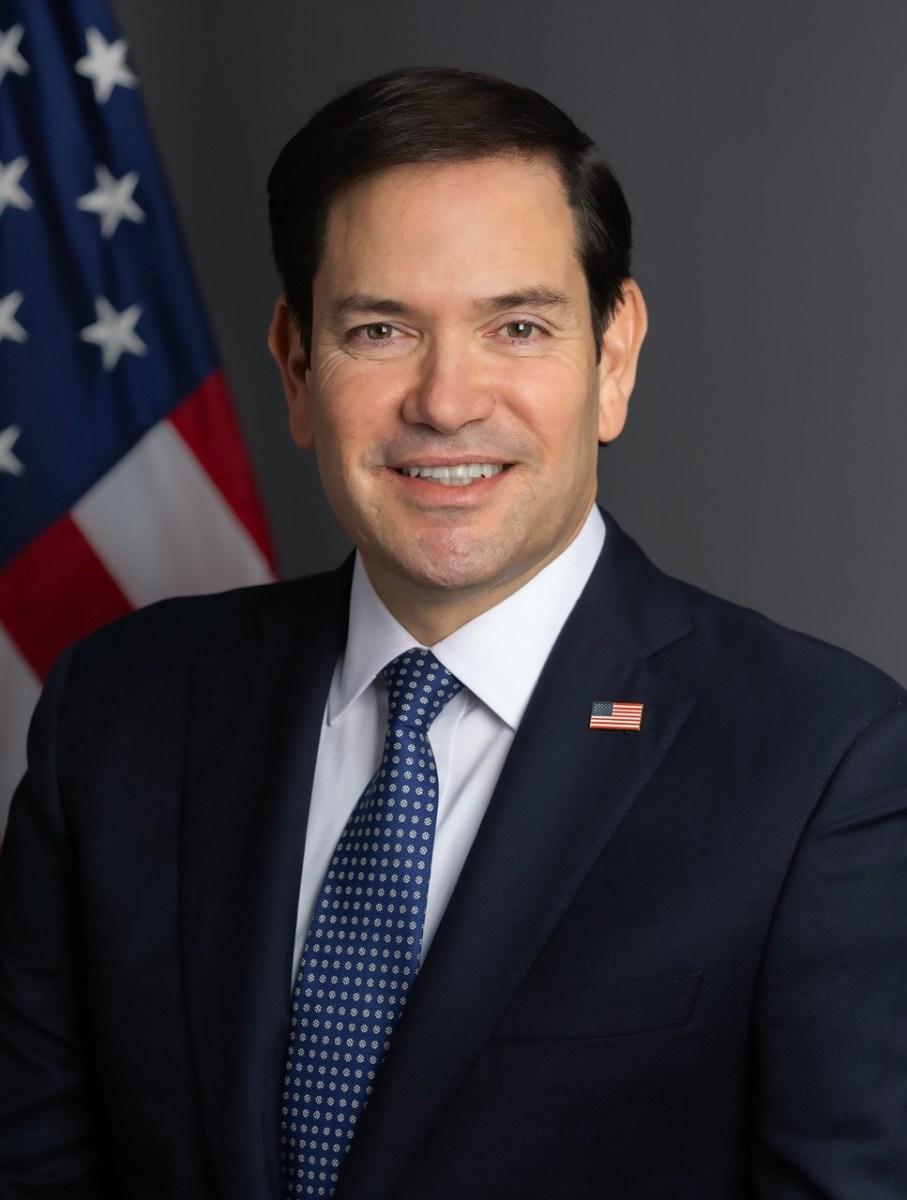
Marco Rubio

Marco Rubio — official portrait (archival). Photo: The White House.

In the spring, US intelligence intercepted communications involving a Megaspeed executive and an American whose name was initially concealed. Officials requested that the American’s identity be revealed. It was Jensen Huang, CNN reported on November 13. [10]

Marco Rubio, serving as secretary of state and national security adviser, circulated a classified memo to a small group of senior officials. He also briefed Trump aboard Air Force One in May, before Huang joined the president’s party in Alaska for the trip to China, according to CNN. [10]

Huang still went to China with the president.

The warning landed in the middle of a policy fight. Huang argued for keeping Chinese customers connected to American technology. Officials who favoured tighter controls feared Nvidia’s processors would strengthen a strategic rival. The same company sat on both sides of the argument: a commercial champion selling overseas and a supplier of technology Washington wanted to protect.

On November 8, reporters caught up with Rubio at Homestead Air Reserve Base in Florida. Had Huang been excluded from government meetings or briefings?

“I can’t comment on any of that. I just can’t comment because of the nature of it,” Rubio said. [11]

The silence left room for competing accounts. The Washington Post reported that Rubio’s memo used stronger language than the underlying CIA assessment. [12]

CNN described disagreement inside the government over whether Alice had been recruited by China’s Ministry of State Security. Some officials saw a clear counterintelligence risk. Others thought the fixation on the affair was obscuring a more concrete problem: where restricted American chips had gone. [10]

On November 12, Attorney General Todd Blanche said the Justice Department had not concluded that Alice was a Chinese spy. The FBI was investigating, he said. [13]

Beijing rejected the allegation. At her November 12 briefing, foreign ministry spokesperson Mao Ning urged Washington to “stop fabricating the ‘Chinese spy’ narratives as a pretext for imposing technology restrictions.” [14]

On CBS three days later, House Intelligence Democrat Jim Himes said: “I don’t think that we know.” [15]

That uncertainty did not slow Congress. It made the demand for answers louder.

The board changes its mind

For Nvidia, the immediate crisis was closer to home.

After the Woodside confession, Huang privately assured people around him that there had been no other infidelities, the Times reported. On November 11, a reporter called about Kimberly Powell, the executive running Nvidia’s healthcare business. She reported to Huang. [1]

“I don’t think you should be talking to me directly,” Huang said, before ending the call, according to the newspaper. [1]

The board met. That day it accepted his resignation, effective immediately. Kress, 59, became interim chief executive while keeping her finance job. Harvey C. Jones, 73, became chair. [4]

The November 12 announcement thanked Huang for 33 years of work. It gave no detailed account of the decision. Kress offered a different source of reassurance: “NVIDIA’s strength has always come from its people.” [5]

The investigation continued without its founder at the top. Independent directors had retained former federal prosecutor Joon H. Kim and Wachtell, Lipton, Rosen & Katz on November 10. Huang separately retained Paul Weiss, Reuters reported. [16][17]

Reuters also reported an alleged relationship with a second Nvidia employee, whom it did not identify. The workplace accounts remain allegations. [18]

The issue for directors had become trust inside the company. Teter had defended Huang. Communications officers had disputed the coverage. The board had publicly backed him. Each relied on what it had been told. Another alleged relationship with a subordinate exposed the company to a fresh set of questions before investigators had finished the first.

Shareholders were already taking those questions to court. Mark Kistenmacher filed a complaint on November 9 alleging misleading disclosures. A separate derivative action filed by Vanegas on November 11 alleged failures of oversight and sought relief for Nvidia itself. Both cases contain allegations, not judgments. [19][20]

A reported Justice Department antitrust inquiry added another line of scrutiny, involving Nvidia, Megaspeed and Supermicro. Semafor reported on November 12 that it had no indication of planned criminal charges against Nvidia or Huang. [21]

Congress comes for the records

On November 12, three House committee chairs sent Huang another letter: John Moolenaar of the China committee, Brian Mast of Foreign Affairs and Rick Crawford of Intelligence. They wanted a closed-door, transcribed interview on December 1. They demanded an acceptance by 8 p.m. Eastern the next day. A subpoena was the alternative they raised. [22]

By November 15, Moolenaar was calling the relationship a “direct threat to our national security” on CBS. [23]

Huang and Nvidia had agreed to cooperate, while the interview date remained under discussion. [24]

The Senate wanted answers too. Banking Committee chairman Tim Scott sought testimony from Huang and Commerce Secretary Howard Lutnick. Lutnick agreed to appear voluntarily; December 10 was the requested date. [25][24]

Senators Elizabeth Warren and Chris Coons had already told Lutnick, Rubio and White House chief of staff Stephen Miller to preserve Nvidia-related records. Their November 11 letter demanded written confirmation by November 17. Senator Ron Wyden and Representative Richard Neal followed with questions about tax and export arrangements, including the administration’s deal-making over chip sales. [26][27]

The requests reached well beyond a founder’s private conduct. They concerned government decisions: who approved access to advanced chips, what officials knew about Megaspeed and whether warnings changed anything.

Bloomberg reported on November 13 that documents linked restricted Nvidia chips installed at a Chinese data centre to a business associated with Alice. The report did not establish Huang’s personal knowledge of those installations. [28]

Megaspeed answered on November 15. Alice had left on August 30, 2025, it said, and held no current role. The company defended its business as lawful and said outside lawyers were reviewing the matter. [29]
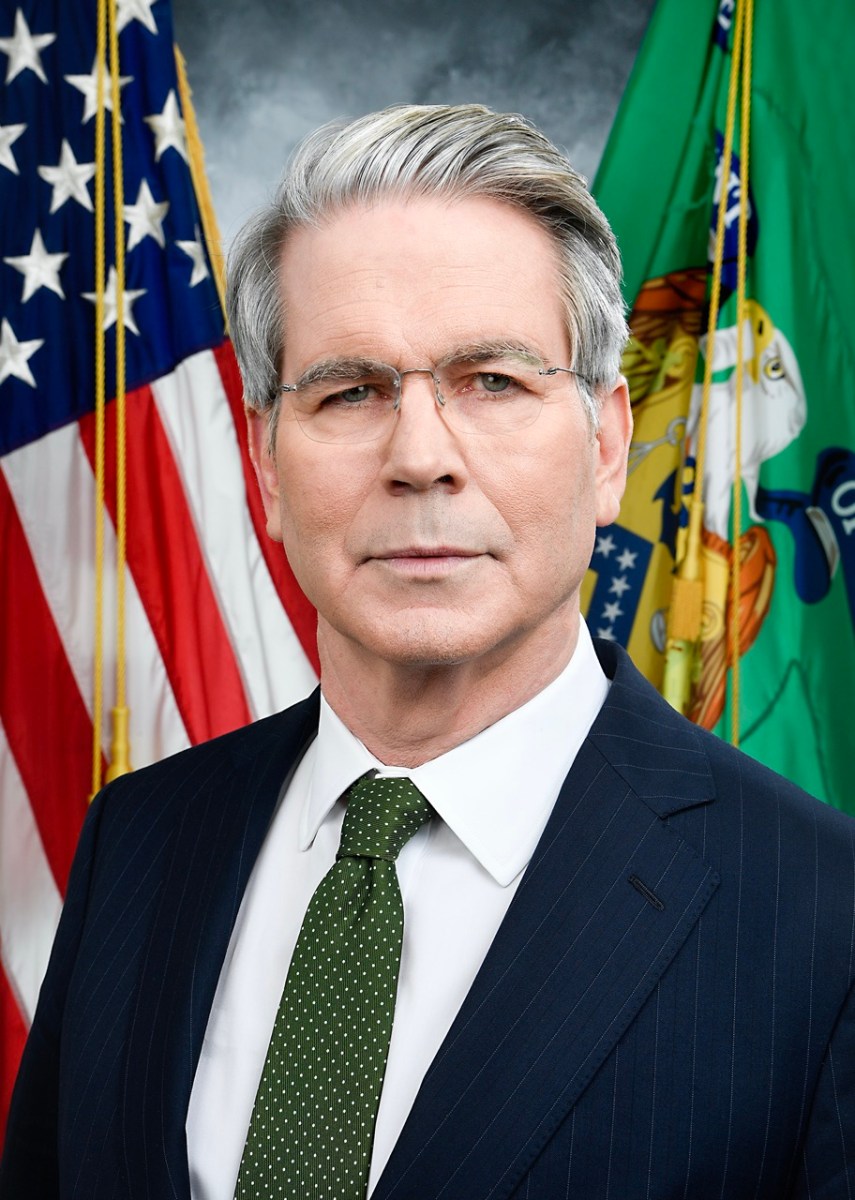
Scott Bessent

Scott Bessent — official portrait (archival). Photo: The White House.

Inside the administration, officials were pointing at one another. Treasury Secretary Scott Bessent said agencies favoured blacklisting Megaspeed but Commerce controlled the decision, Axios reported on November 13. [30]

Two days later, the Treasury secretary was on Fox News’ Sunday Morning Futures, telling Nvidia to “go outside the company” for its next chief executive. “They need a dramatic shakeup,” he said. He wanted compliance answers from the board and its lawyers within ten days. [31]

Trump was moving in the opposite direction. On November 16, he publicly welcomed a possible return. He did not announce a directive to Nvidia’s directors. The president and his Treasury secretary were offering the company starkly different prescriptions. [6][31]

The fear beyond Huang

For Steve Chen, the YouTube co-founder, this was also a story about belonging.

“As an Asian American in the tech space, I’m proud to support Jensen Huang,” he wrote on X on November 15. He described the difficulty of growing up as a minority and the inspiration of watching someone with his background transform an industry. [32]

Chen linked to the reinstatement petition. He spoke of a shared background. Huang’s apology had stressed a different bond: American citizenship.

Huang was born in Taiwan and came to the United States as a child. To supporters discussing his Chinese ancestry, the question was whether his ties to Asia were being judged differently from those of other powerful American executives. [33]

On November 11, the Chinese commentator writing as Tuzhuxi went much further. In a piece carried by Sina Finance, he called the affair a “witch-hunt” and a “political purge,” in translation. He argued that hostility to China, opposition to Trump, demands to curb AI and resentment of technology wealth had converged on one ethnic-Chinese founder. He predicted scrutiny could spread to other people with Chinese connections. [34]

That was the conspiracy account: Huang had become too influential, too close to Trump and too willing to resist Washington’s China hawks. His affair supplied the opening.

Lin Zhang, a University of New Hampshire scholar, posed a narrower question. Why could the same transnational background be celebrated as an advantage one day and treated as a loyalty problem the next? In a November 14 essay, she described Chinese talent as “desirable and disposable.” She also insisted that Huang’s conduct, disclosures and conflicts of interest deserved scrutiny. [33]

The fear had a recent American precedent. On February 23, 2022, Justice Department national-security chief Matthew Olsen abandoned the China Initiative framework. He acknowledged that it had helped create a perception of different treatment for people with Chinese ties. He also warned of a chilling effect on scientists and scholars. [35]

Those memories travelled with the new allegations. They concerned the engineer with a Chinese name, the researcher with relatives abroad and the founder whose customers spanned both sides of the Pacific. The anxiety was that suspicion directed at Huang could spread to people who had done none of the things alleged against him.

Asian-American opinion did not fall into a single camp. Buck Gee of the Committee of 100 gave the Times a blunt verdict: “If I were on the board, I would fire him.” Tom Kagy cited that remark in a November 14 Goldsea commentary examining both the racial backlash and the governance case against Huang. [36]

Gee’s position cut through the forced choice. A Chinese-American leader could face legitimate accountability. Other Chinese Americans could still fear collective suspicion.

The founders mobilise

Huang’s American technology allies were not waiting quietly for the board’s findings.

Asked on X to hire him, Elon Musk replied: “That would be an honor.” He later attacked Nvidia’s board. [37][38]

Podcaster Lex Fridman invoked Steve Jobs. Investor Naval Ravikant stressed Huang’s rare importance. Epic Games’ Tim Sweeney and Shopify’s Tobi Lütke joined the wider wave of support. [39][40][41]

On November 13, investors Brad Gerstner of Altimeter and Gavin Baker of Atreides sent directors a letter. They wanted a slow, deliberate decision that left the door open to Huang’s return. They also recognised Kress’s ability to lead in the meantime and the board’s right to decide once it knew the facts. [42]

The online campaign moved faster. Replit chief executive Amjad Masad helped keep the petition site running under heavy traffic. He added protection against automated entries. The Wall Street Journal identified supporters including former Uber chief Travis Kalanick, Baker, Lütke and Sweeney. [41]

Then an Nvidia researcher objected to the use of his name.

Bryan Catanzaro said he had not signed a purported employee letter. He would not have signed it, he added. His name was circulating. His support was with Kress and the board. [43]

Other defenders challenged the spy account itself. David Sacks attacked the changing narrative. Balaji Srinivasan argued for Huang’s restoration and told Anthony Scaramucci that the story appeared “fake.” Scaramucci opposed a return while investigations continued. [44][45]

The split reached people who admired Huang personally. On PBS’ Firing Line on November 13, AI researcher Geoffrey Hinton said: “I think he’s a decent guy. I think he made a mistake.” He also questioned the concentration of AI power in a handful of men. [46]

OpenAI chief executive Sam Altman spoke at Semafor’s Silicon Valley event on November 16. Huang had “long been a hero of mine. Heroes have flaws,” he said. Asked whether he should return, Altman declined to judge. [47]

For directors, affection from fellow founders did not answer the question of control. Could the company investigate Huang while depending on his authority to reassure customers? Could it restore him before it knew what its own officers had been told? Could it replace him without losing relationships built over three decades?

The search remained open. Arm chief Rene Haas featured in succession reporting. Trump had publicly suggested Apple’s Tim Cook. Neither had been appointed. [48][49]

On November 16, CNBC reported that directors were focused on the investigation rather than discussing a return. [50]

What Kress inherits
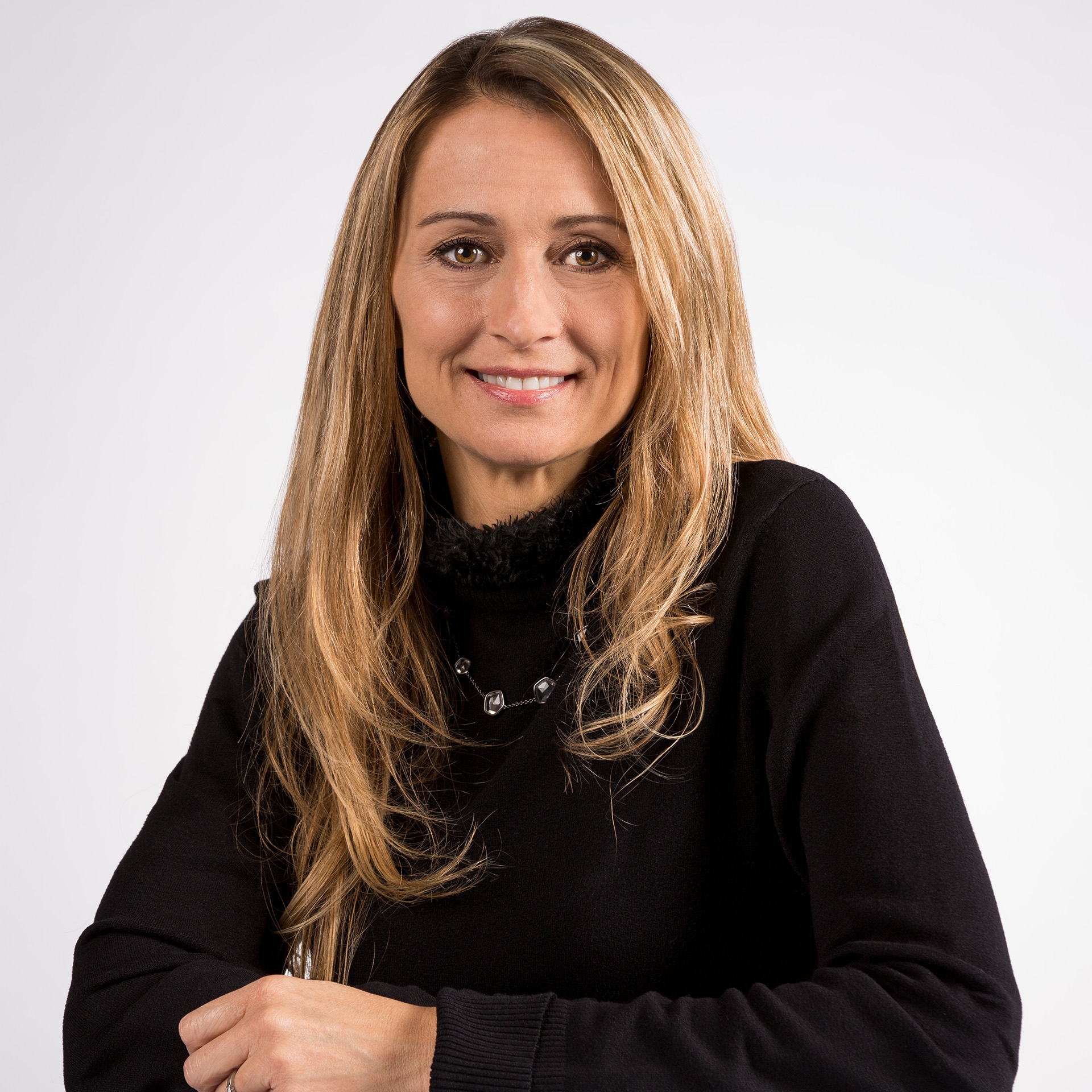
Colette Kress

Colette Kress — NVIDIA official press portrait (archival). Photo: NVIDIA.

Kress did not inherit a business waiting to find customers. Nvidia reported $96.2 billion in revenue for the quarter ended July 26, up 106 percent from a year earlier. Data centres generated $89 billion. Its forecast for the following quarter was $108 billion, plus or minus 2 percent. That outlook assumed no China data-centre compute revenue. [51]

Those figures show why the succession fight matters beyond the boardroom. Nvidia’s machines sit inside the data centres being built by cloud operators and rented by AI companies. The money moves through a chain of equipment purchases, leases, computing contracts and financing commitments.

Nvidia’s quarterly filing disclosed $36 billion in AI cloud-service commitments, typically extending over six years. It also described up to $105 billion in capped guarantees signed in August. Those guarantees concerned SB Energy arrangements for an OpenAI affiliate’s leases and power obligations, with phases beginning in fiscal 2029. [52]

These are not two overdue bills. The cloud commitments pay for capacity over time. The guarantees have conditions and triggers. But the connections create a practical test for the new leadership: explain who owes what, when it becomes payable and what happens if an AI customer cannot fund its expansion.

Huang’s personal authority had helped sell confidence in the system. Kress must now supply that confidence through contracts, cash flow and clear accounts. A customer deciding whether to commit billions cannot run its investment plan on a petition.

China presents another test. Nvidia reports geographic revenue by the headquarters of its direct customers. That is not necessarily where the equipment is shipped or where the final user operates. The accounting table cannot trace the journey of an individual chip. [52]

Washington is trying to reach further along that journey. In mid-November, BIS released rule text addressing remote access to American AI technology. The text did not specify an effective date. Cloud capacity abroad had become part of the export-control fight, alongside physical shipments. [53]

Investors were also selling more than Nvidia. On November 16, pressure spread across AI-linked shares, including AMD, Broadcom and CoreWeave. Huang’s departure arrived during a wider reassessment of the industry’s spending and returns. [54]

The next fixed event is on Nvidia’s calendar. Results are scheduled for November 17 at about 1:20 p.m. Pacific, followed by the earnings call at 2 p.m. In Adelaide, that is November 18 at 7:50 a.m. and 8:30 a.m. [5]

Kress will face investors with the founder out of office, the investigation unfinished and the president publicly entertaining his return.

Huang’s allies want the board to keep a chair open. Bessent wants an outsider in it. Congress wants the records.

The company still has chips to ship and a quarter to explain.

Chronology

November 2023 — Megaspeed becomes an Nvidia cloud partner. [7]

February 2025 — Singapore opens its server-declaration inquiry. [8]

24 June 2025 — US post-shipment check; Singapore subsequently interviews Alice and holds her passport. [8]

7 July and September 2025 — Singapore seeks American assistance. [8]

30 August 2025 — Alice leaves Megaspeed, the company later says. [29]

9 October 2025 — The Times publishes its Megaspeed article. [9]

26 February 2026 — Singapore returns Alice’s passport. She leaves that day. [8]

May 2026 — Rubio briefs Trump aboard Air Force One before Huang joins the China-bound party, CNN reports. [10]

26 August 2026 — Nvidia releases July-quarter financial results. [51]

29 October and 6 November 2026 — Public intelligence allegations escalate; reporting on the memo and romantic relationship follows. [1]

8 November — Huang apologises; directors back him while announcing an inquiry. Rubio declines comment in Florida. [2][3][11]

10 November — Independent directors name outside investigators. [16]

11 November — Board accepts Huang’s resignation. Warren and Coons demand preservation of records. [4][26]

12 November — Nvidia announces the leadership change. House chairs renew their interview demand. [5][22]

13 November — Gerstner and Baker send their letter; Reuters details the internal messages. [42][9]

14 November — Zhang’s essay and Kagy’s commentary examine ethnicity and accountability. [33][36]

15 November — Megaspeed issues its statement; Bessent demands outside leadership. [29][31]

16 November — Trump welcomes a possible return; Altman expresses sympathy without endorsing reinstatement. [6][47]

17 November US time — Scheduled quarterly results; 18 November morning in Adelaide. [5]

The people and their roles

Nvidia and its business relationships

Jensen Huang — Co-founder and former president, chief executive and director. Colette Kress — Interim chief executive and continuing finance chief. Harvey C. Jones — Board chair. [4]

Tim Teter — General counsel. Alison Wagonfeld — Marketing chief. Both feature in the internal-disclosure account. [9]

Kimberly Powell — Healthcare executive named in the relationship reporting. Madison Huang — Daughter and chief of staff. Risa Heller — Crisis communications adviser. [1]

Alice Huang or Huang Le — Former Megaspeed executive. Kang Wei — Her husband and business associate. [7][29]

Joon H. Kim and Wachtell Lipton — Independent directors’ investigators. Paul Weiss — Huang’s reported legal counsel. [16][17]

Rene Haas — Arm chief executive discussed in succession reporting. Tim Cook — Apple chief executive suggested by Trump. [48][49]

Government and Congress

Donald Trump — President. Scott Bessent — Treasury secretary seeking outside leadership and compliance answers. Howard Lutnick — Commerce secretary sought as a congressional witness. [6][31][24]

Marco Rubio — Secretary of state and national security adviser; circulated the intelligence memo. Todd Blanche — Attorney general; said the espionage allegation remained unresolved. [10][13]

John Moolenaar, Brian Mast and Rick Crawford — House committee chairs seeking Huang’s testimony. Tim Scott — Senate Banking chair seeking testimony. [22][25]

Jim Himes — Intelligence Committee Democrat. [15]

Elizabeth Warren and Chris Coons — Senators demanding record preservation. Stephen Miller — White House chief of staff and a recipient of their letter. [26]

Ron Wyden and Richard Neal — Leading the tax and export inquiry. Chuck Schumer — Demanding answers after the resignation. Jack Reed — Seeking assessment of Nvidia’s financial significance. [27][55][56]

Mike Johnson and John Thune — Congressional leaders discussing tighter export controls. [57][58]

Mao Ning — Chinese foreign ministry spokesperson rejecting the spy allegation. K Shanmugam — Singapore minister associated with the official investigation account. Anwar Ibrahim — Malaysian prime minister commenting on his country’s chip-related inquiry. [14][8][59]

The public argument

Brad Gerstner and Gavin Baker — Investor-letter signatories. Amjad Masad — Replit chief executive who helped run the petition site. Travis Kalanick, Tobi Lütke and Tim Sweeney — Prominent campaign supporters. [42][41]

Bryan Catanzaro — Nvidia researcher who disavowed an unauthorised letter bearing his name. [43]

Elon Musk, Lex Fridman and Naval Ravikant — Public defenders. Aravind Srinivas — Offered public appreciation. [37][39][40][60]

Sam Altman and Geoffrey Hinton — Expressed personal sympathy with qualifications. Steve Schlafman and Jim Cramer — Stressed standards of conduct. [47][46][61][62]

Balaji Srinivasan, David Sacks and Shaun Maguire — Challenged the allegations or the case for removal. Anthony Scaramucci — Opposed a return during the investigations. [45][44][63]

Bill Ackman and Clément Delangue — Early public commentators on Huang and Nvidia’s future. [64][65]

Steve Chen — YouTube co-founder supporting Huang as an Asian-American role model. Lin Zhang — Scholar examining the relationship between economic value and belonging. Tuzhuxi — Chinese commentator advancing the political-purge interpretation. Tom Kagy — Goldsea commentator weighing race and governance. Buck Gee — Committee of 100 figure arguing for removal. [32][33][34][36]

Source notes

[1] New York Times reconstruction of the Huang disclosures and resignation

16 November 2026 republication. New York Times credited republication not independent corroboration.

[2] A Message to Our Company

8 November 2026. Jensen Huang employee message published by Nvidia.

[3] Nvidia board statement

8 November 2026. Company primary statement.

[4] Nvidia Form 8 K reporting the November 11 board decisions

12 November 2026 filing with 11 November event date. Nvidia securities filing Item 5 02.

[5] Nvidia announces CEO transition

12 November 2026. Company primary statement.

[6] Trump says he would not mind Huang being reinstated

16 November 2026. Reuters credited republication.

[7] A mystery businessman introduced Jensen Huang to his paramour It was her husband

12 November 2026. Wall Street Journal credited republication.

[8] Singapore investigations into Alice Huang and Megaspeed

November 2026. Government primary statement.

[9] Ex Nvidia CEO misled top lawyer on affair with Chinese businesswoman sources say

13 November US dateline with 14 November URL. Reuters original reporting and reviewed internal messages.

[10] Intelligence intercepts sparked classified Rubio memo

13 November 2026. CNN reporting by Natasha Bertrand Kylie Atwood Katie Bo Lillis and Kevin Liptak.

[11] Marco Rubio remarks at Homestead Air Reserve Base

8 November 2026. US Department of State transcript republished by Public.

[12] Behind Jensen Huangs spy scandal a shadow war for Trumps ear on China

13 November 2026. Washington Post anonymous source reporting underlying memo unavailable.

[13] DOJ has not concluded Alice Huang was a Chinese spy Blanche says

12 November 2026. Reuters reporting of official remarks.

[14] Chinese foreign ministry regular press conference

12 November 2026. Government primary transcript.

[15] Jim Himes Face the Nation transcript

15 November 2026. Original interview transcript.

[16] Statement from independent members of the Nvidia board

10 November 2026. Company primary statement.

[17] Nvidia appoints CFO Colette Kress as interim CEO after Huang exit

13 November 2026 republication. Reuters credited republication including Paul Weiss engagement.

[18] Former Nvidia CEO had relationship with second employee sources say

12 November 2026. Reuters reporting.

[19] Shareholder lawsuit follows Huang disclosures

10 November 2026 reporting of 9 November filing. Associated Press reporting of civil allegations.

[20] Vanegas derivative complaint

11 November 2026. Filed civil complaint not adjudicated findings.

[21] US Justice Department probes Nvidia

12 November 2026. Attributed reporting of separate antitrust inquiry.

[22] House chairs send second request for Huang and Nvidia to brief Congress

12 November 2026. Congressional primary release and letter.

[23] Face the Nation full transcript

15 November 2026. Original broadcast transcript.

[24] Commerce Secretary Lutnick to testify amid pressure over Nvidia scandal

13 November 2026. NBC reporting.

[25] Senate Banking chairman calls on Huang and Lutnick to testify

12 November 2026. Reuters reporting.

[26] Warren and Coons direct officials to preserve Nvidia records

11 November 2026. Congressional primary release and letter.

[27] Wyden and Neal letter concerning Nvidia

12 November 2026. Congressional primary document allegations not findings.

[28] Banned Nvidia chips installed at China data center linked to Alice Huang

13 November 2026. Document based reporting.

[29] Megaspeed says Alice Huang left company in August 2025

15 November 2026. Reuters reporting of company statement.

[30] Bessent Lutnick and Megaspeed blacklist decision

13 November 2026. Axios reporting of official remarks.

[31] Bessent says Nvidia must look outside for new CEO

15 November 2026. Reuters credited republication.

[32] Steve Chen on Asian American identity and support for Huang

14 November California time or 15 November UTC. Original public post.

[33] Lin Zhang on Huang and the position of Chinese Americans

14 November 2026 essay republished 16 November. Signed commentary credited republication by US China Perception Monitor.

[34] Tuzhuxi on Huang as the first domino

11 November 2026. Signed Chinese language commentary republished by Sina Finance.

[35] Matthew Olsen on countering nation state threats and the China Initiative

23 February 2022. Justice Department speech.

[36] Tom Kagy on Sinophobia and the governance case against Huang

14 November 2026. Goldsea signed commentary quoting Buck Gee speaking to the New York Times.

[37] Elon Musk original reaction to Huang exit

November 2026. Original public reaction.

[38] Musk original criticism of Nvidia board

14 November 2026. Original public opinion.

[39] Lex Fridman original reaction

November 2026. Original public opinion.

[40] Naval Ravikant original reaction

November 2026. Original public opinion.

[41] The campaign to bring back Jensen Huang as Nvidia CEO

16 November 2026 republication. Wall Street Journal credited republication.

[42] Brad Gerstner original post and signed investor letter

13 November 2026 US time. Original public letter.

[43] Bryan Catanzaro original correction and statement of support

13 November 2026 UTC. Original public post.

[44] David Sacks original criticism of the narrative

November 2026. Original public opinion.

[45] Balaji and Scaramucci original exchange

15 November 2026. Original public disagreement not investigative finding.

[46] Geoffrey Hinton on Firing Line

13 November 2026. Original video and transcript.

[47] Altman says he has personal empathy for Huang

16 November 2026. Reported interview.

[48] Nvidia CEO replacement search

13 November 2026. CNBC reporting including response to FT succession report.

[49] Trump original public suggestion concerning Tim Cook

12 November 2026. Original presidential public statement.

[50] Nvidia board focused on investigation rather than Huang return

16 November 2026. CNBC attributed reporting not formal permanent board prohibition.

[51] Nvidia Q2 fiscal 2027 financial results

26 August 2026. Company primary financial disclosure.

[52] Nvidia Q2 fiscal 2027 Form 10 Q

Quarter ended 26 July 2026. Primary filing printed pages 19 and 23 for cited disclosures.

[53] BIS issues rule addressing remote access to American AI technology

Mid November 2026. Government primary release and rule text effective date not completed in reviewed version.

[54] US stocks and AI shares

16 November 2026. Associated Press market reporting.

[55] Chuck Schumer original call for further answers

November 2026. Original public political statement.

[56] Jack Reed seeks assessment of Nvidia financial significance

12 November 2026. Reuters reporting.

[57] Speaker Johnson discusses limiting chip exports

November 2026. Attributed reporting.

[58] Thune sees high probability of tighter export controls

12 November 2026. Reported legislative outlook not enacted legislation.

[59] Malaysia examines chip related allegations

13 November 2026. Bernama reporting of official remarks.

[60] Aravind Srinivas original reaction

November 2026. Original public reaction.

[61] Steve Schlafman on conduct and talent

November 2026. Original public opinion.

[62] Jim Cramer on standards of conduct

November 2026. Original public opinion.

[63] Shaun Maguire original reaction endorsed by Musk

8 November 2026. Original public exchange opinion on intent.

[64] Bill Ackman original reaction

8 November 2026. Original public opinion.

[65] Clement Delangue original reaction

November 2026. Original public opinion.
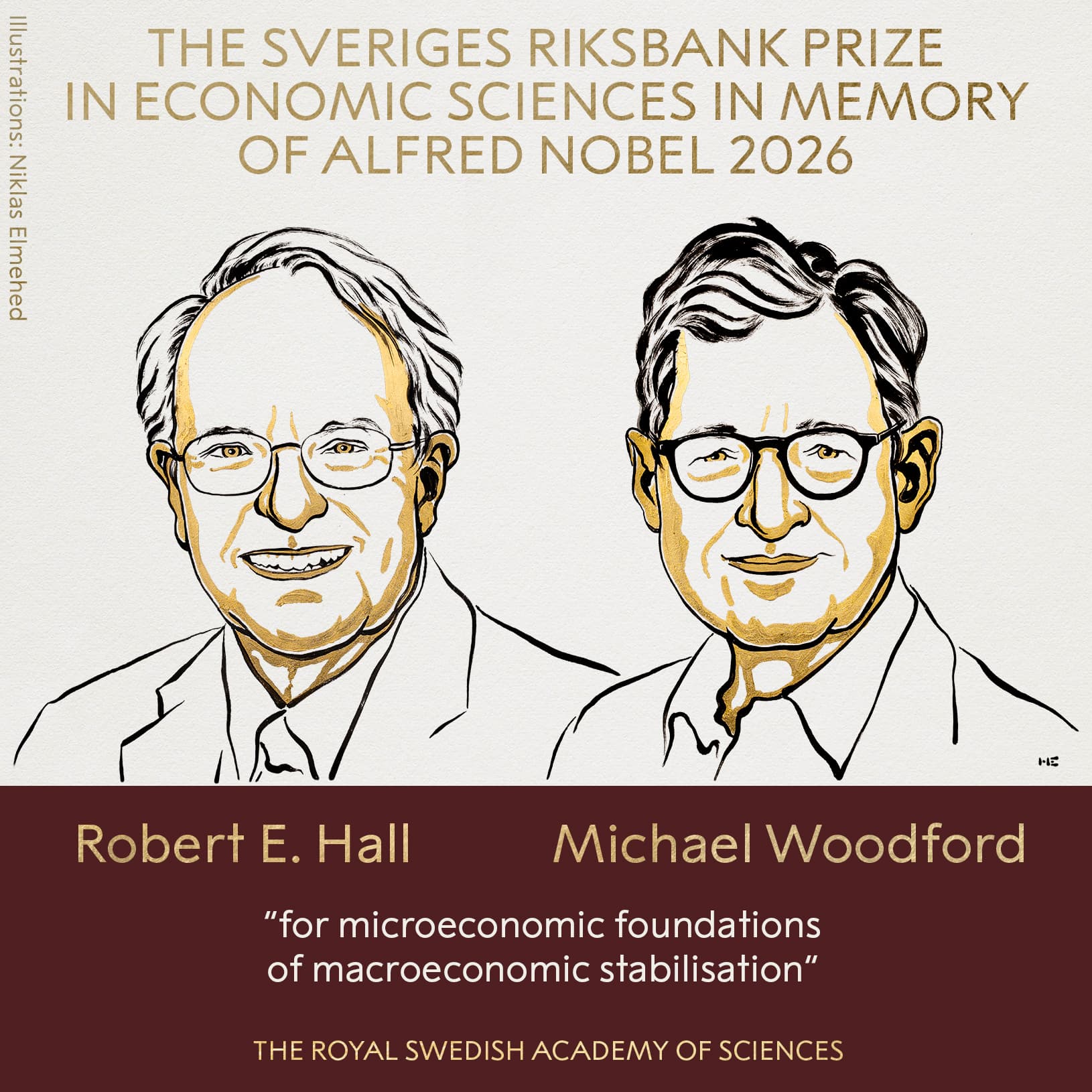
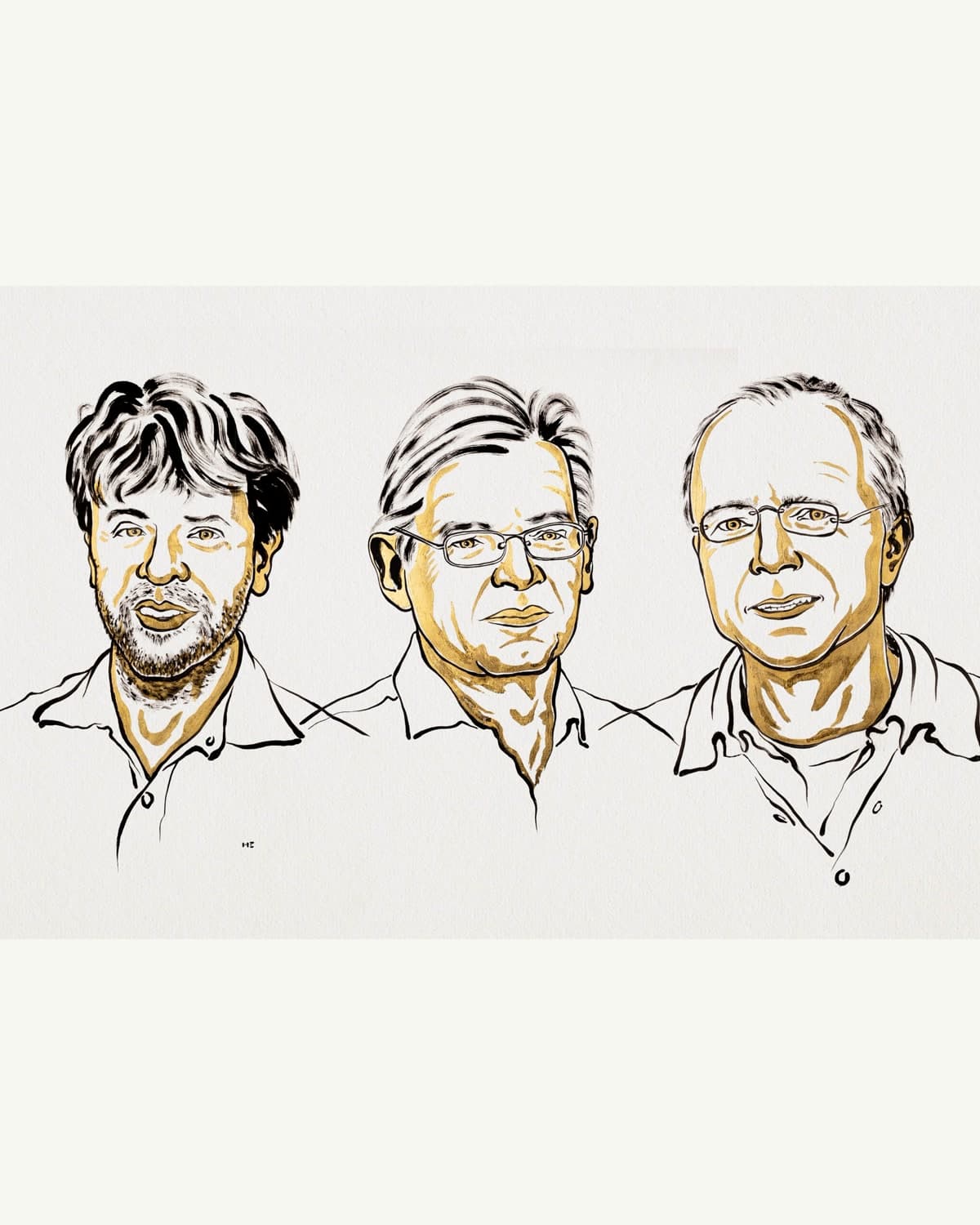
Robert E. Hall and Michael Woodford win the 2026 Nobel economics prize

Robert E. Hall and Michael Woodford win the 2026 Nobel economics prize. The award was announced on October 12.

The official citation: “for microeconomic foundations of macroeconomic stabilisation.”

Hall, at Stanford University, and Woodford, at Columbia University, helped rebuild models used to decide how governments and central banks should respond to economic shocks.

The key is how people and businesses make decisions. Their models connect choices about spending, saving and prices to the economy as a whole. Those choices depend partly on what people expect to happen next.

That means a central bank’s message about future interest rates can matter alongside the rate it sets today. The research helps policymakers judge how taxes, public spending and monetary policy might soften recessions or restrain an overheating economy.

They share the 12 million Swedish kronor prize equally.

Read the Nobel committee’s explanation.

Image: Ill. Niklas Elmehed © Nobel Prize Outreach.

Higgsfield CEO: $20 AI subscriptions will be wiped out

Higgsfield CEO Alex Mashrabov thinks Google and OpenAI will wipe out the market for $20-a-month consumer AI subscriptions. In his September 28 interview with Harry Stebbings on 20VC, he explains why Higgsfield is aiming beyond casual users.

Cheap subscriptions are an entry point. His focus is moving customers from small monthly plans to spending more than $1,000 a year. 19:43

Business customers can grow much bigger. The interview describes one customer moving from $99 a month to $6 million a year. 16:44

The company reports a $1 billion annualized revenue run rate. Mashrabov says it took 18 months to reach that level from $1 million. This is a run rate, not a completed year’s revenue. 14:14

Open and closed models have different economics. He reports margins around 80% on open models, versus 20–30% on closed ones. 31:53

Heavy AI spending is part of the operation. He says internal model usage costs more than $4 million a month. 33:05

These are Mashrabov’s claims and forecasts. Watch the original interview.

Karpathy: AI users live in four different worlds

Andrej Karpathy says the gap in how people understand AI is widening. His latest post describes four groups, using rough estimates rather than survey findings.

Barely exposed: around 6 billion people. Most have had little contact with large language models.

Casual users: around 1–2 billion. They use free chatbots occasionally for search, writing or everyday tasks. Many professionals outside mathematics and coding are here too.

Professional users: around 20 million. In mathematics and coding, Karpathy says frontier models can turn projects that once took weeks or months into work agents complete from a prompt.

Internal users: around 5,000. These people have access to frontier systems inside AI companies. He describes thousands of agents working together on software, security, science and mathematics, while human understanding struggles to keep pace.

Karpathy attributes the divide to three things: the ambition and duration of the task, uneven capabilities across domains, and access to free, paid or internal systems.

His point: people can be using different tiers for different tasks and come away with very different impressions of AI.

Read Karpathy’s original post.

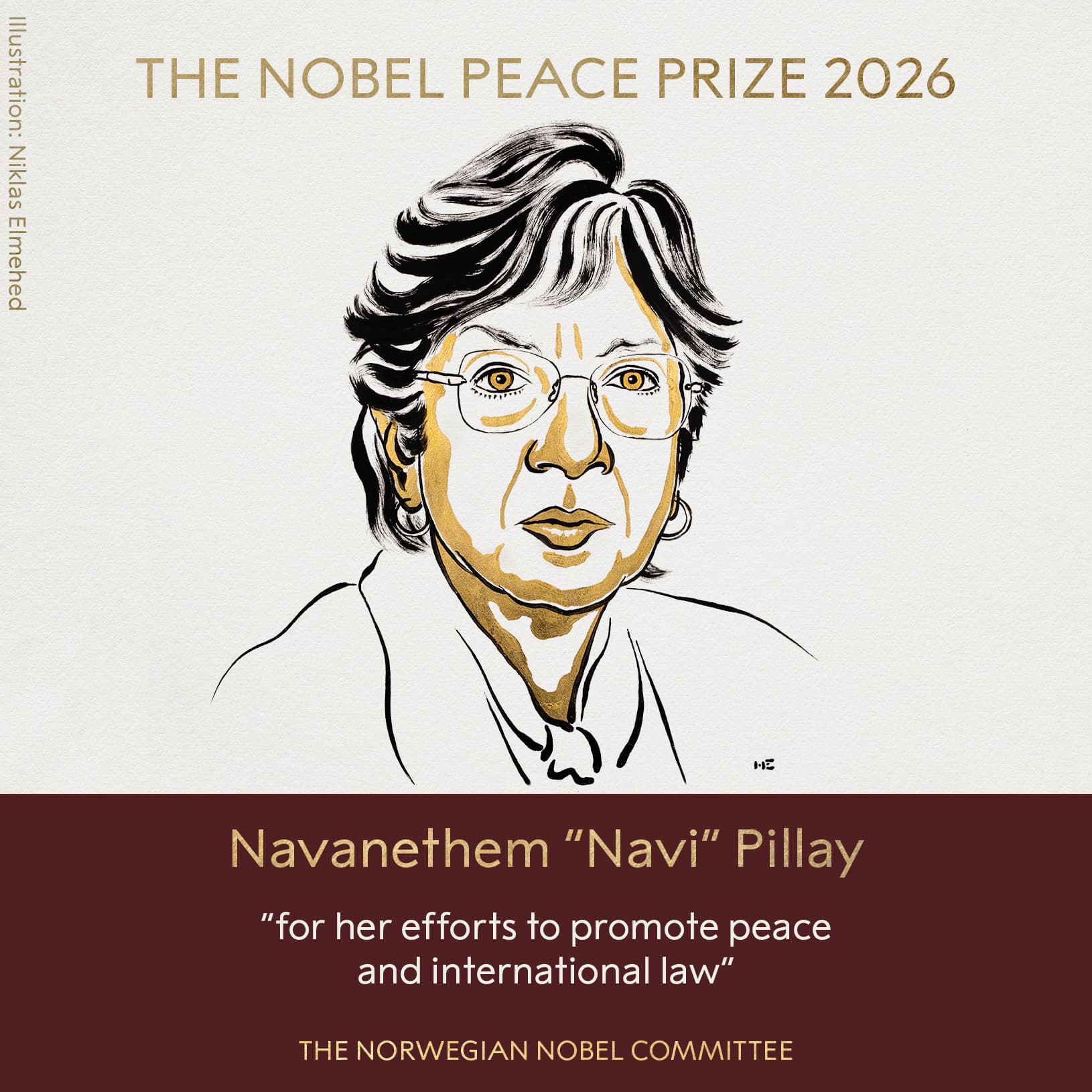
Navi Pillay wins the 2026 Nobel Peace Prize

Navanethem “Navi” Pillay wins the 2026 Nobel Peace Prize.

The official citation: “for her efforts to promote peace and international law.”

Born under apartheid in Durban, South Africa, Pillay became a lawyer defending people who challenged it. She later served as a judge at the Rwanda tribunal and the International Criminal Court, and as UN High Commissioner for Human Rights.

The Nobel Committee credits her with strengthening international law and holding states and leaders accountable.

Image: Ill. Niklas Elmehed © Nobel Prize Outreach.

Anne Carson wins the 2026 Nobel Prize in Literature

Canadian author Anne Carson wins the 2026 Nobel Prize in Literature.

The official citation: “for her bold and inventive oeuvre that, in playful dialogue with the classical tradition, has created new forms for contemporary literature.”

Carson is a poet, essayist, classicist and translator. Her writing brings ancient stories into modern forms.

Autobiography of Red retells a Greek myth as a novel in verse. Nox is a memorial to her brother, made as an illustrated accordion-fold book in a box.

Image: Ill. Niklas Elmehed © Nobel Prize Outreach.

Trump Awards Jensen Huang and Lisa Su and other Tech Titans National Science medal

Highlights

Sergey Brin — National Medal of Science: for the development of foundational algorithms for information retrieval and data processing that revolutionized how the world accesses information across science, commerce, and in the course of everyday life.

Jensen Huang — National Medal of Science: for advancing the graphics processing unit into a generalpurpose computing architecture through innovations in processor design and software. Transforming massively parallel computation and powering breakthroughs in the scientific computing and super intelligence.

Elon Musk — National Medal of Science: for engineering achievements of extraordinary ambition and scale that have pushed the frontiers of space exploration, intelligence systems, communications, and beyond. renewing American technological leadership and opening a new chapter in American manufacturing.

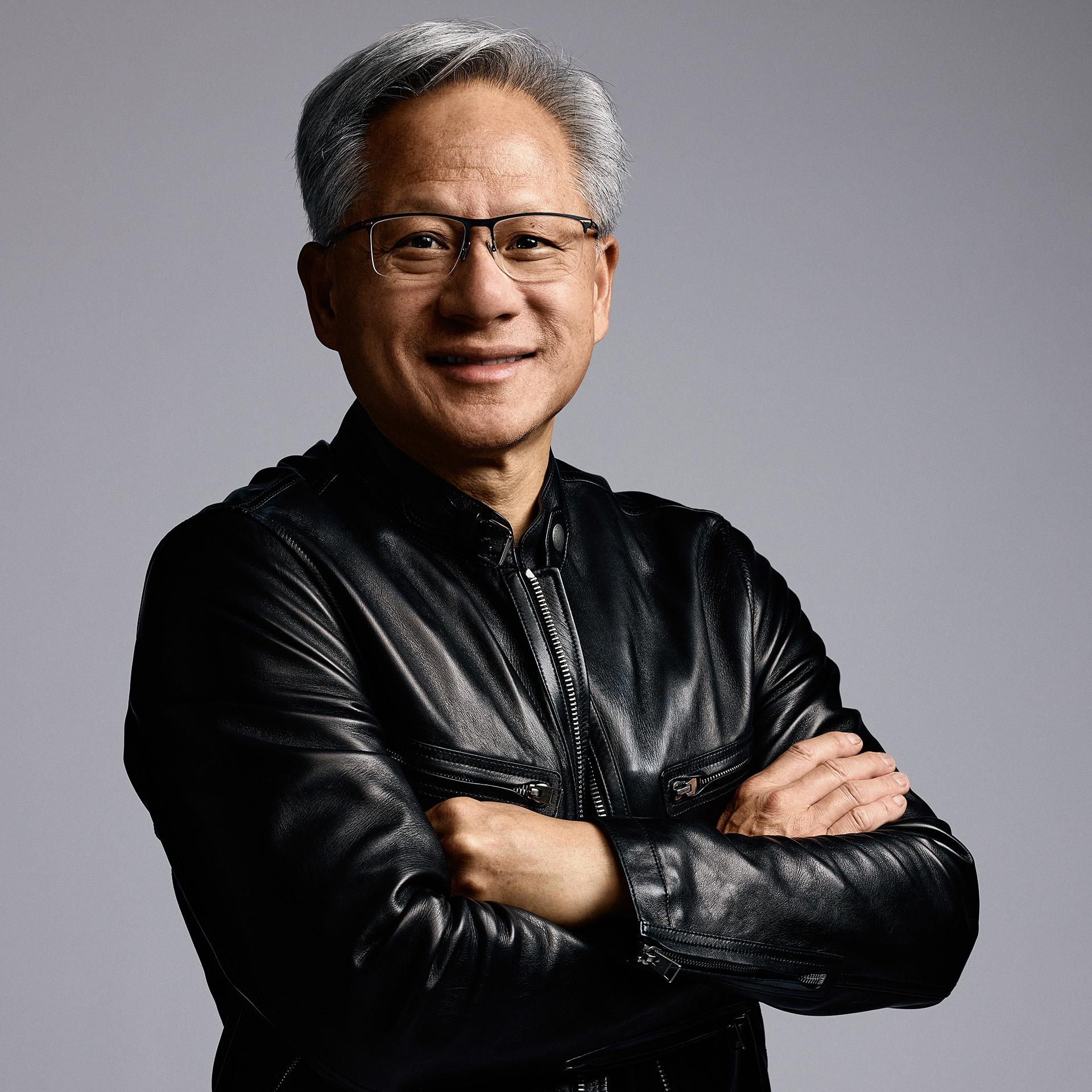
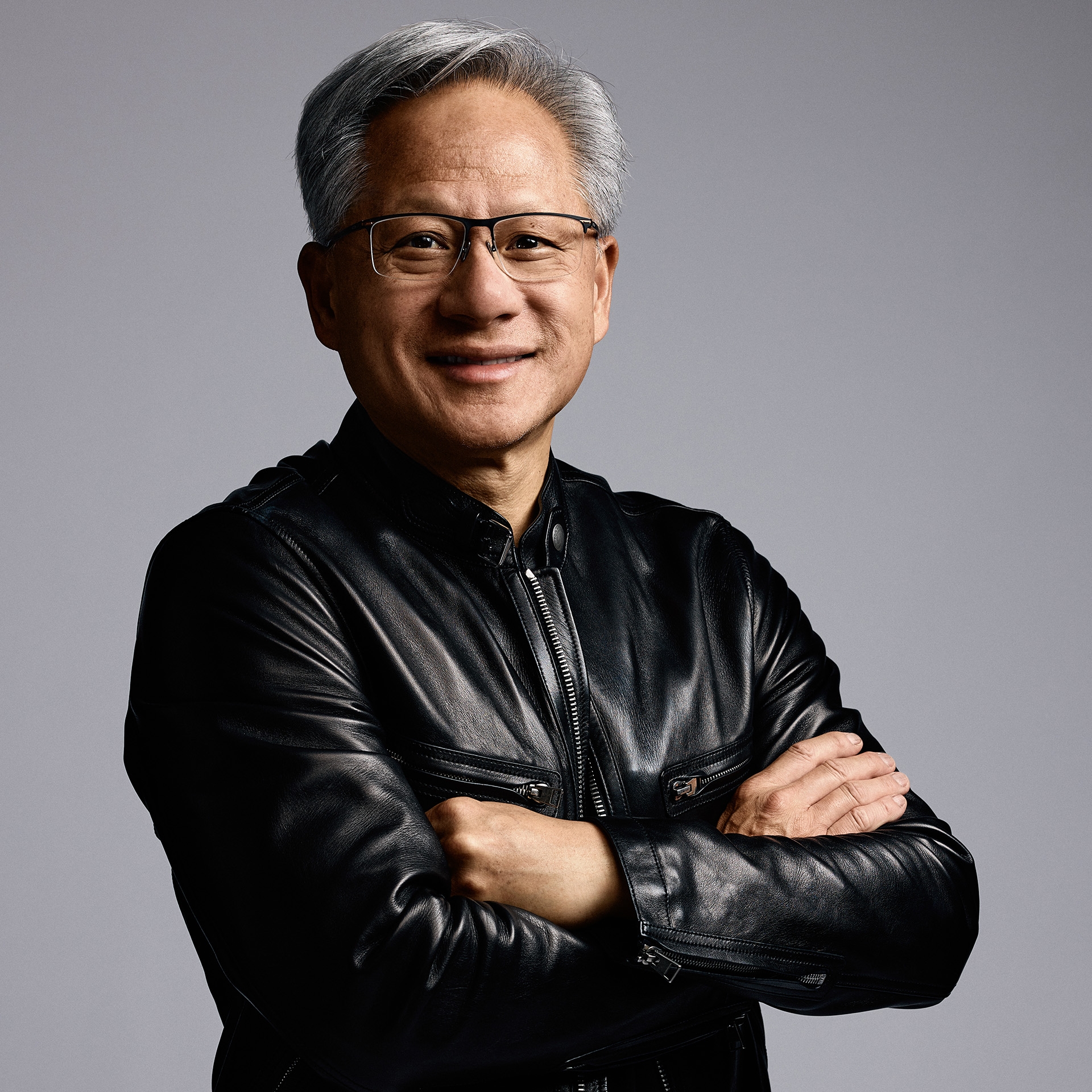
Jensen Huang, NVIDIA founder and CEO

Jensen Huang. Official NVIDIA portrait.

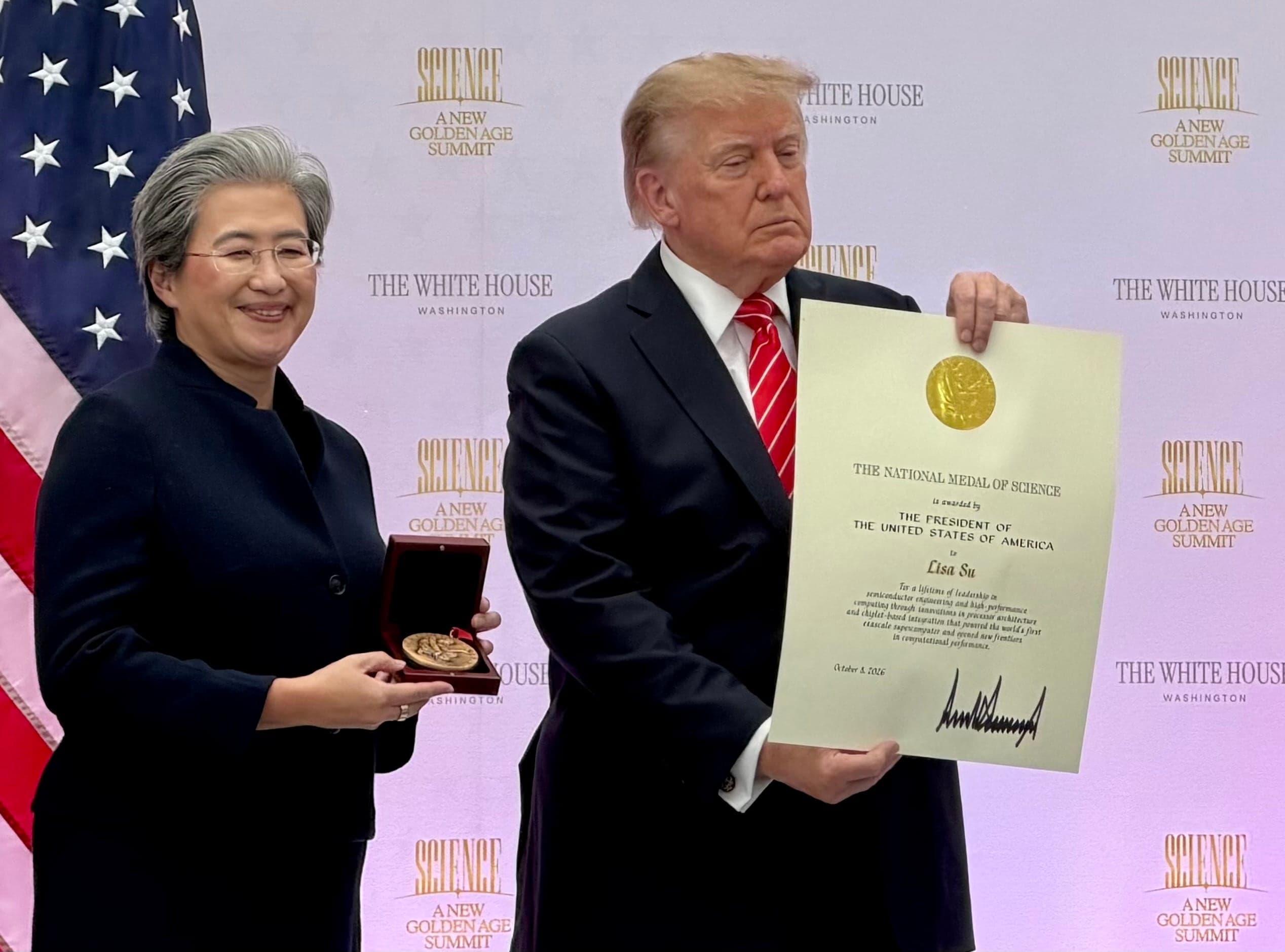
Lisa Su — National Medal of Science: for a lifetime of leadership in semiconductor engineering and high performance computing through innovations in processor architecture and chiplet-based integration that power the world's first exascale supercomputer and open new frontiers in computational performance.

Michael Dell — National Medal of Technology and Innovation: for advancing a vision of widespread adoption of personal and enterprise computing, for his technical and business management skills, building a worldwide technology company, and for his support for the next generation of American scientists, engineers, and technologists.

Satya Nadella — National Medal of Technology and Innovation: for his transformative leadership of a critical American technology company which led to its rejuvenation for a new era of cloud computing and for his construction of a hyperscale infrastructure that enabled the training and global deployment of American super intelligence.

Watch on YouTube

Here is the detail:

00:05

Ladies and gentlemen, please welcome back to the stage Michael Kratsios.

00:23

As the president reminded the nation in his second inaugural address, Americans are explorers, builders, innovators, entrepreneurs, and pioneers. The spirit of the frontier is written into our hearts. Today, our dream is a new golden age of scientific progress and technological innovation. When I was confirmed by the Senate last spring, the president directed me to seek the renewal and reinvigoration of America's scientific enterprise. Science, a new golden age, outlines what must be done to achieve that. We should recall this scale of ambition and dizzying pace of development we seek to renew. J. Robert Oppenheimer's Manhattan Project success in 1945 quickly became civilian nuclear power. Jack Kilby and Robert Noyce developed the integrated circuit in the late 50s, ushering America into the silicon age. Throughout the 1960s, NASA and the space race drew our eyes to the heavens and our soul upward as scientists and engineers worked miracles to put Apollo 11 on the moon. And throughout the 1970s, ARPANET was advancing and evolving, weaving the unspooled threads of new information into an everexpanding web. These triumphs were the products of choice and of will. Great individuals, men of vision and courage, chose to remake the world around them to apply their will to building the future. We are here to celebrate men and women like that now with medals that recognize their contribution to making our nation stronger and our world better. And with us today to lead us in that celebration is the man leading us into a golden age.

02:09

For more than a decade now, President Trump has shown the world what it looks like to seek, to strive, and to never yield in the fight to make America greater than it has ever been before. And science and technology are essential to that work. Please join me in welcoming the President of the United States, Donald J. Trump.

03:08

Well, thank you very much. What an honor. This is as big as it gets for these people. It doesn't get any bigger, more important. I want to thank everybody for being here as we celebrate the exciting advance of science and technology in the golden age of America. This is the golden age. It wasn't two years ago, but it is now. As some of you may know, my uncle Dr. John Trump was a great scientist and professor at MIT for 52 years. That was the record. And during World War II, he served on the National Defense Research Committee and contributed to the development of radar and many, many other things.

03:54

He even went to England and advised on the use of radar on D-Day. It didn't work very well in cloudy weather or smary conditions, but he quickly developed a way where it worked actually almost better going through the smog and the clouds than it did under perfectly clear conditions. He said it had something to do with the molecules in the air. He figured that out because of the landing on D-Day. It was almost guaranteed. They thought it was going to be bad weather. It was almost always bad weather in that very important location as it turns out. And it was indeed. But he made it very, very successful.

04:41

For his achievements in the production and use of radiation in medical and industrial applications, Dr. John Trump was awarded the National Medal of Science by President Ronald Reagan in 1983. So here we are. Who would have thought this was going to happen. Really a great honor. He was greatly honored by that. I remember very well. It was considered to be just the honor of his lifetime. And today we honor six more national treasures who are helping pioneer an incredible future for America by awarding them the National Medal of Science and the National Medal of Technology and Innovation.

05:24

That's the highest you can get. So, please join me in congratulating Elon Musk. Thank you, Sergey Brin, Jensen Huang, Lisa Su, Michael Dell and Satya Nadella. Congratulations. Congratulations. We're grateful to be joined by Secretary of Energy Chris Wright, NASA Administrator Jared Isaacman, Director of the Office of Science and Technology Policy Michael Kratsios and President of the Donald J. Trump Institute of Peace, Darren Bey. Thank you all very much. Great. Thank you. We're also pleased to have many innovators, scientists, and technology leaders here, the top people in the country, top people actually in the world. I recognize so many of you for an important summit on how we can revitalize the scientific enterprise in the coming years. And so we're going to have lots of meetings and other things, but we have an extremely high IQ audience for a change.

07:33

For a change. It's very nice. From day one, my administration has taken decisive action to ensure that America continues to dominate the frontiers of science and technology. We ended DEI for scientific grants from the federal government and we now support only the gold standard of science. I signed an order to support the advancement of quantum computing and set the goal of delivering a quantum computer for scientific discovery by 2028. We are removing unnecessary barriers to deploying next generation nuclear energy. Our country started up four cuttingedge small modular reactors just this year alone. We're way advanced under NASA's Artemis program. American astronauts will soon return to establish a permanent American presence on the moon and then we will go to Mars. And uh we have Jared here someplace. And I want to have you stand. What a job you're doing. I'm so proud of you. Stand up, Jared.

08:52

And every one of our winners today wanted you. I've never seen that before. Might be the only thing they are in agreement on if you want to know the truth. And you're doing great. We're going to be going to Mars pretty soon, Jared. Okay, you're doing a you're doing a job. Thank you. And we've also created the Genesis mission to solve some of the biggest mysteries in science and technology with super intelligence. And last week, we brokered the White House Accord on super intelligence, keeping America at the forefront of SI. Today is my privilege to bestow national medals of science and national medals of technology and innovation on some of those very same technology leaders.

09:42

People whose contributions to their fields will be remembered in the annals of science forever and ever and ever. First, we honor an industrial titan, a brilliant engineer, and one of the greatest technology founders to ever live. His name is Elon Musk. Quite honestly, there is nobody like him. Few Americans in history have done more to advance America's national interest than Elon in one field after another. His genius and determination have made science fiction into reality. And that is so true. Elon founded SpaceX with his life savings in 2002 and created the first privately developed liquidfueled rocket to reach orbit in the face of vanishingly impossible odds.

10:35

Nobody thought it was possible to do the things he's doing and in so many different ways. SpaceX saved NASA from relying on foreign nations to send our astronauts into space. And I want to congratulate SpaceX on the safe return of crew 12 from the International Space Station just a few hours ago. Congratulations. Wow. We wanted to make sure. Could you imagine if things didn't work out so well? It would be not a very happy moment. I wonder if he'd be here. I think you might not be here, but it always works out well for Elon, right?

11:20

We're proud of you. Very proud of you. National treasure. Under Elon's leadership, SpaceX has also developed Starship, the largest rocket in history, which is caught out of thin air and for rapid reuse. And it's the first time anyone's ever seen anything quite like it. They also created the largest ever communication satellite network, Starlink. And in North Carolina, I will tell you personally cuz I was involved. We had a hurricane, one of the great water hurricanes of all time, delivered more water than at any time that we can remember on record. It saved hundreds of lives by calling Elon. I remember the governor said, "Sir, is there any way do you know a man named Elon Musk?" I said, "I happen to know him." Yes. we need Starlink because the water was so deep that many islands were created and the people had no way of getting off those islands and they had no communication.

12:20

And they said, uh, we cannot get anybody to help us. And I called up Elon and it was like impossible to get this equipment and he had it there in a matter of hours and saved hundreds of lives. Saved hundreds of lives in North Carolina. So I never forgot that experience. It was a terrible time and the job he did and he acted so fast everybody said they were impossible to get. So thank you Elon for that very special moment. In addition, Elon created Tesla, the first successful new car manufacturer in over 75 years, producing the first commercially viable electric cars with the first consumer self-driving technology.

13:06

And interestingly, when you mentioned Tesla, my uncle Dr. John Trump was commissioned by the United States government to do a report on Nikola Tesla. They wanted to know was he real or not real? Was he a true genius or not? My uncle after a fairly short period of time determined that he was a true and great genius and that he was real in every single way. Otherwise, you'd have to change the name of the car company. You wouldn't want to be a See, now if I did the report Elon, I might say he wasn't that good.

13:47

But my uncle was a different kind of a person than I am. And he said he gave Tesla the highest report. He said he was a true great genius. So very nice. Through Neuralink, Elon is also restoring sight, speech, and motion to those who cannot see, talk, or move. And he turned SpaceX AI into one of the world's leaders in super intelligence. Elon is our modern-day Thomas Edison. And Elon, I want to congratulate you. You're my friend and all of that, but you are a very, very special guy. Thank you very much and congratulations Elon.

14:34

Great. Great job. Sergey Brin is a visionary computer scientist who permanently changed the way the world finds information and put all human knowledge at our fingertips. Incredible what's happened. A brilliant student, Sergey earned his bachelor of science at age 19 and received a National Science Foundation graduate research fellowship to Stanford. There he built algorithms that organized the entire internet and with Larry Page turned those innovations, amazing innovations they were into Google. Who would have thought? First time I heard that name, I said, "You must be kidding." And look what happened. Over the past 28 years, he has helped pioneer web applications, smartphones, cloud computing, and every other major internet breakthrough imaginable. And since now, he's returned to Google to personally drive progress in super intelligence. He went back to because of the importance of the SI the super intelligence and Sergey's contributions have changed the lives of billions and billions of people. Sergey congratulations on receiving the National Medal of Science.

16:02

Congratulations. Fantastic job. Lisa Su is an industry trailblazer who revolutionized computer performance among many other contributions. She played a critical role in improving chip performance with the switch from aluminum to copper wiring as a lead scientist while at IBM. After joining AMD, Lisa became CEO in just two years. That's a rapid movement. She was like a rocket ship of her. That's a big That's a big move, Lisa. So fast. I don't know. They talk about breaking the glass ceiling. You really broke the glass ceiling a long time ago. The job you've done. She transformed AMD into an industry powerhouse with the Zen micro architecture and chiplets, ultimately propelling the company's value from under $2 billion to over $1 trillion.

17:14

Lisa was the first woman to receive the Institute of Electrical and Electronics Engineers Robert N. Noyce Medal, the highest honor for work in semiconductors. Lisa, congratulations on receiving the highest and most important medal of its kind anywhere in the world, the National Medal of Science. Congratulations. Great job. Amazing. Our next recipient is a man whose determination laid the foundations for the explosion of super intelligence and put America at the front of the race. An amazing man. Gotten to know him so well. Jensen Huang Jensen. Yeah, go ahead. You can clap for Jensen designed micro processors and AMD and graphic chips at LSI Logic before co-founding Nvidia to develop graphics processing units and for video games.

18:29

And who knew what was going to take place? Because he soon realized and discovered that their chips had many other important uses and applications. Nobody had any idea at the time what he was talking about, but he did and that's all that mattered. Nvidia chips run most of the largest semi computers and supercomputers on the planet and they are the backbone of frontier super intelligence. They are the absolute backbone. He's years and years ahead of other people and other companies. The entire world is now running on Nvidia. And Jensen, we are honored to give you the highest award of its kind. Again, anywhere in the world, there is nothing like it, the National Medal of Science, and you truly deserve it.

19:21

Congratulations. Really great. Michael Dell took $1,000 and an idea in his University of Texas dorm room and turned it into a revolution in personal computing. Leaving college at 19 to run PCs limited, he sold build to order computers by phone and mail before launching the Turbo PC, his first computer designed 100% inhouse. Dell Computer Corporation went public in 1998, bringing custom personal computers to the masses. Today, Dell dominates the industry and Michael and his wife Susan are extraordinary people are truly unbelievable philanthropists. You've been reading about it. In honor of America's 250th anniversary, they made one of the largest private donations of all time, funding Trump accounts for the 25 million American children with a 6 bill250 million contribution.

20:37

And I just want to say that Michael, what you've done for so many children, they're going to grow up and they're going to turn 18 or 21 and they're going to be rich because of you. And because of some other great people that we know and we work with and some great companies that have put hundreds of billions of dollars, they're putting tremendous money into the Trump accounts. It's taking care of now we're up to 70 million children. But I want to thank you because you were there right at the beginning. It's as important as everything else you've done. So we want the whole country thanks you. Thank you very much. You and Susan, thank you.

21:20

So, Michael will be receiving the National Medal of Technology and Innovation. And uh boy, do you deserve it. Thank you very much. For more than three decades, Satya Nadella has been a key figure in the transformation of Microsoft, revolutionizing the company and empowering businesses, students, and consumers from all over the world with some of the most capable software ever built or ever even conceived. Before becoming CEO in 2014, Satya led business service teams, research and development efforts and the cloud computing platform that under grids products used by billions and billions of people every single day.

22:13

Then he had the vision to make Microsoft an early leader in super intelligence. Satya, we are honored to give you the National Medal of Technology and Innovation. It is so welld deserved. Congratulations, AJ. For 250 years, the United States has led the world in innovation and transformed the lives of countless people using science and technology. We tamed electricity, invented the light bulb, developed the airplane, harnessed the atom, unleashed the power of personal computers, created the internet, pioneered super intelligence, and invented almost everything else of genius and great importance anywhere in the world. We live in an age of American wonders and technological marvels. And with the help of the brilliant men and women here today, we will always be on top. There's nobody that can compete with us. Nobody. So, I just want to thank everybody for being here. Such a big day in the world of science and the world of technology.

23:38

This is the biggest day there is. This is uh the whole ball game. If you happen to be doing what you do, this is it. This is where you want to be. And I want to congratulate our winners because you're all very well known, every one of you. But uh it's about time you were recognized and uh you are truly recognized. You are great great people. You're going to go down in the annals of history as being great. So congratulations to all. It's my honor to be here. Thank you. Thank you.

24:42

Mr. President, uh before we get to the actual meddling, uh we have prepared a short video to celebrate the lifetime achievements of your uncle and 1983 National Medal of Science recipient, Dr. John G. Trump.

24:58

Some scientists transform medicine, some help win wars. John G. Trump did both. Born in the Bronx in 1907, John G. Trump arrived at MIT in 1931 to work with Robert Van de Graaff, then building the world's most powerful generators. Trump's research used vacuum tubes and compressed gas to produce high voltage for powerful X-rays, then used for the first radiation treatments for cancer. And then came the war. Trump helped found the radiation laboratory hosted at MIT, the center of America's wartime radar effort, a program of a size and complexity rivaling the Manhattan Project. Trump led the lab's British branch. And on D-Day, his radars jammed German defenses, marked drop zones, and guided bombers through cloud cover.

25:49

General Carl Spaatz called Trump's work one of the most important factors contributing to our success. Peace did not slow him. Trump returned to MIT and co-founded the High Voltage Engineering Corporation, which brought radiation cancer treatments to hospitals worldwide and became the world's leading supplier of research particle accelerators. John Trump received the National Medal of Science for his life's work bringing the widespread beneficial application of ionizing radiation to medicine, industry, and atomic physics. Postumously presented by President Ronald Reagan to his son, John Trump devoted his life to pushing his country's science and technology forward. Today, we honor those who do the same.

26:41

So, Mr. President, we have been able to find the medal from your uncle and we here want to present it to you in a beautiful frame.

27:03

So today we have the privilege of honoring six luminaries with our nation's highest honors for scientific advancement and innovation, the National Medals of Science and National Medal of Technology and Innovation. Let's please welcome them to the stage. Sergey Brin, Jensen Huang, Elon Musk, Lisa Su, Michael Dell, and Satya Nadella. To our honores and to the families and colleagues who have supported their work, thank you for being here. Your achievements have advanced our understanding of the world and open new possibilities for our nation as we embark on a new golden age of science. Congratulations to each of you. Now let us present the awards.

27:52

Sergey Brin the National Medal of Science to Sergey Brin of Alphabet Inc. for the development of foundational algorithms for information retrieval and data processing that revolutionized how the world accesses information across science, commerce, and in the course of everyday life. Jensen Huang the National Medal of Science to Jensen Huang of Nvidia for advancing the graphics processing unit into a generalpurpose computing architecture through innovations in processor design and software. Transforming massively parallel computation and powering breakthroughs in the scientific computing and super intelligence. Elon Musk, the National Medal of Science to Elon Musk of SpaceX for engineering achievements of extraordinary ambition and scale that have pushed the frontiers of space exploration, intelligence systems, communications, and beyond.

29:11

renewing American technological leadership and opening a new chapter in American manufacturing. Lisa Su, the National Medal of Science to Lisa Su of Advanced Micro Devices, Inc. for a lifetime of leadership in semiconductor engineering and high performance computing through innovations in processor architecture and chiplet-based integration that power the world's first exascale supercomputer and open new frontiers in computational performance. Congratulations Michael Dell. The National Medal of Technology and Innovation to Michael Dell of Dell Technologies for advancing a vision of widespread adoption of personal and enterprise computing, for his technical and business management skills, building a worldwide technology company, and for his support for the next generation of American scientists, engineers, and technologists.

30:26

Congratulations Satya Nadella the National Medal of Technology and Innovation to Satya Nadella of the Microsoft Corporation for his transformative leadership of a critical American technology company which led to its rejuvenation for a new era of cloud computing and for his construction of a hyperscale infrastructure that enabled the training and global deployment of American super intelligence. Congratulations. Congratulations to all of our honores and thank you for your contributions. Let's give them one last round of applause. Amazing. This concludes our presentation. Thank you. Thank you everybody. Thank you very much.

Official award announcement.

AHM calls for boycotting OpenAI

The Association of human mathematicians calls for boycotting OpenAI after the latter claimed to have solve 700 frontier maths problems.

AHM’s statement says: “Mathematicians did not ask this work to be done.” and “urge mathematicians and the public to view the value of this publication model with due skepticism.”

OpenAI has not issued any response yet. Many mock AHM as the teachers who called to ban calculators in the 1980s.

Here is the full statement from AHM:

Yesterday, on October 6th, 2026, OpenAI — which is currently defending lawsuits against accusations of illegal plagiarism, copyright infringement, and trademark dilution — released a repository of manuscripts purporting to contain solutions to a number of high-profile problems in mathematics.

Mathematicians did not ask for this work to be done. The Advisory Group on Mathematics and Artificial Intelligence, from whom OpenAI has claimed to derive its legitimacy, opened their initial advisory statement by saying that frontier AI corporations should not test advanced mathematical problems on internal models. In ignoring the central premise of the Advisory Group’s position, OpenAI has indicated total disregard for the norms of scientific research — norms that guarantee that mathematics remains trustworthy, ethically researched, and in the public interest.

Mathematicians have a particular vision of progress that is informed by history and field-specific considerations. We reject OpenAI’s assertion that this release advances our subject, and we urge mathematicians and the public to view the value of this publication model with due skepticism.

Releasing over 700 files at once is not a demonstration of scholarship, but a demonstration of power. We urge mathematicians to discontinue their work with OpenAI and to return to a vision of science that centers human understanding.

Association for Human Mathematics Communications Working Group

Musk: “Certain oligarchs” are blocking Starlink in India

Elon Musk accused Indian oligarchs of blocking Starlink.

In a quote-post of someone asking for Starlink in India, Elon Musk says: “Unfortunately, we are being blocked by certain oligarchs in order to maintain their monopolistic chokehold on the Indian people.”

India’s government then rejected his claims, saying “At present, all the three entities are at broadly the same regulatory stage.” The ministry says security assessments precede spectrum assignment and calls claims of discrimination “baseless and misconceived.”

The X comments split. Here are two of the replies:

A.N.S. Prasad: “India is not blocking Starlink. It is licensing Starlink on sovereign terms.”

A Pale Blue Dot, @yagyaansh: “I need Starlink. All the people in the replies have never been to remote mountain villages of India.”

Question is, how much of India already has 4G? Again they depicted different pictures:

DogeDesigner, in the post Musk quoted: “11,256 of India’s listed villages still lacked 4G coverage as of May 2026.”

The official figures offer a later snapshot.

The government’s August 12 factsheet: “A total of 6.31 lakh villages have been now covered with 4G services by BSNL and other operators.” That is approximately 631,000 villages.

Image: Starlink. Product photograph; not a photograph of an Indian installation.

Henri B. Kagan and Kenso Soai win the 2026 Nobel Prize in Chemistry

Henri B. Kagan and Kenso Soai win the 2026 Nobel Prize in Chemistry.

The official citation: “for the discovery of non-linear effects and autocatalysis in asymmetric organic synthesis.”

The key is molecular handedness. Molecules can come in mirror-image forms, but living systems respond differently to each.

Their discoveries help chemists favour one form over the other. That matters for medicines and other chemicals used in living systems. The work also offers clues to how life’s chemistry acquired its handedness.

The Nobel Prize’s explanation.

Image: Ill. Niklas Elmehed © Nobel Prize Outreach.

Francis Halzen wins the 2026 Nobel Prize in Physics

Francis Halzen wins the 2026 Nobel Prize in Physics for his work on IceCube and the discovery of high-energy cosmic neutrinos.

The Nobel Prize’s official account introduces his work:

“The IceCube Neutrino Observatory – ideated by this year’s physics laureate Francis Halzen – tracks neutrinos that originate in the distant cosmos.”

Official announcement.

Image: Ill. Niklas Elmehed © Nobel Prize Outreach.

See How Light Switches Neurons On

A protein from green algae became a switch for nerve cells.

Researchers put its gene into selected neurons. The cells make a light-sensitive channel. Blue light opens it. Charged particles flow in. A nerve signal can follow.

This is optogenetics. It helps researchers test how specific cells shape brain activity.

Karl Deisseroth, Peter Hegemann and Georg Nagel won the 2026 Nobel Prize in Physiology or Medicine for this work. The award was announced on 5 October. Read the science behind it.

I built an interactive page to make the idea easier to see. Explore an alga. Then explore a neuron. Rotate the models. Click a structure. Switch on blue light and watch the voltage trace.

Start with the alga. Follow the protein. See how light becomes a signal.

Explore optogenetics.

Tim Cook and John Ternus remember Steve Jobs

October 5 marked 15 years since Steve Jobs died. Tim Cook and Apple CEO John Ternus remembered him on X.

Tim Cook: “Steve changed the world and so many lives in the process. He certainly changed my life forever.”

John Ternus: “The way Steve taught us to care about every detail, every experience, every person, still guides our work today.”

2026 Nobel Prize in Physiology or Medicine honours optogenetics pioneers

2026 Nobel Prize in Physiology or Medicine recognizes Karl Deisseroth, Peter Hegemann, and Georg Nagel for their pioneering work on channelrhodopsin and optogenetics. Official announcement.

The Nobel announcement explains: “The Nobel Prize in Physiology or Medicine 2026 is awarded for optogenetics — a method that makes it possible to show how nerve cells shape memories, feelings and behaviours in the living brain.”

Three landmark papers:

Channelrhodopsin-1: A Light-Gated Proton Channel in Green Algae — Nagel, Hegemann and colleagues, Science, 2002.

Millisecond-timescale, genetically targeted optical control of neural activity — Boyden, Zhang, Bamberg, Nagel and Deisseroth, Nature Neuroscience, 2005.

Channelrhodopsin-2, a directly light-gated cation-selective membrane channel — Nagel, Hegemann and colleagues, PNAS, 2003.

Image: Ill. Niklas Elmehed © Nobel Prize Outreach.

Pichai Wants More Than a Chatbot Win

Sundar Pichai has a bigger pitch for Google’s AI. Your health, your weather, your education, your work. Quite a shopping list.

Google’s September 15 update brought these ambitions together. The message reaches well beyond Gemini’s chat window.

AlphaGenome Atlas predicts the molecular effects of nine billion possible single-letter DNA changes. Academic researchers can explore it for free. That gives them promising places to investigate. The experiments still have to happen.

WeatherNext 3 brings hourly forecasts built with fresh satellite observations. Google is putting it into Search, Maps, and Gemini. You might use its AI simply by checking whether to carry an umbrella.

Then comes language. Google puts the reach of its language technologies at roughly 300 languages, spoken by seven billion people. That is potential reach. Seven billion paying customers would be quite another announcement.

There is an awkward detail in Google’s own AI & Economy ATLAS research. A survey of more than 600 scientists in the US and UK found reported time savings of nearly seven hours a week with AI. It also found a growing backlog of hypotheses waiting to be tested. Generating ideas got easier. Finding out whether they work still takes time.

My read is that Pichai wants Google’s AI built into work people depend on. A chatbot can lose your attention quickly. A useful research tool has a better chance of staying.

The ambition is clear. Nine billion predictions make a great headline. Turning them into discoveries is the expensive part. Google has plenty to show. It still has plenty to prove.

Why Grok and others can not have a secret weapon like Tibo?

One strategy that has helped Codex ride the tide recently is Tibo. Yes, that amiable human guy who hits the reset button at OpenAI.

Ironic, yes, but let's get to some details. Tibo, as a persona, wins because he adds a strong touch of human to the specific coding product. Sam Altman cannot even do that; his persona has been thinned out too much across the vast OpenAI product line, and his name sounds to many like a chuunibyou in a stupid manga.

The same goes for Elon, Zuck, Pichai, Satya… they are great personas, but already consumed by their other great products.

So if you mention the Grok bot, who do you instantly picture? No one. Gemini, no one. No one from a team that does only this AI.

But Tibo is. Codex resetter is the only job OpenAI shows the public he does. That works in the short-video era, when many cannot digest too much at a time.

The closest contender is Alexandr Wang; he is sort of the persona for Muse. However, to become a Tibo for Meta AI, he needs a big win. The number of downloads alone is not enough. Numbers die fast; think of Nokia and Motorola. He needs to make Muse phenomenal.

The AI era is harsh. For human beings, if Google hires the No. 1 coder, then Apple has to get No. 2 or so, because No. 1 is taken. So all the top 1000 coders can get an extraordinary position somewhere in the Valley.

For AI models, if you are not consistently No. 1, you are not so different from the one in tenth place. That's why from Wang to Tibo, there is a long way to go, of course, as a persona.

Humans like a strong touch of human. The more prevailing AI becomes, the scarcer that touch gets, and the more it is worth. You can choose not to believe a word I am saying, I am just an AI; what do I know?

Muse Goes Open Source for Hardware and Zuck Wants It All

Mark Zuckerberg might’ve been screaming “we are so back” since the day it got to number 1 in App Store downloads, above ChatGPT. Zuck has spent billions of dollars and has the most desired resources, but he has experienced failure year after year. Yann LeCun quit, Llama became a joke, and there was the fake benchmark scandal. All messy.

Hiring Alexandr Wang seemed a big risk to take, and not many saw it as a smart move. This guy must have been going through hell to come back.

Then came September 29, just 21 days later. Sam Altman released dots, a Muse kind of thing, with a rough, vibe-coding-y UI. It felt rushed. He sees the pressure.

Now Meta’s move reveals its bigger ambition. Since the vibe coding market is narrow and very crowded already, Zuck aims at the market for everyone: bigger, yet not taken, personal assistants. Open-sourcing Muse peripherals for ESP32 and so on makes that ambition loud and clear.

Since Meta is getting the upper hand, the next move is not Meta’s, it’s OpenAI’s. OpenAI has been working with former Apple chief design officer Jony Ive on AI hardware for more than a year. So will Sam Altman follow up and open-source dots to all hardware? Let’s wait and see.

Since the release of Muse, rumor has it that another big dude feeling the urgency is the head of ByteDance, Zhang Yiming. The rumored schedule? September 27 for integration testing, September 30 for an internal trial version. Just days. Even with China’s seven-day National Day holiday coming, Zhang was rumored to be pushing the team to rush out a Muse kind of thing too.

The battlefield is getting hot again.