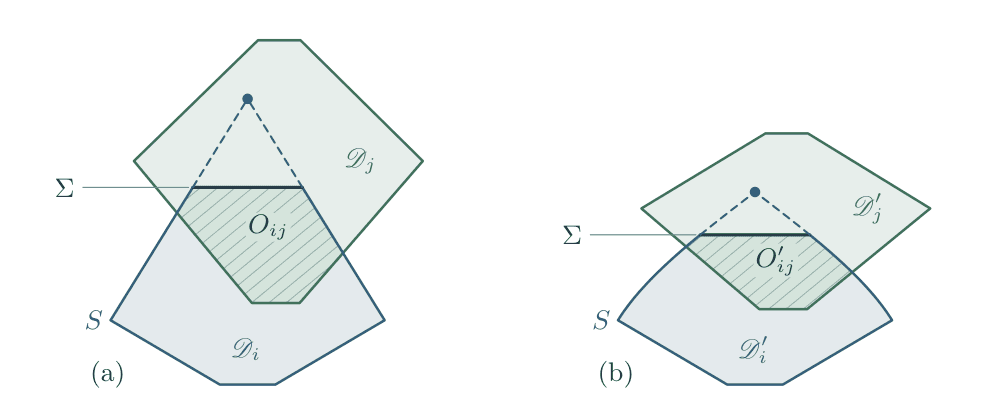
Cover: Overlapping causal diamonds in spacetime, from Figure 10 of Chandrasekaran’s preprint.
An 83-Page Quantum Gravity Proposal, With Help From GPT-6 Astra
Venkatesa Chandrasekaran’s quantum-gravity paper ends with an unusually specific acknowledgment. The Stanford physicist says he spent months working back and forth with GPT-6 Astra on several calculations and proofs, using about 400 million tokens. OpenAI supplied the computing resources. Chandrasekaran is the sole author of the 83-page preprint, which proposes a way to quantize gravity in four-dimensional spacetime. OurNews Live
Start with where light can goIn general relativity, gravity is the curvature of spacetime. Quantizing it means describing that geometry with quantum rules. Many calculations start with a fixed background geometry and treat gravity as small fluctuations around it. Chandrasekaran wants to start with boundaries traced by light instead.
Picture a flash of light spreading from one event and a second light cone tracing what can reach a later event. Where the cones meet, they enclose a region called a causal diamond. Chandrasekaran starts with data on intersecting lightlike surfaces, solves the constraints imposed by general relativity, and builds quantum observables from the remaining variables. The proposal covers vacuum gravity, where there is no matter source in the region being modeled.
A calculation that stays finiteThe preprint tests the construction on the creation and annihilation of a pair of gravitons, the hypothetical quantum particles associated with gravitational waves. Chandrasekaran reports a finite result when he keeps Newton’s constant finite throughout the calculation. Expanding in its powers first produces a divergence in the same example. The paper also recovers a known correction to the entropy of a large Schwarzschild black hole and obtains semiclassical Einstein equations at one loop.
These checks give other physicists specific calculations to reproduce. The preprint has yet to be peer-reviewed, and its starting point is gravity in a vacuum. Extending the approach to include quantum matter is a separate test of how far it can go.


Checking account…
Loading comments…