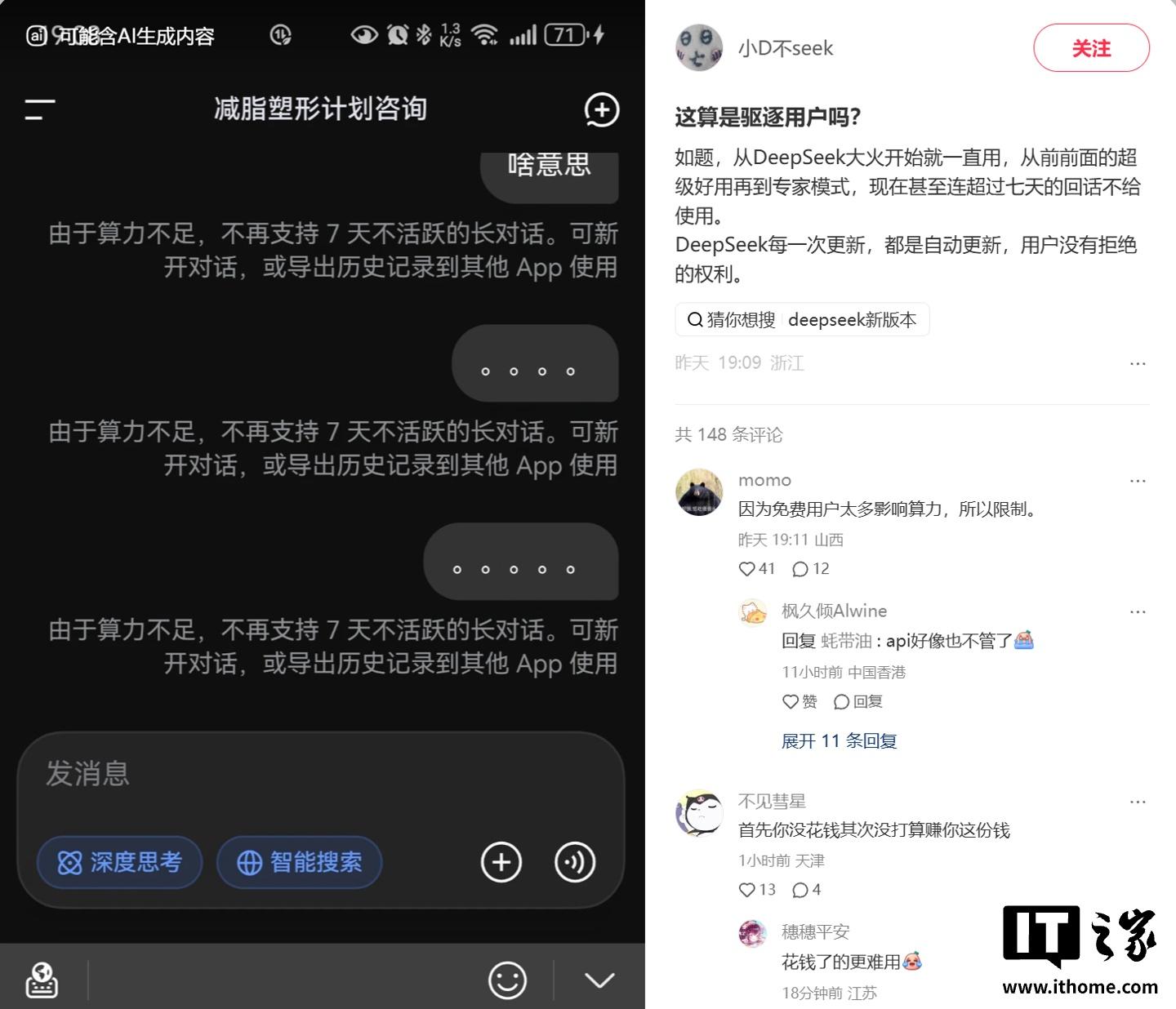
Cover: User-reported DeepSeek notices and reactions, reproduced in IT Home's November 16, 2026 report. These screenshots concern reported consumer-service limits.
China’s AI squeeze: DeepSeek hits limits, Tencent scrambles, Washington tightens the tap
On November 15, some DeepSeek users opened an old conversation and got an unwelcome message: their chatbot could no longer keep the conversation going.
The reason was blunt. Insufficient computing power. Chats left idle for seven days could become unavailable; users were offered a fresh conversation or an export to another app, according to screenshots reported by IT Home on November 16. Some users reported even shorter windows.
Then Washington announced a new squeeze on the overseas chips powering Chinese AI.
The timing practically wrote the viral headline. America closes the loophole. Chinese chatbots run out of juice.
The trouble? The shortages got there first.
Tencent's warning came eleven days earlier.
On November 5, Tencent acknowledged that its new Hy4 model was running into scarce high-end computing capacity and concentrated peak demand. This followed its November 4 arrival in WorkBuddy.
Tencent said it had already expanded the inference cluster tenfold. Ten times the machinery, and users could still hit limits. The company suggested switching to Hy3 or using the service at quieter hours, according to Yicai's report of its statement.
That's the awkward economics of a popular AI launch: every enthusiastic new customer also arrives with a claim on an expensive chip.
There was a bigger headache in the background. On November 4, the Financial Times reported that Oracle had abandoned a roughly $7 billion, five-year arrangement to lease advanced chips to Tencent after US pressure. The proposed capacity involved about 100,000 chips across Southeast Asian data centers, Reuters reported, crediting the FT. Reuters said it could not independently verify the account.
That would be a huge hole in Tencent's expansion plans. It is also a different event from switching off an operating cluster overnight.
Washington is going after the rental counter.
Buying a restricted chip and renting access to one abroad have offered very different routes to the same prize: compute.
The Commerce Department's November 16 announcement targets that overseas access. The public-inspection rule reaches qualifying advanced-chip services supplied to Chinese-controlled customers, including large arrangements exceeding 12 million aggregate total processing performance, or TPP.
TPP is a chip-performance measure. The threshold concerns aggregate capacity, not the number of questions somebody asks a chatbot.
The rule text is scheduled for Federal Register publication on November 19, with effectiveness tied to publication. Existing qualifying remote-compute services get 90 days to obtain a license.
For a Chinese lab counting on an overseas GPU farm, that creates a new dependency. The next training run can depend on an American licensing decision as well as a supplier's delivery schedule.
Qwen and Doubao complicate the blackout story.
Alibaba launched Qwen4-Max on November 16, offering it through its cloud API and other products. A launch can coexist with tight capacity. Still, the specific event that day was a model release, rather than a published notice of a shutdown.
ByteDance has a particularly large overseas exposure in reported plans. In March, the Wall Street Journal reported access through Aolani Cloud in Malaysia to approximately 36,000 NVIDIA B200 chips, according to Reuters' account.
Meanwhile, its workplace product Doubao Work had moved in the opposite direction on November 6: it removed its five-hour usage quota while retaining the weekly allowance, Economic Observer reported. That change concerned Doubao Work, rather than every Doubao service.
The rule also makes a telling distinction. A limited exception for recommendation-only work does not extend to generating text, images or video. Running a recommendation engine and training the next conversational model can land a company on different sides of the licensing line.
The rumor runs faster than the paperwork.
In Radio Free Asia's November 17 report, adviser Lin Xiumin predicted that losing offshore compute could quickly produce capacity and memory problems. It was a forecast of what the squeeze could do.
DeepSeek's warning and Tencent's tenfold expansion show how little spare room some services already had. Washington is now adding a licensing clock to that pressure.
The next revealing development will be painfully practical: which overseas suppliers secure licenses, which customers get less capacity, and which model teams have to start rationing their ambitions.





Checking account…
Loading comments…