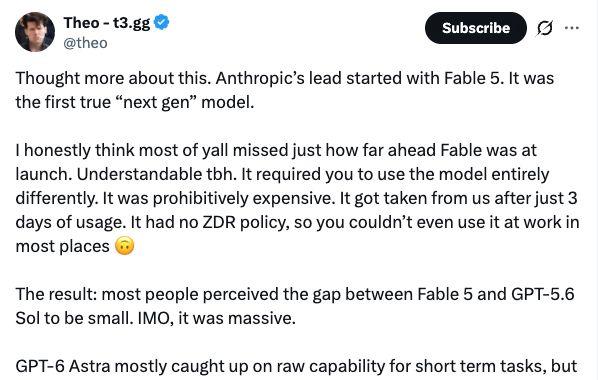
Cover: The opening of Theo Browne's original November 18, 2026 X post, shown as the source document for his argument.
Theo’s OpenAI complaint: the benchmark wins, the coding session loses
OpenAI arrived with cheaper tokens and a new scoreboard. Theo Browne wanted to talk about what happens after a coding agent has been left working for a while.
On November 18, the developer and T3 founder posted his verdict on X: “Anthropic’s lead started with Fable 5.”
His argument is sharper than a preference for one chatbot's personality. He thinks developers underestimated a jump in capability because the first version was awkward to buy, difficult to deploy at work and demanding to use well. Then Opus made more of that experience practical.
Here are the useful takeaways from his full post.
The first leap was easy to miss. Browne argues that Fable 5 demanded a different way of working. High cost, restricted access and the lack of a zero-data-retention policy at the time limited how much people could actually try it. In his telling, an adoption problem disguised a capability lead.
A short task can flatter a model. He says GPT-6 Astra largely caught up on short-task capability, while Anthropic's models stayed more coherent through long runs. That's the distinction at the center of his criticism: getting an answer and sustaining a complicated job are different experiences.
Opus made the fancy stuff usable. He credits Opus 5.5 with bringing more of Fable's strengths to everyday users through lower cost, more generous subscription limits and enterprise suitability.
Readable work is part of the product. His complaint about OpenAI is that benchmark progress has come with a less coherent, less readable working experience. That is Browne's assessment of the models, not a controlled head-to-head result.
The replies exposed a familiar developer fault line. Some readers described Fable as their personal breakthrough. Others pushed back on the tidy history, pointing to readability complaints and regressions in Anthropic's own releases. Even the fan club has a bug tracker.
The price sheet adds a complication.
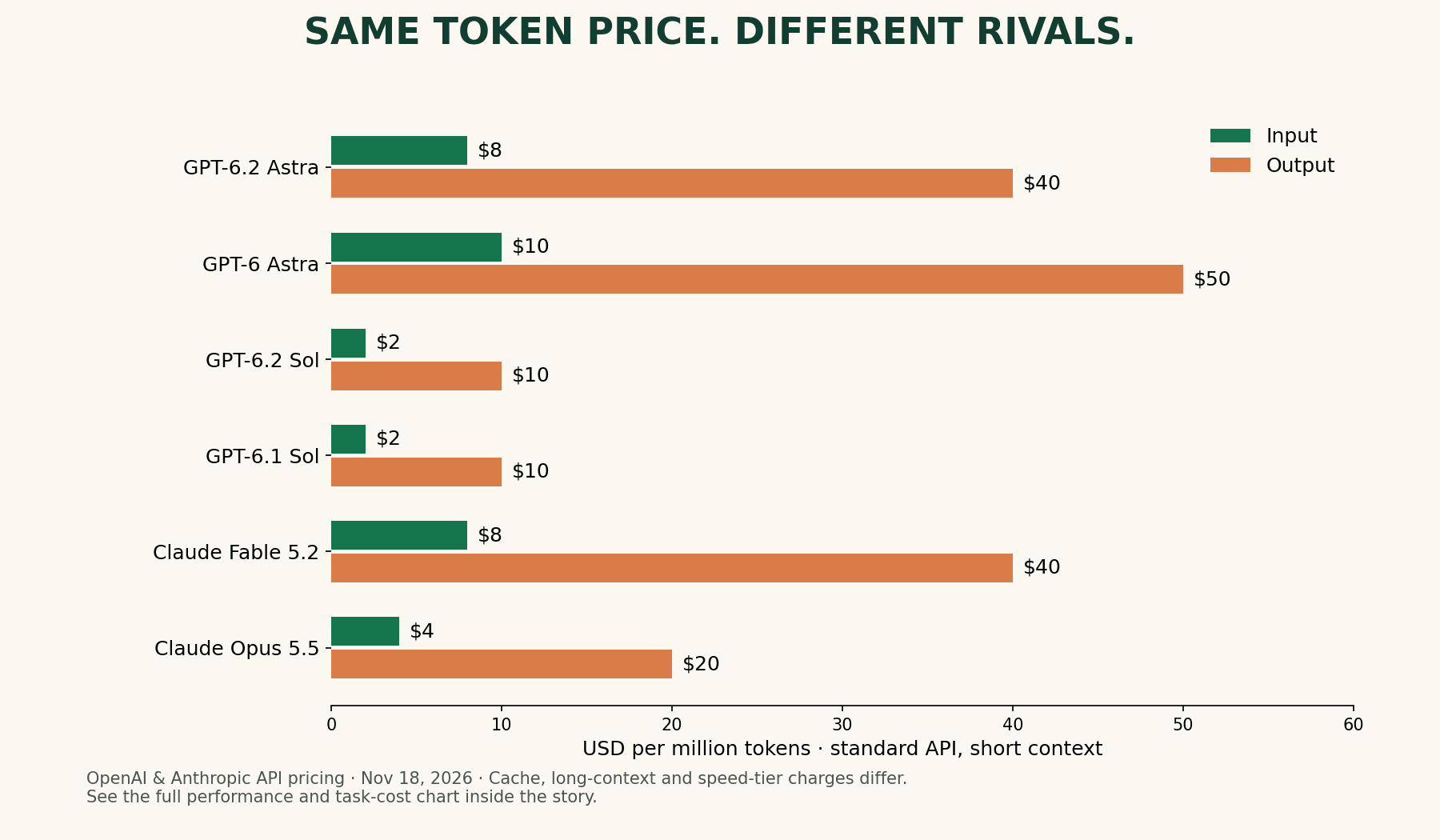
At current standard API rates, Sol 6.2 costs $2 per million input tokens and $10 per million output tokens. Astra 6.2 costs $8/$40. Anthropic lists Opus 5.5 at $4/$20 and Fable 5.2 at $8/$40. These are input/output token rates, not subscription allowances or a prediction of the bill for a completed project.
That leaves Sol with a tempting opening: half Opus's token rates. But a cheaper agent that needs more steering can hand the saving back in developer time. Conversely, paying for the model you enjoy using does not guarantee it will finish a particular task faster.
Our release comparison puts the published scores and prices side by side. Browne is arguing about the part the charts struggle to price: how much babysitting the agent requires once the job gets messy.
For teams choosing a coding model, his post suggests a better audition than a clever one-shot prompt. Give it the long, irritating task. See whether it keeps the plan straight, leaves readable changes and tells you when it gets stuck.
The demo gets applause. The unattended afternoon gets the renewal.



Checking account…
Loading comments…