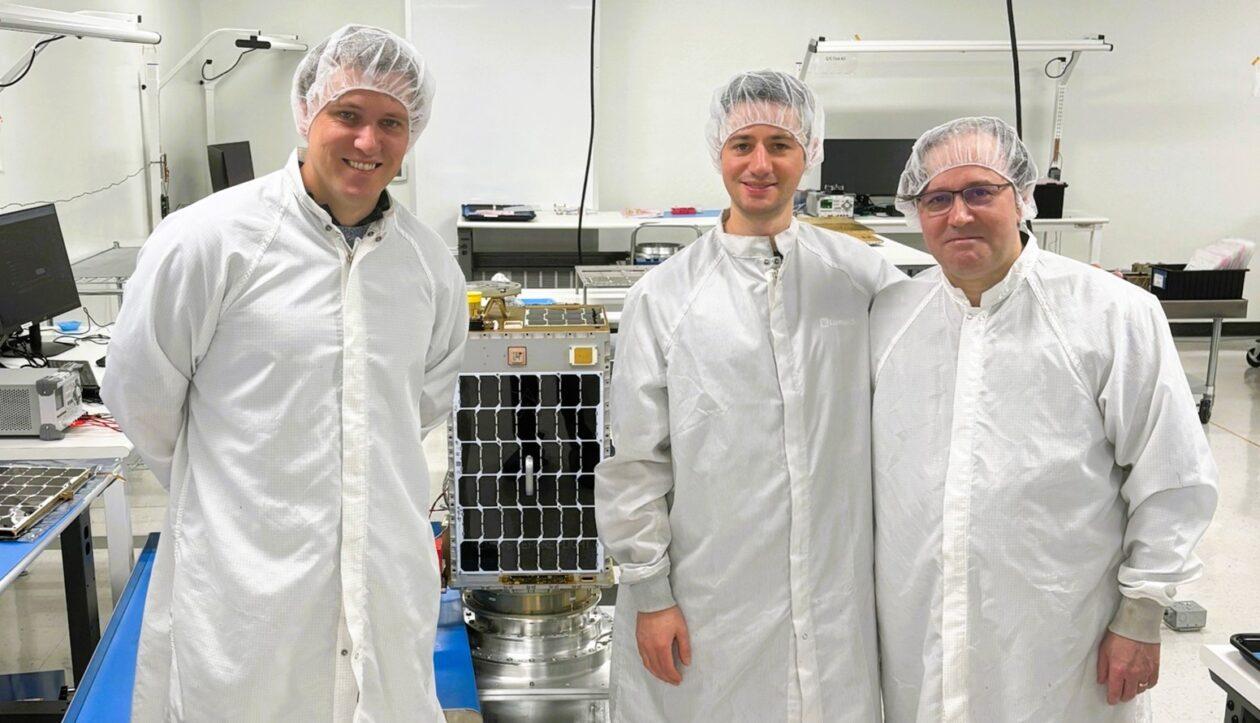
Cover: Starcloud’s founders with the company’s first satellite. Photo from Starcloud via GeekWire.
Starcloud’s CEO Says LeCun Used the Wrong Radiators
“The laws of physics are not the problem here. The assumptions are,” Starcloud CEO Philip Johnston wrote on X. He was replying to Yann LeCun’s estimate that a single GPU rack in space would need about five metric tons of radiators.
Take the two numbers Johnston challenged. LeCun’s five-ton estimate across 100 square meters works out to about 50 kilograms per square meter. Johnston pointed to past NASA studies of two-sided radiator panels at about 3.7 kilograms per square meter. He also argued a satellite cooling chips can run its radiators hotter than a cooling loop built for a crewed station. Hotter panels can shed more heat from the same area, if the coolant returning to the chips stays within their temperature limits.
Together, those assumptions led Johnston to sketch an entire spacecraft at about three metric tons or less. At a future launch price of $100 per kilogram, that would put the launch at roughly $300,000. He compared that with about $630,000 for five years of power and cooling for a comparable rack on Earth at 10 cents per kilowatt-hour. Those figures cover different parts of the bill. A full comparison would also have to count the spacecraft, the computing equipment and what it costs to keep both running.
Starcloud has already flown an Nvidia H100. The next test for Johnston’s argument is how light the complete cooling system can stay when it has to handle a full rack.

Checking account…
Loading comments…