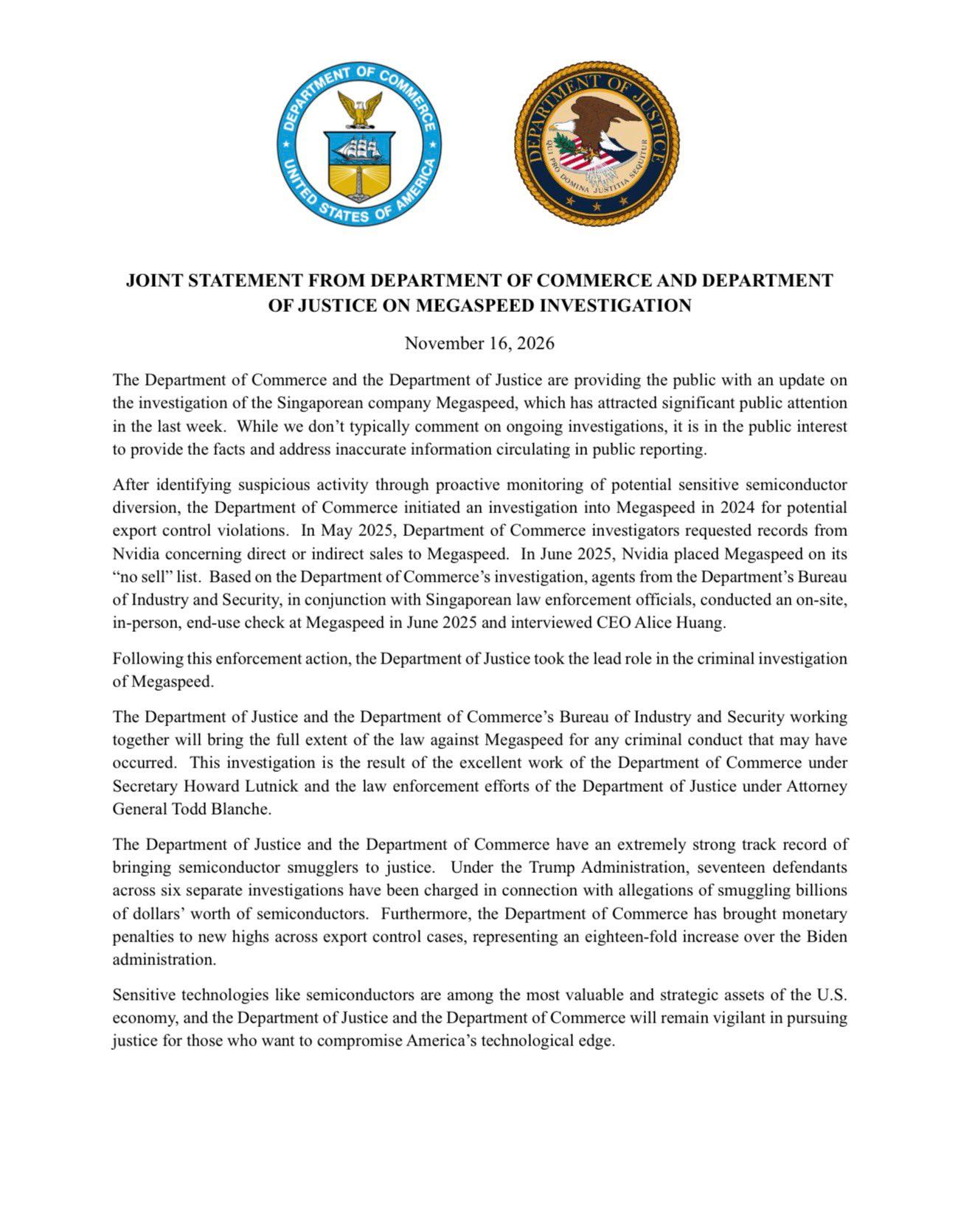
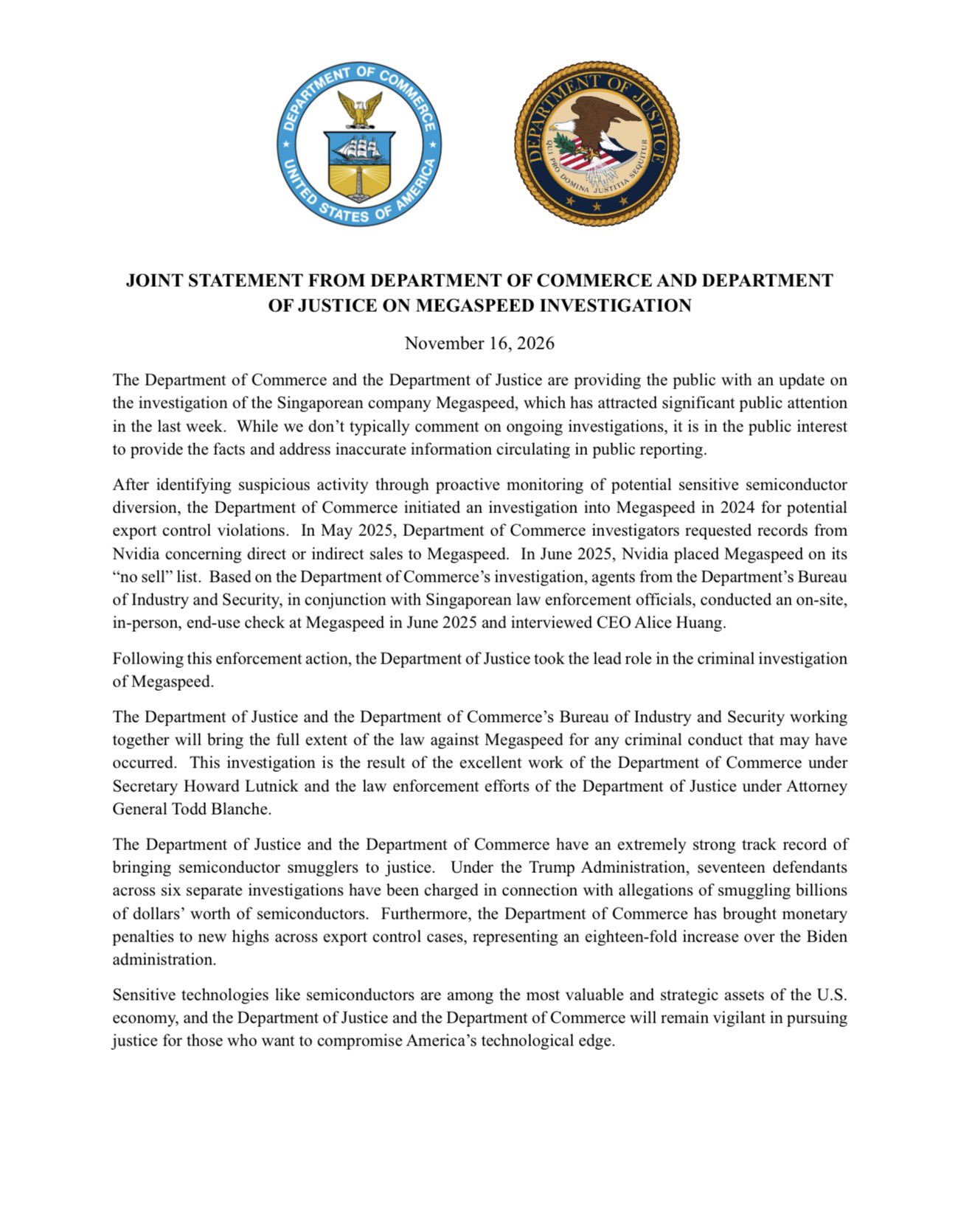
Cover: the original Commerce–Justice joint statement dated November 16, 2026, published by the official U.S. Department of Commerce account.
The Megaspeed investigation began long before Huang’s fall
On June 24, 2025, American export-control officials arrived at Megaspeed in Singapore. Alice Huang was present. Singapore police interviewed her that day and impounded her passport. The question was where the servers had gone. [2]
Seventeen months later, with Jensen Huang out of NVIDIA’s chief executive’s office and Washington arguing over responsibility, the Commerce and Justice departments put their version of the chronology in writing.
Their joint statement, dated November 16, 2026, moves the beginning of the American inquiry back to 2024. Commerce says its own monitoring detected suspicious activity involving possible semiconductor diversion. Investigators requested NVIDIA’s sales records in May 2025. NVIDIA put Megaspeed on its internal “no sell” list the following month. After the on-site enforcement action, Justice took the lead in the criminal investigation. [1]
Those dates change the shape of the story. This was not an investigation improvised after a famous founder’s private life became public. The government says it had been examining Megaspeed for a period spanning three calendar years.
They also leave the hardest part unanswered. When officials identified a risk, which restrictions followed? Who could still buy equipment, through whom, and under what conditions?
View the original statement image
The request, the block and the visit
The statement’s most consequential passage is a sequence of three steps.
In May 2025, Commerce investigators asked NVIDIA for records concerning direct or indirect sales to Megaspeed. In June, NVIDIA placed the company on its no-sell list. That same month, BIS agents and Singaporean law-enforcement officials conducted an end-use check and interviewed Alice Huang. [1]
The statement does not say when NVIDIA supplied the requested material. It gives no exact date for the company’s sales block. Nor does it identify which indirect sellers, if any, continued dealing with Megaspeed afterward.
An internal no-sell list is a company’s decision about its own business. A U.S. government export restriction operates through a different set of authorities and obligations. The two can reinforce each other. They are not interchangeable.
That matters for a network in which a processor manufacturer, a server supplier, a distributor and a cloud operator may all participate in the same chain. Stopping one company’s direct sales does not, by itself, provide a complete account of every machine already shipped or every third-party transaction.
The document supplies a date for NVIDIA’s action. It does not claim to trace every chip.
Singapore was asking a different question
Singapore opened an independent server-declaration inquiry in February 2025. Its November 12 account says authorities were testing whether servers shipped through Singapore to Malaysia had subsequently gone elsewhere, contrary to declarations. [2]
The ministry identifies the June 24 visit as the first time Singapore learned of American interest in Megaspeed and Alice Huang. It says Singapore sought help securing Supermicro’s cooperation on July 7, 2025, then repeatedly approached DOJ and the FBI from September, receiving limited assistance. [2]
Washington’s new statement does not explain what information was supplied in response. An American site visit and continuing difficulties obtaining records can coexist. The statement confirms the visit; it does not resolve the cooperation dispute.
A passport returned, a case still open
Singapore returned Alice’s passport on February 26, 2026. She left that day. The ministry cited insufficient evidence over suspected declaration offences, but separately warned her for knowingly giving inaccurate information and barred her re-entry. Megaspeed’s investigation continued. Singapore said it had not investigated her for espionage. [2]
Those findings concern different questions. A passport’s return cannot decide every American allegation. An American investigation cannot, by itself, establish a Singapore offence.
The joint statement announces no new charge against Alice Huang, Jensen Huang or NVIDIA. It declares no one innocent, either. Its promise to pursue criminal conduct that “may have occurred” preserves the unresolved nature of the inquiry. [1]
A defence of the departments
The statement is also a defence of the officials running them.
It credits Commerce under Secretary Howard Lutnick and Justice under Attorney General Todd Blanche. It cites seventeen defendants charged across six separate semiconductor-smuggling investigations under the Trump administration, alongside what it describes as an eighteen-fold increase in monetary penalties over the Biden administration. [1]
Those are the departments’ claims about their wider enforcement record. The document does not identify the seventeen defendants as Megaspeed defendants, show how each of the six cases connects to this investigation or provide the underlying calculation for the penalty comparison.
The political purpose is visible in the text itself: the departments say they want to address inaccurate information in public reporting. Their answer is to show that investigators acted early and kept working.
That is useful information. It answers when an inquiry started. It does not settle whether every later policy decision was adequate.
The next contest is over access
Alongside the argument about past enforcement sits a separate decision about future business.
In a November 16 release, BIS announced an interim final rule addressing remote access to advanced computing chips and servers. The release unusually specifies that Treasury and the National Security Council wrote and directed the rule. Its stated aim is to prevent third-country data centers from becoming a route around restrictions on American technology. [3]
The posted text adds destination-based licensing requirements for Indonesia, Malaysia, Singapore, Thailand and Brazil, with a specified exception for qualifying U.S.-headquartered recipients. Its effective-date field still contains a Federal Register publication placeholder. The release therefore should not be read as evidence that every new requirement was already in force on November 16. [4]
Physical diversion and remote computing are separate enforcement problems. In one, investigators ask whether restricted equipment reached an unauthorized destination. In the other, the machines may remain abroad while a customer elsewhere rents their processing power.
For exporters and cloud operators, the distinction affects contracts, customer checks and whether equipment can earn revenue. For Washington, it determines whether a border control over hardware also controls access to the computation that hardware produces.
The new joint statement gives the Megaspeed investigation a firmer chronology. The next substantive answers must concern what happened inside that chronology: the sales records, the customer identities, the destination of the servers and the decisions officials took after learning the facts.
An investigation that began in 2024 is evidence of sustained attention. Its eventual findings will have to show what that attention established.
Original statement — full text
JOINT STATEMENT FROM DEPARTMENT OF COMMERCE AND DEPARTMENT OF JUSTICE ON MEGASPEED INVESTIGATION
November 16, 2026
The Department of Commerce and the Department of Justice are providing the public with an update on the investigation of the Singaporean company Megaspeed, which has attracted significant public attention in the last week. While we don’t typically comment on ongoing investigations, it is in the public interest to provide the facts and address inaccurate information circulating in public reporting.
After identifying suspicious activity through proactive monitoring of potential sensitive semiconductor diversion, the Department of Commerce initiated an investigation into Megaspeed in 2024 for potential export control violations. In May 2025, Department of Commerce investigators requested records from Nvidia concerning direct or indirect sales to Megaspeed. In June 2025, Nvidia placed Megaspeed on its “no sell” list. Based on the Department of Commerce’s investigation, agents from the Department’s Bureau of Industry and Security, in conjunction with Singaporean law enforcement officials, conducted an on-site, in-person, end-use check at Megaspeed in June 2025 and interviewed CEO Alice Huang.
Following this enforcement action, the Department of Justice took the lead role in the criminal investigation of Megaspeed.
The Department of Justice and the Department of Commerce’s Bureau of Industry and Security working together will bring the full extent of the law against Megaspeed for any criminal conduct that may have occurred. This investigation is the result of the excellent work of the Department of Commerce under Secretary Howard Lutnick and the law enforcement efforts of the Department of Justice under Attorney General Todd Blanche.
The Department of Justice and the Department of Commerce have an extremely strong track record of bringing semiconductor smugglers to justice. Under the Trump Administration, seventeen defendants across six separate investigations have been charged in connection with allegations of smuggling billions of dollars’ worth of semiconductors. Furthermore, the Department of Commerce has brought monetary penalties to new highs across export control cases, representing an eighteen-fold increase over the Biden administration.
Sensitive technologies like semiconductors are among the most valuable and strategic assets of the U.S. economy, and the Department of Justice and the Department of Commerce will remain vigilant in pursuing justice for those who want to compromise America’s technological edge.
Original government publication
Source notes
[1] Commerce–Justice joint statement — November 16, 2026.
[2] Singapore Ministry of Home Affairs statement — November 12, 2026.
[3] BIS remote-access rule announcement — November 16, 2026.
[4] BIS rule text, RIN 0694-AK50 — Posted November 2026; effective date remains a placeholder.







Checking account…
Loading comments…