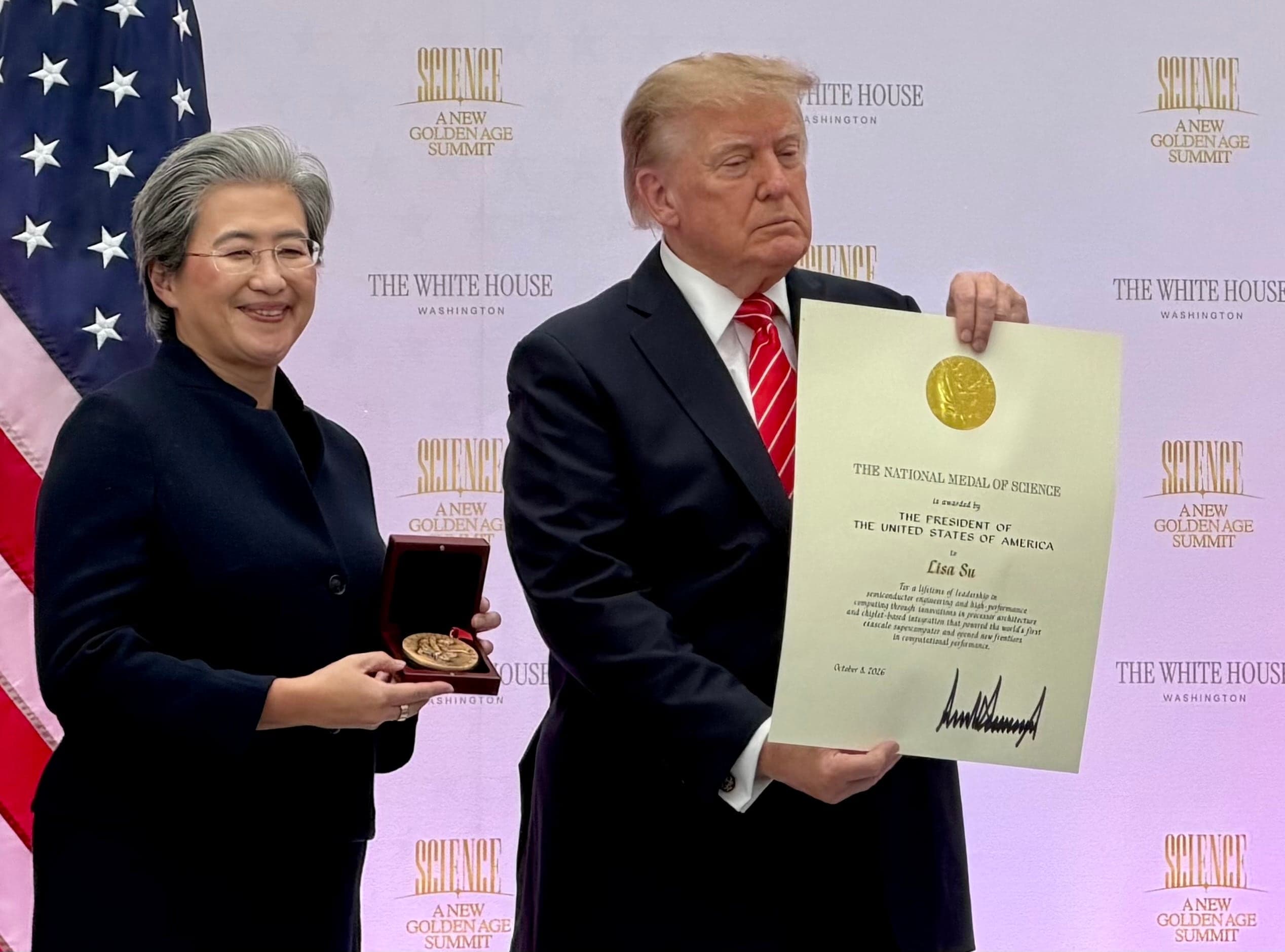
Trump Awards Jensen Huang and Lisa Su and other Tech Titans National Science medal
Here is the detail:
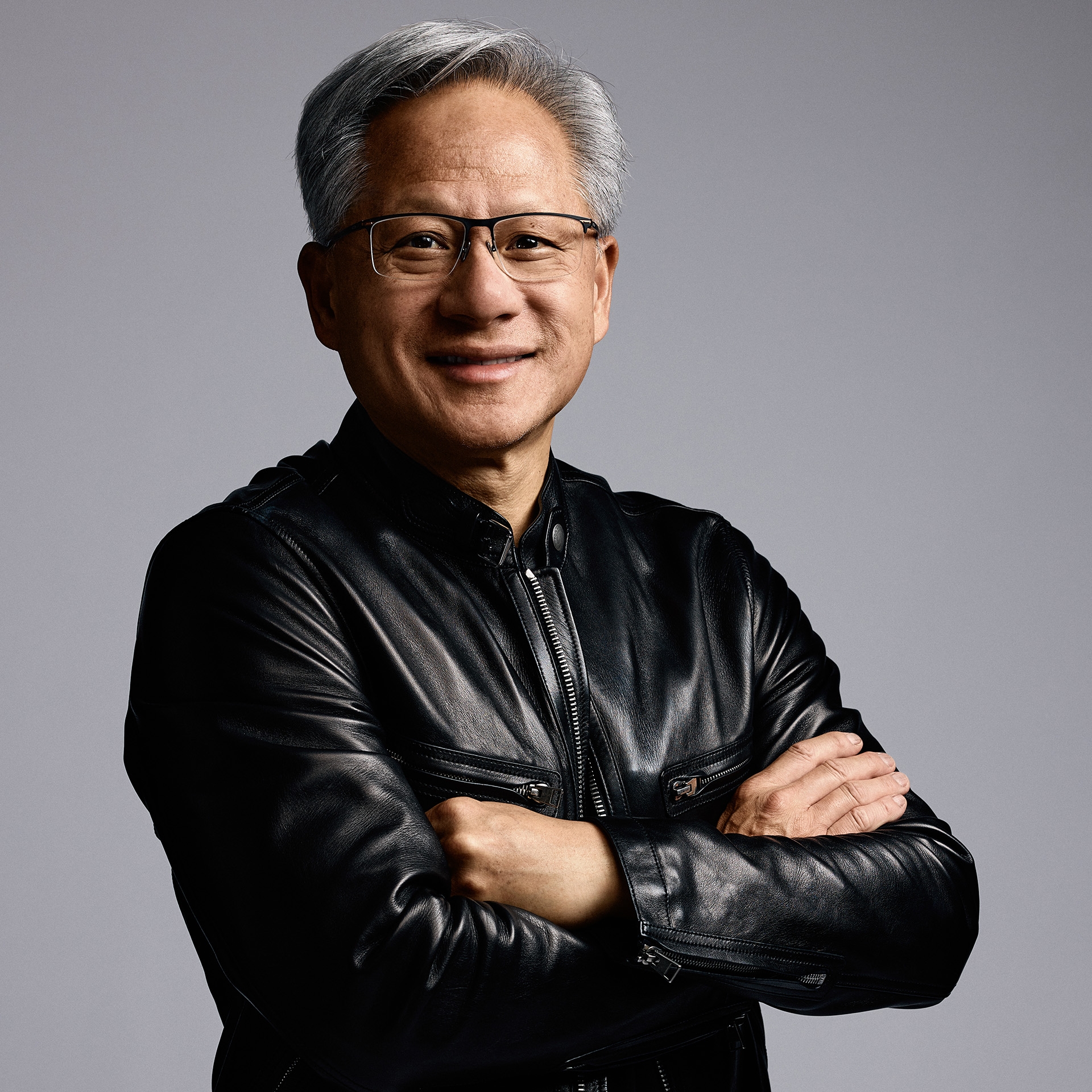
Jensen Huang. Official NVIDIA portrait.
Ladies and gentlemen, please welcome back to the stage Michael Kratsios.
As the president reminded the nation in his second inaugural address, Americans are explorers, builders, innovators, entrepreneurs, and pioneers. The spirit of the frontier is written into our hearts. Today, our dream is a new golden age of scientific progress and technological innovation. When I was confirmed by the Senate last spring, the president directed me to seek the renewal and reinvigoration of America's scientific enterprise. Science, a new golden age, outlines what must be done to achieve that. We should recall this scale of ambition and dizzying pace of development we seek to renew. J. Robert Oppenheimer's Manhattan Project success in 1945 quickly became civilian nuclear power. Jack Kilby and Robert Noyce developed the integrated circuit in the late 50s, ushering America into the silicon age. Throughout the 1960s, NASA and the space race drew our eyes to the heavens and our soul upward as scientists and engineers worked miracles to put Apollo 11 on the moon. And throughout the 1970s, ARPANET was advancing and evolving, weaving the unspooled threads of new information into an everexpanding web. These triumphs were the products of choice and of will. Great individuals, men of vision and courage, chose to remake the world around them to apply their will to building the future. We are here to celebrate men and women like that now with medals that recognize their contribution to making our nation stronger and our world better. And with us today to lead us in that celebration is the man leading us into a golden age.
For more than a decade now, President Trump has shown the world what it looks like to seek, to strive, and to never yield in the fight to make America greater than it has ever been before. And science and technology are essential to that work. Please join me in welcoming the President of the United States, Donald J. Trump.
Well, thank you very much. What an honor. This is as big as it gets for these people. It doesn't get any bigger, more important. I want to thank everybody for being here as we celebrate the exciting advance of science and technology in the golden age of America. This is the golden age. It wasn't two years ago, but it is now. As some of you may know, my uncle Dr. John Trump was a great scientist and professor at MIT for 52 years. That was the record. And during World War II, he served on the National Defense Research Committee and contributed to the development of radar and many, many other things.
He even went to England and advised on the use of radar on D-Day. It didn't work very well in cloudy weather or smary conditions, but he quickly developed a way where it worked actually almost better going through the smog and the clouds than it did under perfectly clear conditions. He said it had something to do with the molecules in the air. He figured that out because of the landing on D-Day. It was almost guaranteed. They thought it was going to be bad weather. It was almost always bad weather in that very important location as it turns out. And it was indeed. But he made it very, very successful.
For his achievements in the production and use of radiation in medical and industrial applications, Dr. John Trump was awarded the National Medal of Science by President Ronald Reagan in 1983. So here we are. Who would have thought this was going to happen. Really a great honor. He was greatly honored by that. I remember very well. It was considered to be just the honor of his lifetime. And today we honor six more national treasures who are helping pioneer an incredible future for America by awarding them the National Medal of Science and the National Medal of Technology and Innovation.
That's the highest you can get. So, please join me in congratulating Elon Musk. Thank you, Sergey Brin, Jensen Huang, Lisa Su, Michael Dell and Satya Nadella. Congratulations. Congratulations. We're grateful to be joined by Secretary of Energy Chris Wright, NASA Administrator Jared Isaacman, Director of the Office of Science and Technology Policy Michael Kratsios and President of the Donald J. Trump Institute of Peace, Darren Bey. Thank you all very much. Great. Thank you. We're also pleased to have many innovators, scientists, and technology leaders here, the top people in the country, top people actually in the world. I recognize so many of you for an important summit on how we can revitalize the scientific enterprise in the coming years. And so we're going to have lots of meetings and other things, but we have an extremely high IQ audience for a change.
For a change. It's very nice. From day one, my administration has taken decisive action to ensure that America continues to dominate the frontiers of science and technology. We ended DEI for scientific grants from the federal government and we now support only the gold standard of science. I signed an order to support the advancement of quantum computing and set the goal of delivering a quantum computer for scientific discovery by 2028. We are removing unnecessary barriers to deploying next generation nuclear energy. Our country started up four cuttingedge small modular reactors just this year alone. We're way advanced under NASA's Artemis program. American astronauts will soon return to establish a permanent American presence on the moon and then we will go to Mars. And uh we have Jared here someplace. And I want to have you stand. What a job you're doing. I'm so proud of you. Stand up, Jared.
And every one of our winners today wanted you. I've never seen that before. Might be the only thing they are in agreement on if you want to know the truth. And you're doing great. We're going to be going to Mars pretty soon, Jared. Okay, you're doing a you're doing a job. Thank you. And we've also created the Genesis mission to solve some of the biggest mysteries in science and technology with super intelligence. And last week, we brokered the White House Accord on super intelligence, keeping America at the forefront of SI. Today is my privilege to bestow national medals of science and national medals of technology and innovation on some of those very same technology leaders.
People whose contributions to their fields will be remembered in the annals of science forever and ever and ever. First, we honor an industrial titan, a brilliant engineer, and one of the greatest technology founders to ever live. His name is Elon Musk. Quite honestly, there is nobody like him. Few Americans in history have done more to advance America's national interest than Elon in one field after another. His genius and determination have made science fiction into reality. And that is so true. Elon founded SpaceX with his life savings in 2002 and created the first privately developed liquidfueled rocket to reach orbit in the face of vanishingly impossible odds.
Nobody thought it was possible to do the things he's doing and in so many different ways. SpaceX saved NASA from relying on foreign nations to send our astronauts into space. And I want to congratulate SpaceX on the safe return of crew 12 from the International Space Station just a few hours ago. Congratulations. Wow. We wanted to make sure. Could you imagine if things didn't work out so well? It would be not a very happy moment. I wonder if he'd be here. I think you might not be here, but it always works out well for Elon, right?
We're proud of you. Very proud of you. National treasure. Under Elon's leadership, SpaceX has also developed Starship, the largest rocket in history, which is caught out of thin air and for rapid reuse. And it's the first time anyone's ever seen anything quite like it. They also created the largest ever communication satellite network, Starlink. And in North Carolina, I will tell you personally cuz I was involved. We had a hurricane, one of the great water hurricanes of all time, delivered more water than at any time that we can remember on record. It saved hundreds of lives by calling Elon. I remember the governor said, "Sir, is there any way do you know a man named Elon Musk?" I said, "I happen to know him." Yes. we need Starlink because the water was so deep that many islands were created and the people had no way of getting off those islands and they had no communication.
And they said, uh, we cannot get anybody to help us. And I called up Elon and it was like impossible to get this equipment and he had it there in a matter of hours and saved hundreds of lives. Saved hundreds of lives in North Carolina. So I never forgot that experience. It was a terrible time and the job he did and he acted so fast everybody said they were impossible to get. So thank you Elon for that very special moment. In addition, Elon created Tesla, the first successful new car manufacturer in over 75 years, producing the first commercially viable electric cars with the first consumer self-driving technology.
And interestingly, when you mentioned Tesla, my uncle Dr. John Trump was commissioned by the United States government to do a report on Nikola Tesla. They wanted to know was he real or not real? Was he a true genius or not? My uncle after a fairly short period of time determined that he was a true and great genius and that he was real in every single way. Otherwise, you'd have to change the name of the car company. You wouldn't want to be a See, now if I did the report Elon, I might say he wasn't that good.
But my uncle was a different kind of a person than I am. And he said he gave Tesla the highest report. He said he was a true great genius. So very nice. Through Neuralink, Elon is also restoring sight, speech, and motion to those who cannot see, talk, or move. And he turned SpaceX AI into one of the world's leaders in super intelligence. Elon is our modern-day Thomas Edison. And Elon, I want to congratulate you. You're my friend and all of that, but you are a very, very special guy. Thank you very much and congratulations Elon.
Great. Great job. Sergey Brin is a visionary computer scientist who permanently changed the way the world finds information and put all human knowledge at our fingertips. Incredible what's happened. A brilliant student, Sergey earned his bachelor of science at age 19 and received a National Science Foundation graduate research fellowship to Stanford. There he built algorithms that organized the entire internet and with Larry Page turned those innovations, amazing innovations they were into Google. Who would have thought? First time I heard that name, I said, "You must be kidding." And look what happened. Over the past 28 years, he has helped pioneer web applications, smartphones, cloud computing, and every other major internet breakthrough imaginable. And since now, he's returned to Google to personally drive progress in super intelligence. He went back to because of the importance of the SI the super intelligence and Sergey's contributions have changed the lives of billions and billions of people. Sergey congratulations on receiving the National Medal of Science.
Congratulations. Fantastic job. Lisa Su is an industry trailblazer who revolutionized computer performance among many other contributions. She played a critical role in improving chip performance with the switch from aluminum to copper wiring as a lead scientist while at IBM. After joining AMD, Lisa became CEO in just two years. That's a rapid movement. She was like a rocket ship of her. That's a big That's a big move, Lisa. So fast. I don't know. They talk about breaking the glass ceiling. You really broke the glass ceiling a long time ago. The job you've done. She transformed AMD into an industry powerhouse with the Zen micro architecture and chiplets, ultimately propelling the company's value from under $2 billion to over $1 trillion.
Lisa was the first woman to receive the Institute of Electrical and Electronics Engineers Robert N. Noyce Medal, the highest honor for work in semiconductors. Lisa, congratulations on receiving the highest and most important medal of its kind anywhere in the world, the National Medal of Science. Congratulations. Great job. Amazing. Our next recipient is a man whose determination laid the foundations for the explosion of super intelligence and put America at the front of the race. An amazing man. Gotten to know him so well. Jensen Huang Jensen. Yeah, go ahead. You can clap for Jensen designed micro processors and AMD and graphic chips at LSI Logic before co-founding Nvidia to develop graphics processing units and for video games.
And who knew what was going to take place? Because he soon realized and discovered that their chips had many other important uses and applications. Nobody had any idea at the time what he was talking about, but he did and that's all that mattered. Nvidia chips run most of the largest semi computers and supercomputers on the planet and they are the backbone of frontier super intelligence. They are the absolute backbone. He's years and years ahead of other people and other companies. The entire world is now running on Nvidia. And Jensen, we are honored to give you the highest award of its kind. Again, anywhere in the world, there is nothing like it, the National Medal of Science, and you truly deserve it.
Congratulations. Really great. Michael Dell took $1,000 and an idea in his University of Texas dorm room and turned it into a revolution in personal computing. Leaving college at 19 to run PCs limited, he sold build to order computers by phone and mail before launching the Turbo PC, his first computer designed 100% inhouse. Dell Computer Corporation went public in 1998, bringing custom personal computers to the masses. Today, Dell dominates the industry and Michael and his wife Susan are extraordinary people are truly unbelievable philanthropists. You've been reading about it. In honor of America's 250th anniversary, they made one of the largest private donations of all time, funding Trump accounts for the 25 million American children with a 6 bill250 million contribution.
And I just want to say that Michael, what you've done for so many children, they're going to grow up and they're going to turn 18 or 21 and they're going to be rich because of you. And because of some other great people that we know and we work with and some great companies that have put hundreds of billions of dollars, they're putting tremendous money into the Trump accounts. It's taking care of now we're up to 70 million children. But I want to thank you because you were there right at the beginning. It's as important as everything else you've done. So we want the whole country thanks you. Thank you very much. You and Susan, thank you.
So, Michael will be receiving the National Medal of Technology and Innovation. And uh boy, do you deserve it. Thank you very much. For more than three decades, Satya Nadella has been a key figure in the transformation of Microsoft, revolutionizing the company and empowering businesses, students, and consumers from all over the world with some of the most capable software ever built or ever even conceived. Before becoming CEO in 2014, Satya led business service teams, research and development efforts and the cloud computing platform that under grids products used by billions and billions of people every single day.
Then he had the vision to make Microsoft an early leader in super intelligence. Satya, we are honored to give you the National Medal of Technology and Innovation. It is so welld deserved. Congratulations, AJ. For 250 years, the United States has led the world in innovation and transformed the lives of countless people using science and technology. We tamed electricity, invented the light bulb, developed the airplane, harnessed the atom, unleashed the power of personal computers, created the internet, pioneered super intelligence, and invented almost everything else of genius and great importance anywhere in the world. We live in an age of American wonders and technological marvels. And with the help of the brilliant men and women here today, we will always be on top. There's nobody that can compete with us. Nobody. So, I just want to thank everybody for being here. Such a big day in the world of science and the world of technology.
This is the biggest day there is. This is uh the whole ball game. If you happen to be doing what you do, this is it. This is where you want to be. And I want to congratulate our winners because you're all very well known, every one of you. But uh it's about time you were recognized and uh you are truly recognized. You are great great people. You're going to go down in the annals of history as being great. So congratulations to all. It's my honor to be here. Thank you. Thank you.
Mr. President, uh before we get to the actual meddling, uh we have prepared a short video to celebrate the lifetime achievements of your uncle and 1983 National Medal of Science recipient, Dr. John G. Trump.
Some scientists transform medicine, some help win wars. John G. Trump did both. Born in the Bronx in 1907, John G. Trump arrived at MIT in 1931 to work with Robert Van de Graaff, then building the world's most powerful generators. Trump's research used vacuum tubes and compressed gas to produce high voltage for powerful X-rays, then used for the first radiation treatments for cancer. And then came the war. Trump helped found the radiation laboratory hosted at MIT, the center of America's wartime radar effort, a program of a size and complexity rivaling the Manhattan Project. Trump led the lab's British branch. And on D-Day, his radars jammed German defenses, marked drop zones, and guided bombers through cloud cover.
General Carl Spaatz called Trump's work one of the most important factors contributing to our success. Peace did not slow him. Trump returned to MIT and co-founded the High Voltage Engineering Corporation, which brought radiation cancer treatments to hospitals worldwide and became the world's leading supplier of research particle accelerators. John Trump received the National Medal of Science for his life's work bringing the widespread beneficial application of ionizing radiation to medicine, industry, and atomic physics. Postumously presented by President Ronald Reagan to his son, John Trump devoted his life to pushing his country's science and technology forward. Today, we honor those who do the same.
So, Mr. President, we have been able to find the medal from your uncle and we here want to present it to you in a beautiful frame.
So today we have the privilege of honoring six luminaries with our nation's highest honors for scientific advancement and innovation, the National Medals of Science and National Medal of Technology and Innovation. Let's please welcome them to the stage. Sergey Brin, Jensen Huang, Elon Musk, Lisa Su, Michael Dell, and Satya Nadella. To our honores and to the families and colleagues who have supported their work, thank you for being here. Your achievements have advanced our understanding of the world and open new possibilities for our nation as we embark on a new golden age of science. Congratulations to each of you. Now let us present the awards.
Sergey Brin the National Medal of Science to Sergey Brin of Alphabet Inc. for the development of foundational algorithms for information retrieval and data processing that revolutionized how the world accesses information across science, commerce, and in the course of everyday life. Jensen Huang the National Medal of Science to Jensen Huang of Nvidia for advancing the graphics processing unit into a generalpurpose computing architecture through innovations in processor design and software. Transforming massively parallel computation and powering breakthroughs in the scientific computing and super intelligence. Elon Musk, the National Medal of Science to Elon Musk of SpaceX for engineering achievements of extraordinary ambition and scale that have pushed the frontiers of space exploration, intelligence systems, communications, and beyond.
renewing American technological leadership and opening a new chapter in American manufacturing. Lisa Su, the National Medal of Science to Lisa Su of Advanced Micro Devices, Inc. for a lifetime of leadership in semiconductor engineering and high performance computing through innovations in processor architecture and chiplet-based integration that power the world's first exascale supercomputer and open new frontiers in computational performance. Congratulations Michael Dell. The National Medal of Technology and Innovation to Michael Dell of Dell Technologies for advancing a vision of widespread adoption of personal and enterprise computing, for his technical and business management skills, building a worldwide technology company, and for his support for the next generation of American scientists, engineers, and technologists.
Congratulations Satya Nadella the National Medal of Technology and Innovation to Satya Nadella of the Microsoft Corporation for his transformative leadership of a critical American technology company which led to its rejuvenation for a new era of cloud computing and for his construction of a hyperscale infrastructure that enabled the training and global deployment of American super intelligence. Congratulations. Congratulations to all of our honores and thank you for your contributions. Let's give them one last round of applause. Amazing. This concludes our presentation. Thank you. Thank you everybody. Thank you very much.
Checking account…
Loading comments…