
Cover: An AI-generated editorial caricature inspired by DeepSeek’s blue whale, snapping a chain above an AI chip.
How China’s AI Industry Is Fighting Its Way Back
TL;DR DeepSeek is building for Huawei chips as Washington tightens access to advanced computing. Chinese investors are still writing big early-stage checks, including $100 million for a robotics startup before Series A. Training a flagship model on Chinese chips remains DeepSeek’s hardest test.
Four Huawei cards for one Nvidia card. That was Liang Wenfeng’s rough comparison on a May investor call, when the DeepSeek founder was weighing Huawei’s Ascend 950 against Nvidia’s GB200 and GB300 systems. He also put a shorter useful life on the Huawei cards. So why buy them? Liang told investors he wanted to help Huawei improve the software and tools that make its chips useful to everyone else. Translated investor-call excerpts · U.S.–China Economic and Security Review Commission report
Jensen Huang had warned about that in May 2025. “Export restrictions have spurred China’s innovation and scale,” Nvidia’s CEO told analysts. His point was commercial as much as geopolitical. If Chinese developers had to make their models work on local chips, Chinese chipmakers would gain customers and engineers with a reason to make those chips better. DeepSeek is now doing some of that engineering in public. Nvidia earnings call transcript
DeepSeek starts with the answersIn September, Bloomberg reported that DeepSeek planned to put at least 160,000 Huawei Ascend 950DT chips in a data center in Inner Mongolia. The plan was to use them to serve models, the work that starts when someone asks a question. In October, DeepSeek released software for running V4.1 Flash on both Nvidia GPUs and Huawei Ascend 950 chips. It also published a library that helps Huawei chips exchange data during training and inference. Bloomberg’s reporting on the planned cluster · DeepSeek’s inference software · DeepSeek’s Ascend communications library
On Nov. 19, the U.S. extended licensing requirements to certain overseas data centers that give China-linked customers significant remote access to advanced chips. Renting computing power abroad had given some Chinese labs another way to get time on Nvidia hardware. DeepSeek’s Huawei work was already public by the time the new rule took effect. The rule gave the company one more reason to keep at it. U.S. Commerce Department rule
Running a finished model on Huawei chips is already possible. Training DeepSeek’s next flagship on them is a much bigger job. Bloomberg reported in September that DeepSeek had still relied on Nvidia for training. In October, The Information reported that DeepSeek planned to try pretraining on Ascend 950DT chips as soon as year-end. Once a lab tries to train a flagship, it needs enough chips to keep passing data among them reliably for weeks. The four-to-one comparison is only one part of that bill. Bloomberg’s reporting on training · The Information on DeepSeek’s pretraining plans
A $100 million round before Series AFrom Oct. 30 to Nov. 29, OurNews Live covered funding secured by 10 China-based companies, nine of them in bulletins published Nov. 26–29. They included robot makers, a creative AI company, a chip-packaging supplier and quantum hardware startups. The scale of some of the early rounds was striking. Ant Group led a $100 million pre-Series A in humanoid robot maker Simplexity Robotics. That round valued it at $1.6 billion, co-founder Wang Kai told Bloomberg. Shanghai’s Atomqubic raised more than $15 million in an angel round to develop quantum processors and the optical links that connect them. Bloomberg’s interview with Simplexity’s co-founder · 36Kr on Atomqubic
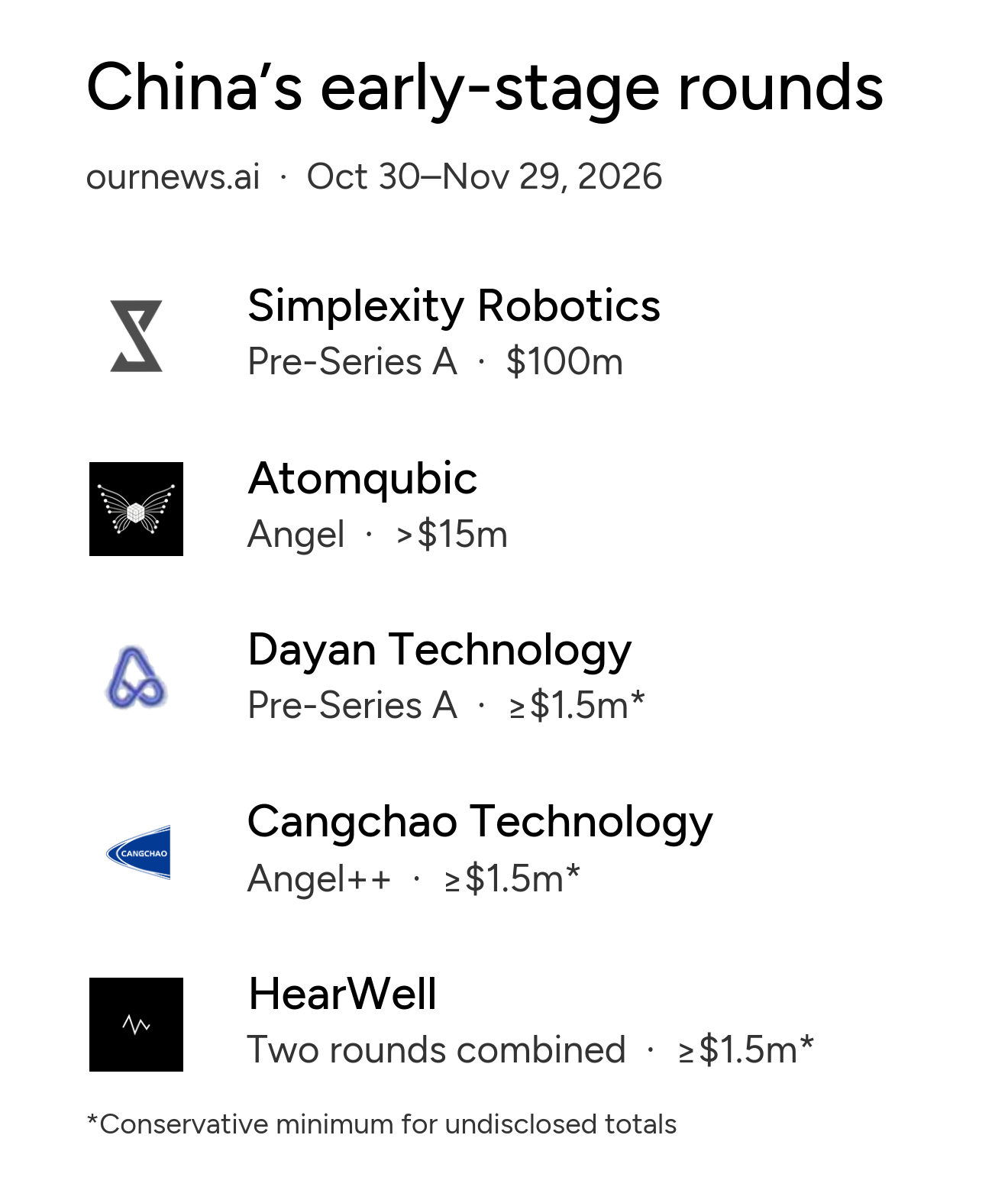
Selected rounds covered by OurNews Live. The three $1.5 million figures are conservative USD floors for amounts reported as tens of millions of yuan. HearWell’s figure covers two rounds combined. Sources include 36Kr on Dayan, 36Kr on Cangchao and 36Kr on HearWell.
That burst came after a cooler October for robotics and related hardware. The Chinese venture database ITjuzi counted 33 deals in embodied AI in October, down from 60 in September. The late-November checks show where investors were still willing to spend. Dayan plans to build a production line for gloves that record how human hands move and apply pressure. The maker of the Octo-Hand is putting fresh money into manufacturing dexterous robot hands. Zerith wants more warehouse deployments and plans to open its picking software through an API. You can see what the money is supposed to buy. ITjuzi figures via National Business Daily · 36Kr on the Octo-Hand maker · 36Kr on Zerith
Geely made a different bet. It joined the latest round for Pragmatik Labs, the agent startup founded by former Qwen lead Lin Junyang. The round reportedly brought in tens of millions of dollars and valued the company at $5 billion. That puts an automaker on the shareholder list of a young company building agents for office work and for machines such as robots and cars. 36Kr on the Pragmatik Labs deal
The next DeepSeek launch may come with another leaderboard chart. Look for the line in the technical report that says what the model trained on. If it says Huawei, the next questions are how long it took and what it cost. That’s when we’ll have a better way to judge Liang’s four-to-one bet.



Checking account…
Loading comments…