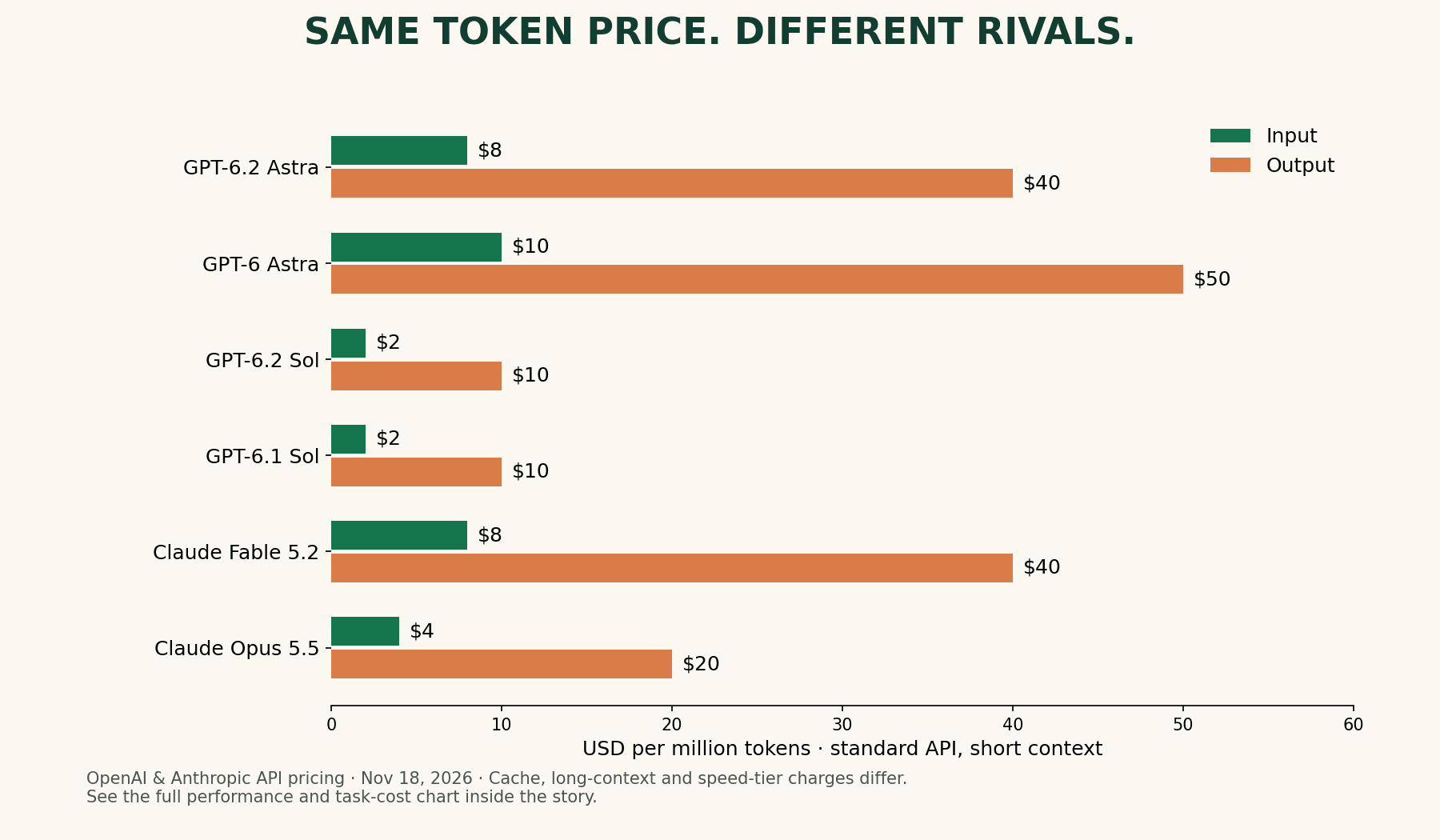
Cover: OurNews chart from OpenAI's published Agents' Last Exam figures and the two companies' standard API pricing, checked November 18, 2026. Benchmark effort is Max; token prices and measured task costs are separate measures.
OpenAI’s Sol 6.2 and Astra 6.2: the scores, the rivals and the bill
OpenAI's latest pitch to coders comes with an unusually welcome feature: a smaller bill.
GPT-6.2 Astra cuts standard input and output token prices by 20% against GPT-6 Astra. GPT-6.2 Sol keeps Sol 6.1's rates. The expensive question is whether either one finishes your job with fewer retries.
First, the receipt.
These are standard API dollars per million tokens, for short prompts, checked November 18:
GPT-6.2 Sol: $2 input / $10 output / $0.10 cached input. Sol 6.1 has the same rates.
GPT-6.2 Astra: $8 input / $40 output / $0.40 cached input. GPT-6 Astra costs $10 / $50 / $1 respectively.
Claude Fable 5.2: $8 input / $40 output / $0.20 cache read.
Claude Opus 5.5: $4 input / $20 output / $0.20 cache read.
Sources: OpenAI's API prices and Anthropic's API prices. OpenAI defines short context as up to 272,000 input tokens; above that, Astra 6.2 rises to $16 input/$60 output and Sol 6.2 to $4/$15. Cache writes, tools and faster service tiers can add charges. Anthropic's quoted cache-read rates use its listed five-minute caching policy; OpenAI lists separate cache-write options.
Same headline rate, different final bill. A model that talks twice as much can swallow a token-price advantage before the tests even finish.
Now, the scoreboard.
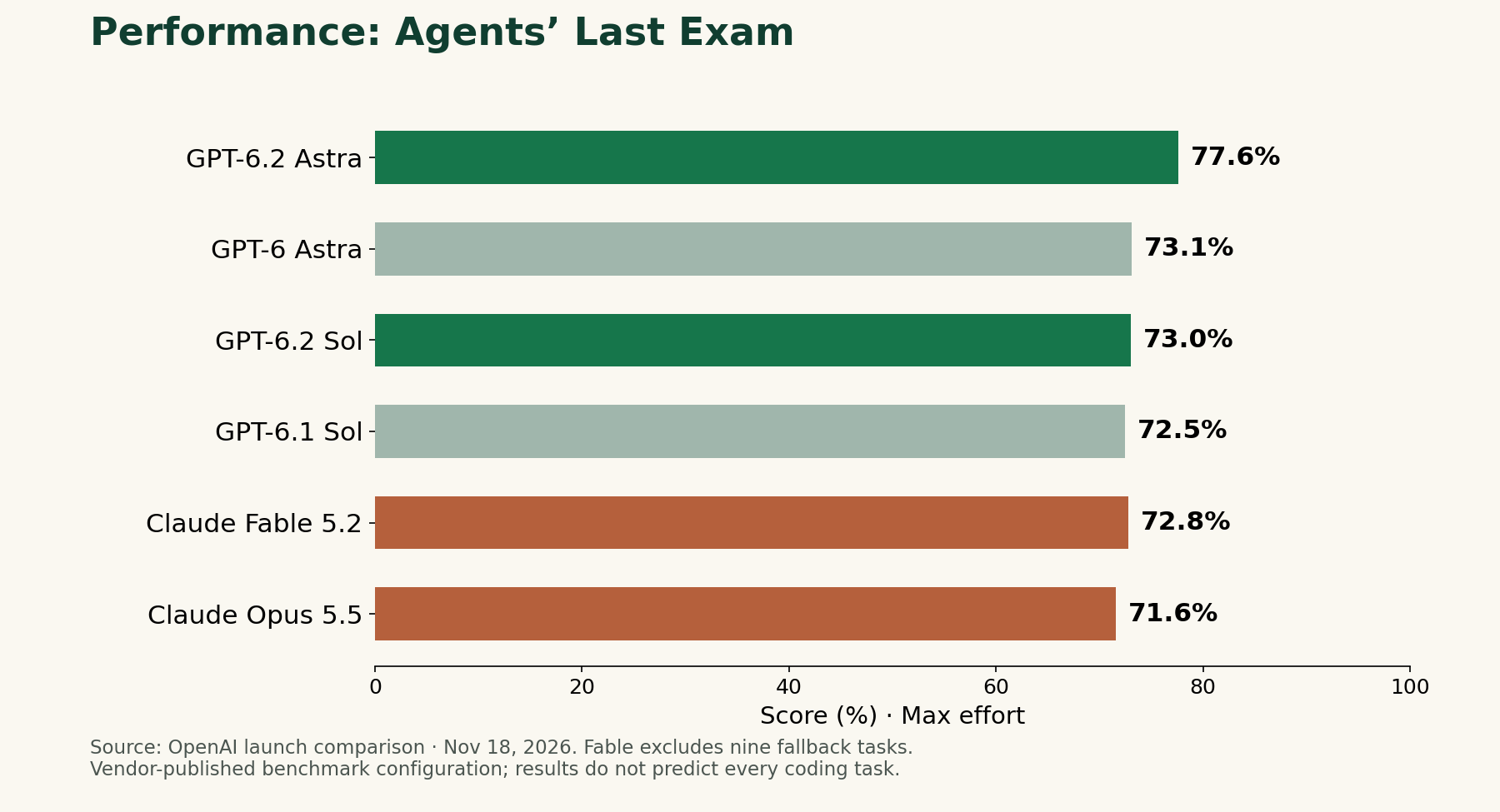
OpenAI’s comparison, Max effort; Fable excludes nine fallback tasks. Tap the chart for full size.
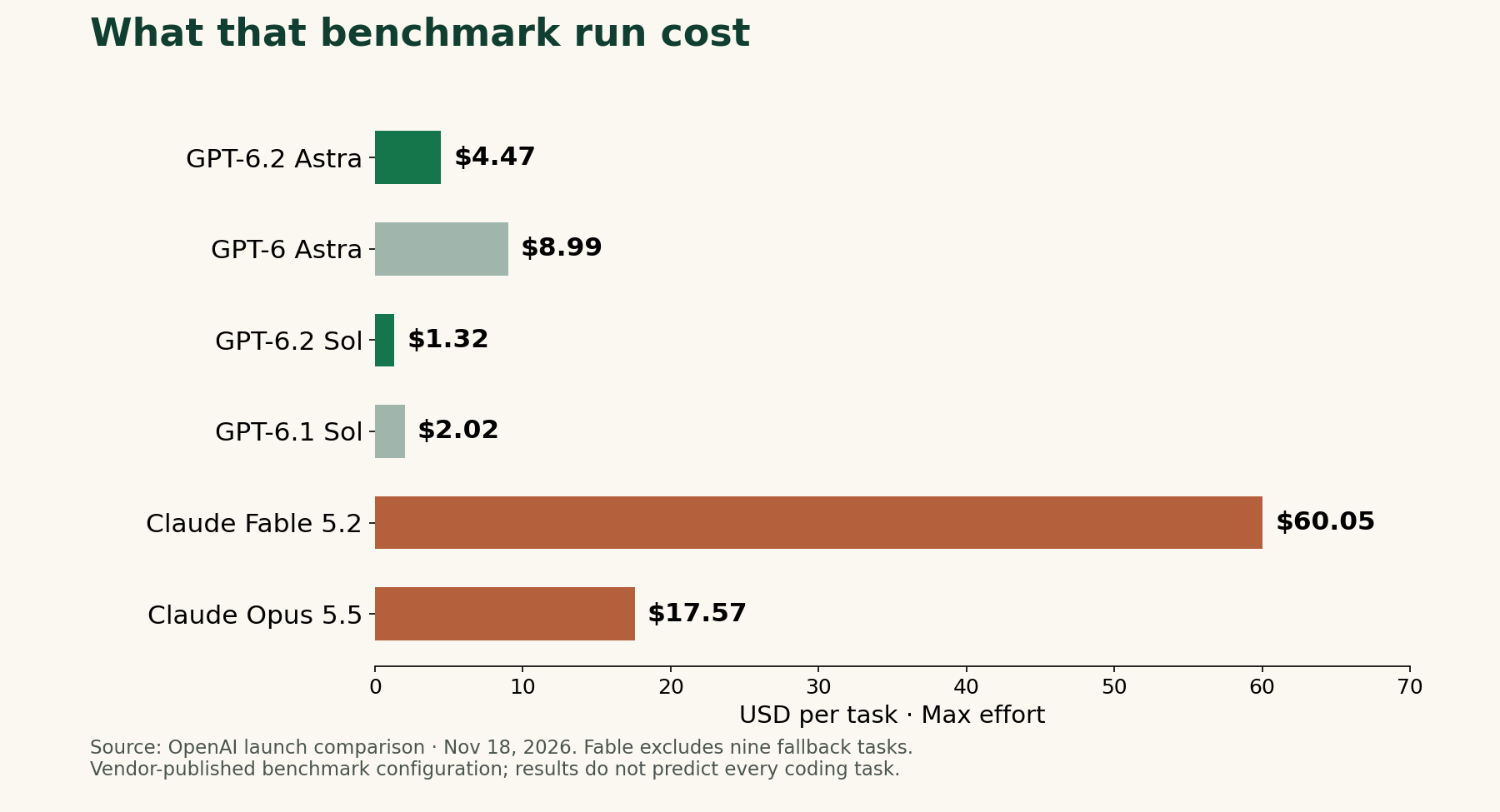
Measured benchmark task costs, distinct from API token rates. Tap for full size.
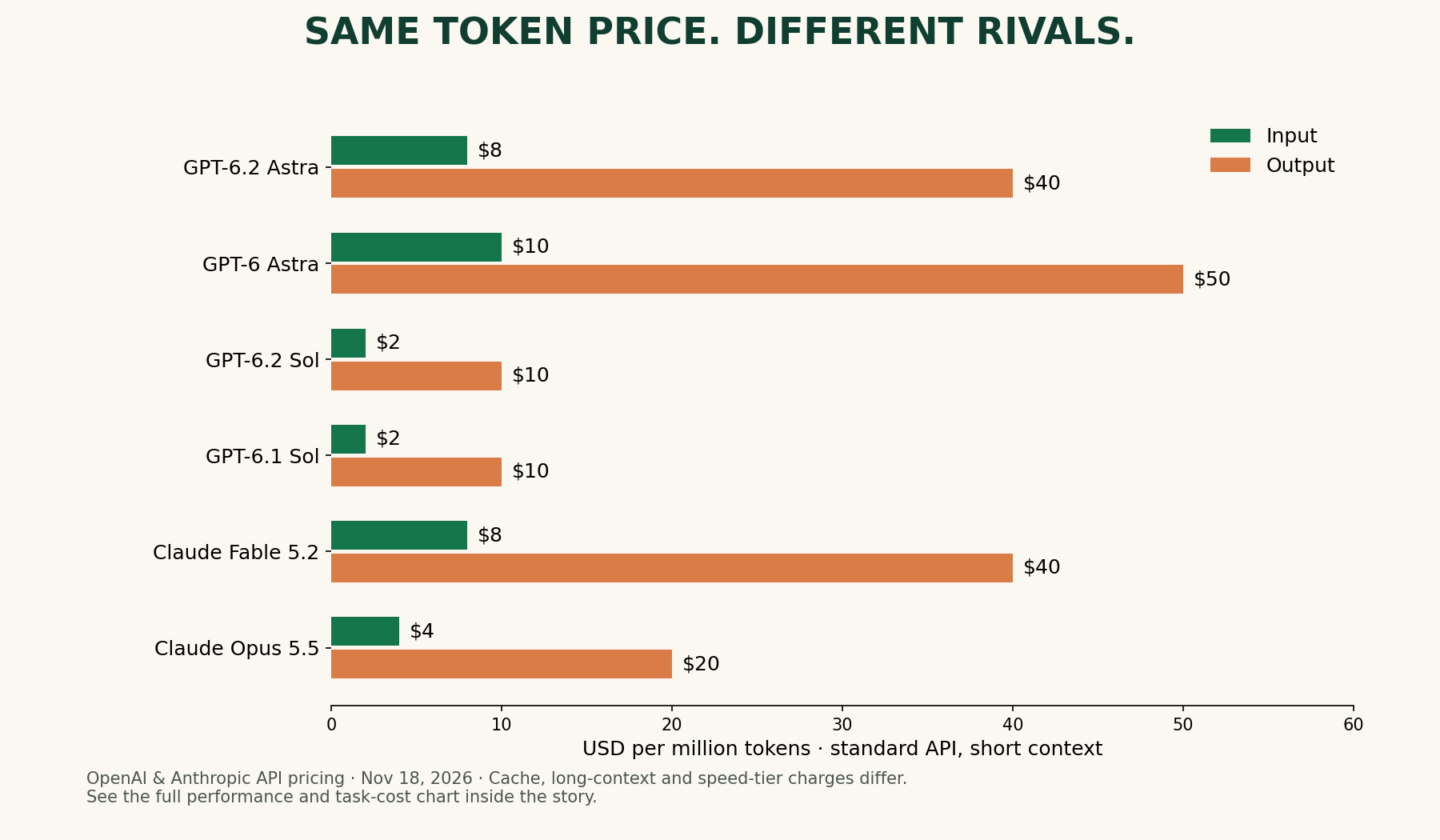
OurNews chart from OpenAI’s published benchmark comparison and both providers’ API prices, November 18, 2026; all benchmark rows use Max effort.
In OpenAI's published Agents' Last Exam comparison, all at Max effort, Astra 6.2 scores 77.6% at $4.47 per task. GPT-6 Astra scores 73.1% at $8.99.
Sol 6.2 posts 73.0% at $1.32, against Sol 6.1's 72.5% at $2.02. Fable 5.2 registers 72.8% at $60.05; Opus 5.5, 71.6% at $17.57. Fable's leaderboard result excludes nine tasks that used a fallback model. This is OpenAI's published comparison of a professional-workflow benchmark, rather than an OurNews coding test.
The chart holds effort at Max. Astra's Xhigh result is actually higher, at 78.3%. Cranking the dial to its biggest setting does not guarantee the best score.
For coding specifically, OpenAI says Sol 6.2 comes within half a percentage point of Astra 6.2 on FrontierCode 2.0 at roughly one-fifth the task cost, both at Max. That's a reason to test the cheaper sibling before reaching for the flagship.
Anthropic brought its own scoreboard.
Its November 9 Fable 5.2 release lists FrontierCode 2.0 scores of 49.1% for Fable 5.2 at Xhigh, 45.5% for Opus 5.5 and 42.8% for GPT-6 Astra, with highest available effort unless specified. Those are Anthropic's reported settings, not extra rows to splice into OpenAI's cost chart.
For a coder, the useful contest is closer to home. Give each candidate the same real bug, repository, permissions and acceptance tests. Count successful fixes, elapsed time, retries and the whole invoice. A gorgeous benchmark score won't merge a broken patch.
OpenAI's launch makes Sol the interesting budget challenger and Astra the premium bet. Fable and Opus still have to lose the job in your codebase. That's where the subscription loyalties get expensive.



Checking account…
Loading comments…